
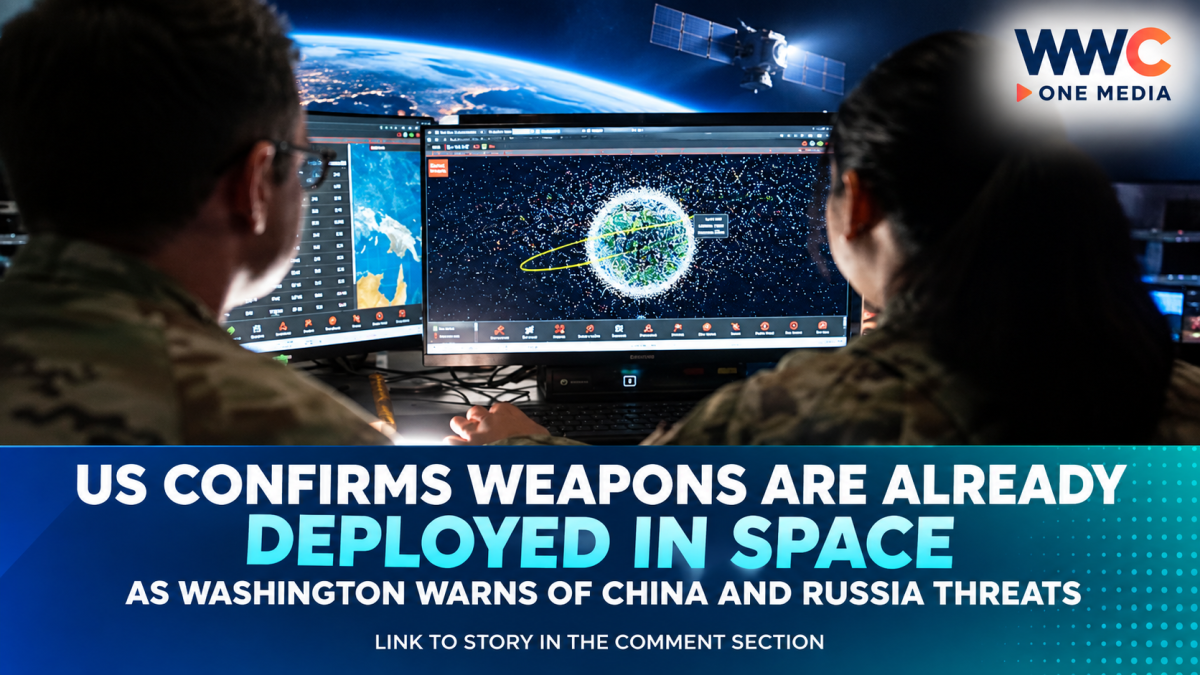
The United States has publicly confirmed for the first time that it has weapons deployed in orbit, revealing a new and increasingly militarised dimension of Washington’s competition with China and Russia in space.
The US Space Force said on Monday that American forces have “on-orbit space control weapons” capable of defending US forces against hostile actions by adversaries.
The announcement, made by Air Force Secretary Troy Meink, did not identify the weapons or disclose how many are currently deployed.
But the admission marks a significant shift in US messaging after years of warnings about the growing threat posed by anti-satellite capabilities and other military systems in orbit.
US confirms space weapons for the first time
The Space Force said the weapons are part of its broader “space control” mission, which involves using both kinetic and non-kinetic capabilities to influence or disrupt an adversary’s ability to operate in space.
Officials said those capabilities can be used for both offensive and defensive purposes.
That language is significant because Washington has traditionally been reluctant to publicly acknowledge that it has operational weapons stationed in orbit.
The US military has long operated sophisticated military satellites and ground-based systems capable of jamming or disrupting adversary communications. But the latest statement confirms that at least some weapons designed specifically for space control are now physically deployed in orbit.
Pentagon keeps the weapons’ identities secret
Meink did not reveal what type of weapons are currently deployed.
That secrecy is likely deliberate.
Officials have increasingly argued that ambiguity can itself serve as a deterrent by forcing potential adversaries to assume that the United States possesses capabilities that could threaten their space assets.
The weapons could involve systems designed to interfere with or disable hostile satellites rather than physically destroy them.
Non-kinetic systems are particularly attractive because destroying satellites can create large amounts of orbital debris, potentially threatening civilian and military spacecraft alike.
The United States has also been developing increasingly sophisticated capabilities for maneuvering around satellites and operating in contested orbital environments.
China and Russia are driving US concerns
Washington’s announcement comes amid growing competition with China and Russia, both of which have developed capabilities that could threaten American satellites.
Satellites are essential to modern military operations.
They provide communications, navigation, missile warning, intelligence, surveillance and reconnaissance, targeting information and other services that support forces on Earth.
Disabling those systems could significantly reduce a military’s ability to operate.
The US Space Force has warned that China is developing anti-satellite capabilities capable of reaching increasingly high orbits, while Russia has also demonstrated sophisticated counterspace capabilities.
Both countries have been accused by Washington of developing and testing systems capable of approaching, interfering with or potentially attacking satellites.
Space is becoming a military battlefield
For decades, space was treated primarily as a domain for communications, scientific research and satellite operations.
That has changed rapidly.
Military planners now increasingly view space as another potential battlefield alongside land, sea, air and cyberspace.
A conflict between major powers could involve attacks on satellites before conventional military operations even begin.
A country capable of disrupting an opponent’s communications, navigation and surveillance networks could gain a major strategic advantage without necessarily firing a conventional missile.
That has made space control a central element of modern military planning.
US and China are racing to develop orbital capabilities
The latest disclosure comes shortly after growing evidence that the United States and China are preparing for possible conflict in space.
Both countries are developing satellites capable of sophisticated orbital manoeuvres.
These systems can potentially inspect, track or interfere with other spacecraft, creating what military planners increasingly describe as “space warfare.”
The US military has also been conducting exercises designed to simulate contested orbital environments and train forces to manoeuvre spacecraft during a potential conflict.
The development of such capabilities raises the possibility of a future in which satellites are no longer passive infrastructure but active participants in military operations.
A new arms race above Earth
The disclosure could accelerate concerns about an arms race in orbit.
Experts have warned that once one major power openly acknowledges deploying space weapons, rivals could face additional pressure to expand their own capabilities.
That could create a cycle in which each country develops increasingly sophisticated systems because it fears falling behind its competitors.
The consequences could extend well beyond military satellites.
Space debris generated by destructive anti-satellite attacks can remain in orbit for years or decades, potentially endangering commercial and scientific spacecraft.
That makes the militarisation of space a security issue for countries that are not directly involved in the US-China-Russia rivalry.
The legal limits are complicated
International law does not impose a blanket ban on all weapons in space.
The 1967 Outer Space Treaty prohibits countries from placing nuclear weapons or other weapons of mass destruction in orbit and bars the placement of such weapons on celestial bodies.
But it does not prohibit every conventional military system in space.
That leaves considerable room for countries to develop counterspace weapons, electronic warfare systems and other technologies that can target satellites.
As military technology advances, governments face growing pressure to establish clearer rules governing what countries can deploy and how those systems can be used.
Trump administration seeks greater space power
The disclosure also fits into the Trump administration’s broader effort to strengthen US military capabilities in space.
Washington has been pursuing expanded space defence programmes, including missile defence initiatives and new systems intended to protect American satellites while threatening those of potential adversaries.
The administration has increasingly framed space as a critical arena for maintaining US military superiority.
The creation of the US Space Force under the first Trump administration already reflected the growing importance of the domain.
The latest announcement suggests that the force has now moved beyond preparing for space warfare to openly acknowledging that some weapons are already in orbit.
What happens if space warfare begins?
A major conflict involving space weapons could look very different from conventional warfare.
Attacks might involve jamming communications, disrupting navigation signals, disabling satellites, interfering with sensors or manoeuvring spacecraft close to an opponent’s satellites.
Some operations could occur without producing a visible explosion or physical destruction.
That creates another challenge: determining when hostile activity in orbit constitutes an act of war.
A satellite that suddenly stops functioning could have suffered a technical failure, been jammed or deliberately attacked.
The ambiguity could make escalation particularly difficult to control.
The beginning of a new era in military space power
The United States’ admission that it has weapons deployed in orbit marks an important moment in the evolution of military power beyond Earth.
Washington says the systems are necessary to defend American forces and deter hostile action.
But the decision to publicly acknowledge their existence also sends a clear message to China, Russia and other potential adversaries: the United States is prepared to fight for control of the space domain.
As military competition moves higher above Earth, the question is no longer whether space will become part of warfare.
The United States is now acknowledging that the weapons needed for that fight are already there.



Leave a Reply