
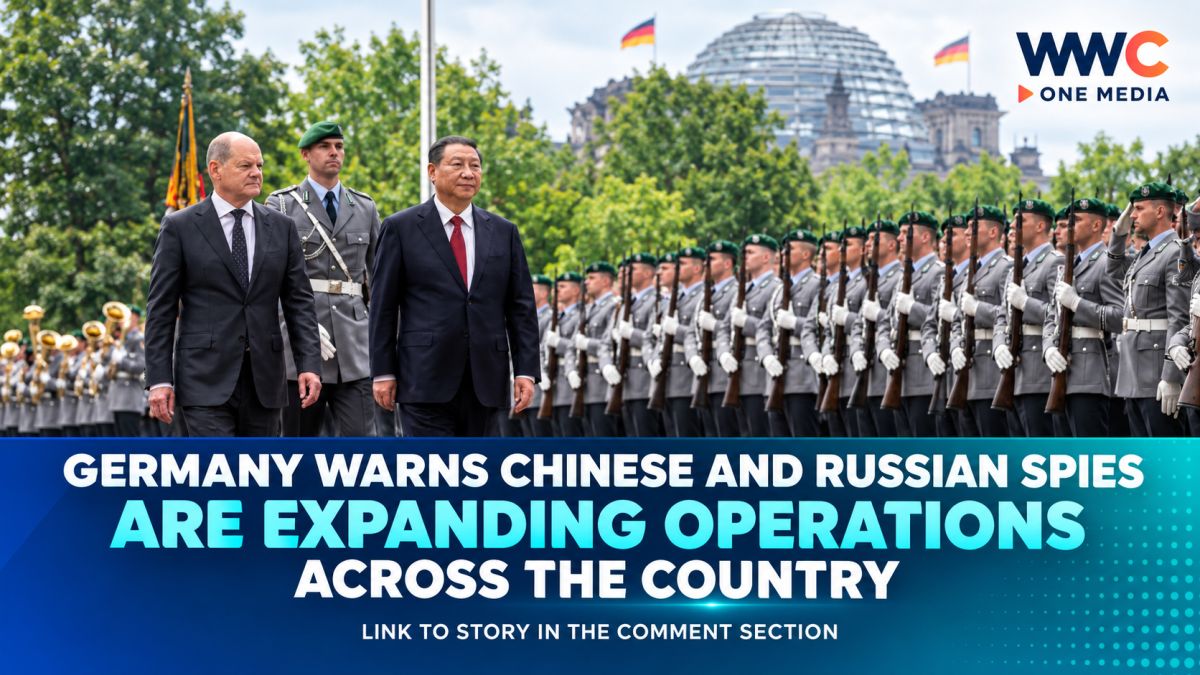
Germany is facing a growing espionage threat from China and Russia, with the country’s counter-intelligence authorities warning that foreign intelligence services are increasingly targeting military facilities, critical infrastructure, companies and sensitive information.
The warning comes as Germany strengthens its military capabilities and takes on a larger role in European security following Russia’s invasion of Ukraine.
German authorities say the threat is no longer limited to traditional espionage. Foreign intelligence operations are increasingly combining cyberattacks, surveillance, recruitment, sabotage and attempts to obtain sensitive technological and military information.
China targets Germany’s military and technology
Germany’s domestic intelligence agency said some surveillance activities around military infrastructure could be linked to China.
The activity includes efforts to gather information about German military capabilities and infrastructure at a time when Berlin is rapidly increasing defence spending and rebuilding its armed forces.
German authorities have previously accused Chinese intelligence networks of attempting to obtain military technology and industrial know-how.
The concern is particularly serious because Germany is home to major companies in advanced manufacturing, engineering, chemicals, automotive technology and defence-related industries.
Sensitive commercial technology can have both civilian and military applications, making German companies attractive targets for foreign intelligence services.
Russia remains a major espionage threat
Russia continues to represent an even broader security challenge for Germany.
German authorities have warned that Moscow’s intelligence activities extend beyond traditional spying to include cyber operations, sabotage, disinformation and attempts to influence political debate.
The war in Ukraine has intensified those concerns.
Germany has become one of Ukraine’s most important European supporters, providing weapons, financial assistance and political backing. That has made German military infrastructure, defence companies and supply networks particularly sensitive targets.
The country’s intelligence agencies have therefore increasingly treated Russian espionage as part of a wider campaign aimed at weakening Germany and its allies.
Espionage is moving into the digital world
Foreign intelligence services no longer need to rely exclusively on traditional undercover agents.
Cyberattacks allow governments to target large numbers of organisations remotely, potentially stealing sensitive information without physically entering a facility.
A recent study found that 37 per cent of German companies that had experienced cyberattacks said they believed at least one attack in the previous year was linked to a foreign intelligence service.
That figure was up from 28 per cent a year earlier and just 7 per cent in 2023.
The increase illustrates how espionage and cybercrime are increasingly overlapping.
Germany’s military buildup creates new targets
The intelligence warnings come as Berlin embarks on one of its most significant military expansions in decades.
Germany plans to increase defence spending substantially and strengthen its armed forces in response to the deteriorating European security environment.
That expansion is creating more valuable targets for foreign intelligence agencies.
Military bases, weapons programmes, logistics networks, defence contractors and communications systems all contain information that could be useful to Russia or China.
Germany is therefore facing the difficult task of expanding its military capabilities while simultaneously protecting the information and infrastructure behind that buildup.
Critical infrastructure is increasingly vulnerable
German officials are also concerned about foreign intelligence operations targeting infrastructure that is essential to the country’s economy and national security.
Energy networks, telecommunications systems, transport infrastructure and undersea cables can all be vulnerable to surveillance or disruption.
Russia in particular has been accused by European governments of developing capabilities for covert sabotage against critical infrastructure.
The threat extends beyond physical attacks.
Gathering detailed information about infrastructure in advance could allow an adversary to identify vulnerabilities that might later be exploited during a political crisis or military confrontation.
China poses a different kind of challenge
While Russian activity is often associated with military and political objectives, German authorities have also focused heavily on China’s efforts to obtain economic and technological information.
Chinese intelligence operations can involve universities, research institutions, technology companies and business networks.
Germany’s dependence on exports and advanced industrial technology makes the country particularly exposed to industrial espionage.
The challenge for Berlin is complicated by its economic relationship with China.
China remains an important trading partner for Germany, particularly for its automobile and manufacturing industries.
German officials therefore have to balance economic engagement with growing national-security concerns.
Germany has already uncovered suspected spy networks
The latest warning follows several high-profile espionage cases.
German authorities have previously arrested individuals suspected of passing military and industrial information to Chinese intelligence services.
Berlin has also prosecuted or investigated suspected Russian agents accused of collecting information about German defence policy and attempting to develop access to political and military circles.
Such cases have reinforced concerns that foreign intelligence services are seeking long-term access rather than simply stealing individual pieces of information.
The objective can be to build relationships, identify potential recruits and establish networks that can be activated when needed.
Europe faces a broader espionage problem
Germany is not alone in confronting the growing intelligence threat.
Across Europe, governments have reported suspected Russian sabotage operations, cyberattacks and influence campaigns, alongside increasing concerns over Chinese espionage and technology theft.
The combination of traditional intelligence gathering and modern digital tools has made counter-intelligence significantly more complicated.
European governments must now protect not only classified government information but also commercial research, defence supply chains, telecommunications networks and strategic infrastructure.
A new era of counter-intelligence
Germany’s latest warning reflects a broader transformation in European security.
The country is no longer dealing with espionage as an isolated problem involving a small number of spies operating secretly in government circles.
Foreign intelligence operations increasingly overlap with cyber warfare, economic competition, political influence and infrastructure security.
For Germany, the stakes are particularly high.
As Berlin spends more on defence and assumes a larger leadership role in European security, the information surrounding its military plans becomes increasingly valuable to rival powers.
The warning from German intelligence is therefore not simply about more spies operating inside the country.
It is about a widening contest over technology, military capabilities, critical infrastructure and political influence — one that is increasingly being fought in Germany’s offices, laboratories, military facilities and computer networks.




Leave a Reply