
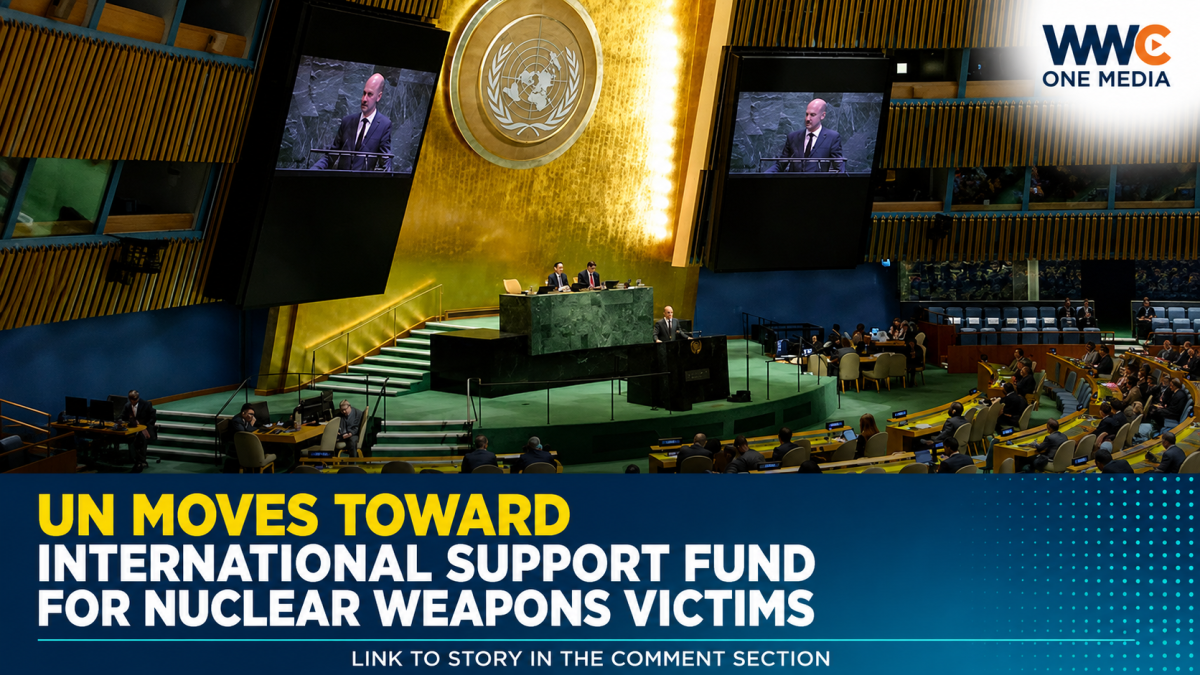
The United Nations is taking a significant step toward addressing the long-term human and environmental consequences of nuclear weapons, with survivors and communities affected by atomic bombings and nuclear testing calling for greater international support.
A first-of-its-kind international meeting on victim assistance and environmental remediation was held at UN Headquarters in New York on Sept. 1, bringing together governments, civil society representatives and people directly affected by nuclear weapons use and testing.
The meeting was convened under UN General Assembly resolutions 79/60 and 80/56, which call for international cooperation to assist countries and communities dealing with the consequences of nuclear weapons use and testing. Resolution 79/60 was adopted in December 2024 by a vote of 174-4-6.
Survivors bring their message to the UN
Among those speaking was Masako Wada, an atomic bomb survivor from Nagasaki and assistant secretary-general of Nihon Hidankyo, Japan’s confederation of atomic and hydrogen bomb survivors.
Wada warned that the world must not create another generation of people suffering from the consequences of nuclear weapons. Japanese media reported that she argued there is currently no adequate international mechanism capable of providing relief if nuclear weapons are used again.
Nihon Hidankyo, which has spent decades documenting survivors’ experiences and campaigning against nuclear weapons, received the 2024 Nobel Peace Prize for its efforts to highlight the humanitarian consequences of nuclear warfare.
The organization continues to advocate for assistance to survivors and solidarity with nuclear-affected communities around the world.
Kazakhstan warns that old nuclear scars remain
The issue extends far beyond Hiroshima and Nagasaki.
Karipbek Kuyukov of Kazakhstan, a survivor of repeated Soviet-era nuclear testing, also addressed the meeting. His experience reflects the continuing consequences of nuclear testing on communities living around former test sites.
Kazakhstan has repeatedly highlighted the legacy of the Semipalatinsk nuclear test site, where hundreds of Soviet nuclear tests were conducted before the site was closed in 1991.
The UN meeting was co-chaired by Kazakhstan and Kiribati, two countries that have experienced the long-term consequences of nuclear testing. Japan, New Zealand and other affected or concerned countries also participated.
What would the proposed international fund do?
The initiative is focused on two major areas.
Victim assistance would seek to improve support for people and communities affected by nuclear weapons use or testing.
Environmental remediation would address contamination and environmental damage left behind by nuclear weapons activities.
The goal is to strengthen international cooperation and explore mechanisms for supporting affected states, rather than leaving individual countries to deal with decades of consequences on their own.
However, it is important to clarify that the UN has not yet created a fully operational global compensation fund. The Sept. 1 meeting was part of an international process aimed at developing cooperation and exploring ways to establish such financial support.
The timing is raising fresh concern
The meeting comes as international concern over nuclear risks remains high.
At a separate UN meeting marking the International Day Against Nuclear Tests, UN disarmament officials warned about the dangers of renewed nuclear testing. More than 2,000 nuclear tests have been conducted globally since 1945, according to the Comprehensive Nuclear-Test-Ban Treaty Organization, while several major nuclear powers have not ratified the Comprehensive Nuclear-Test-Ban Treaty.
That history is one reason survivors and affected countries argue that the consequences of nuclear weapons cannot be treated simply as events of the past.
For communities exposed to radiation and environmental contamination, the effects can continue across generations.
Japan’s government also expressed solidarity with victims and survivors at the New York meeting, saying Japan has a responsibility to share the experiences of communities affected by the atomic bombings.
A warning from those who lived through it
The UN initiative does not itself eliminate nuclear weapons or prevent future nuclear use.
But it represents an attempt to place the experiences of survivors and affected communities at the center of international discussions about the nuclear legacy.
For people who have spent decades living with the consequences of nuclear weapons, the issue is not simply historical.
It is about who pays the human and environmental price long after the weapons have been detonated.
And as nuclear tensions rise around the world, one question is becoming increasingly difficult to ignore: Who will be there to help the victims if nuclear weapons are ever used again?
WWC ONE MEDIA J.M.D


Leave a Reply