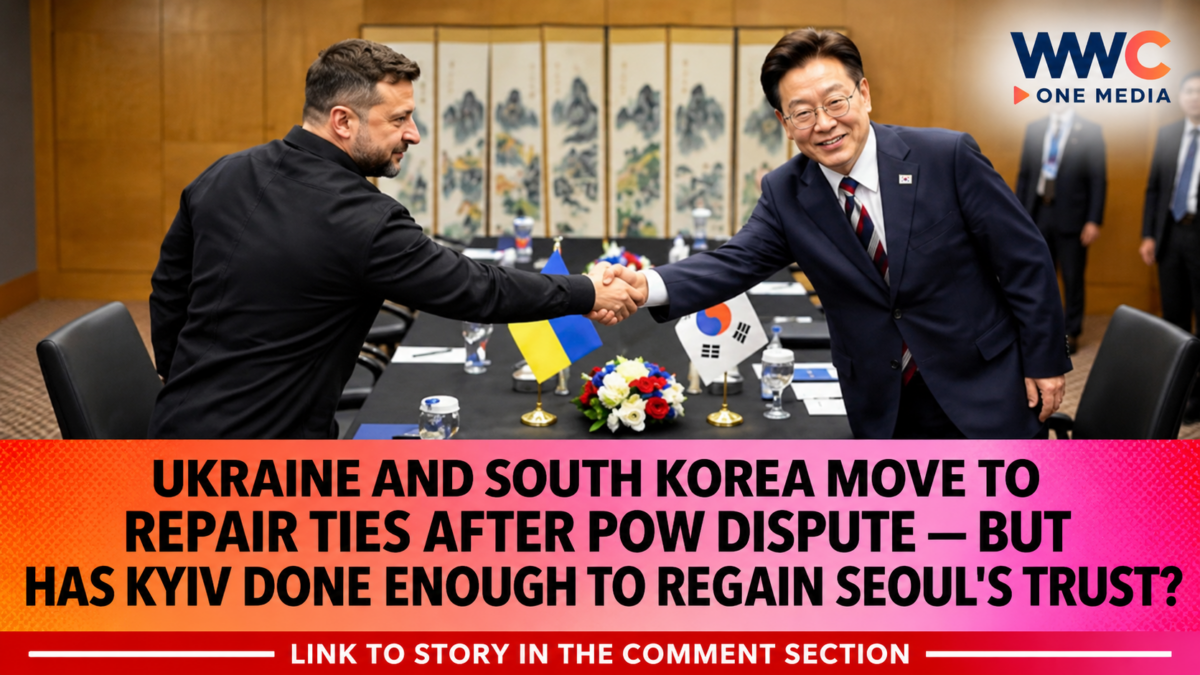
Ukraine and South Korea are taking steps to repair their strained diplomatic relationship after a dispute over the public disclosure of two North Korean prisoners of war transferred from Ukraine to Seoul threatened to undermine cooperation between the countries.
Ukrainian Foreign Minister Andrii Sybiha said on November 10 that relations were moving towards recovery following what he described as a positive meeting with his South Korean counterpart, Cho Hyun, on the sidelines of the Group of Seven (G7) foreign ministers’ gathering in Paris.
Sybiha said the two ministers had spoken frankly about recent disagreements and that he believed the next steps towards the full normalisation of bilateral relations were now within reach.
His comments signal a possible turning point after weeks of diplomatic tension that included South Korea recalling its ambassador to Ukraine and withdrawing around half of its embassy staff.
The dispute began when Ukrainian President Volodymyr Zelenskyy publicly announced that two North Korean soldiers captured while fighting alongside Russian forces had been transferred to South Korea. Seoul said the disclosure violated a confidentiality understanding intended to protect the soldiers and their families in North Korea.
Although both governments appear interested in restoring cooperation, the latest diplomatic meeting does not mean all disagreements have been settled.
What Triggered the Ukraine-South Korea Diplomatic Crisis?
The dispute centres on two North Korean soldiers captured by Ukrainian forces in Russia’s Kursk region in January 2025.
The men were part of North Korea’s military deployment supporting Russia’s war against Ukraine. Their capture attracted international attention because they were among the first North Korean soldiers known to have been taken alive during the conflict.
Both reportedly expressed a desire to relocate to South Korea rather than return to North Korea.
After months of discussions involving Kyiv and Seoul, the two soldiers were eventually transferred to South Korea.
However, the arrangement became a diplomatic controversy when Zelenskyy disclosed the transfer during his address to the United Nations General Assembly in September 2026.
South Korea said the two governments had agreed to keep the transfer confidential because of security, diplomatic and humanitarian concerns. Seoul argued that public disclosure could endanger the soldiers and their relatives who remained in North Korea.
Ukraine disputed South Korea’s account of the confidentiality arrangement, creating a disagreement over what had actually been agreed between the governments.
The issue quickly escalated from a sensitive prisoner-transfer matter into a wider diplomatic confrontation.
South Korea Recalled Its Ambassador and Reduced Embassy Staff
Seoul responded strongly to the disclosure.
On October 8, South Korea announced that it would recall its ambassador to Ukraine amid the growing dispute. The government said it hoped the issues could be resolved through continued diplomatic discussions but did not initially provide further details.
South Korea also withdrew approximately half of its embassy personnel from Ukraine, according to subsequent reporting by Yonhap.
The diplomatic measures reflected the seriousness of Seoul’s concerns, particularly its position that Kyiv had failed to respect an understanding involving sensitive information.
South Korean officials maintained that confidentiality was important not only for diplomatic trust but also for the safety of the former prisoners and their families.
The disagreement also raised concerns about whether the dispute could affect South Korea’s future assistance to Ukraine.
For Kyiv, maintaining a strong relationship with Seoul is important because South Korea is a major economic and technological power with significant influence in international security and defence industries.
WWC ONE MEDIA previously examined how the confidential prisoner transfer triggered a widening diplomatic confrontation between the two countries.
What Happened During the Latest Meeting in Paris?
The latest effort to repair relations took place on November 10, when Sybiha met Cho on the sidelines of the G7 foreign ministers’ meeting in Paris.
Sybiha described the discussion as positive and said the two sides had addressed the recent disagreements directly.
He expressed appreciation for South Korea’s past and future support, particularly its backing for Ukraine’s sovereignty and territorial integrity.
He also said Ukraine wanted an increasingly dynamic and high-level relationship with South Korea.
However, Seoul’s account of the meeting showed that important concerns remained.
According to South Korea’s Foreign Ministry, Cho emphasised mutual respect, trust and the faithful implementation of bilateral agreements as basic requirements for developing relations between the two countries.
He also expressed hope that outstanding issues could be resolved smoothly.
The language was significant because it indicated that South Korea still expects Ukraine to address the concerns surrounding the prisoner transfer and the alleged confidentiality arrangement.
The two ministers also discussed regional security, humanitarian assistance and support for Ukraine’s reconstruction.
Sybiha subsequently said that further steps were needed to achieve full normalisation, while reaffirming Kyiv’s willingness to build a pragmatic partnership with Seoul.
Why the Two North Korean Prisoners Became So Important
The case involves far more than a disagreement over diplomatic communication.
The two soldiers are part of a much larger North Korean military involvement in Russia’s war against Ukraine.
Ukrainian and South Korean estimates have placed the number of North Korean troops sent to support Russia since 2024 at approximately 14,000 to 15,000. Most have been associated with operations in Russia’s Kursk region.
Their deployment represents a significant expansion of military cooperation between Moscow and Pyongyang.
North Korean personnel have gained experience in a modern war involving drones, artillery, electronic warfare and advanced weapons systems.
For South Korea, information from captured North Korean soldiers could have important intelligence and security implications.
Their experiences may help analysts better understand North Korean military training, battlefield tactics, command structures and cooperation with Russian forces.
The prisoners’ transfer therefore became a sensitive issue involving not only Ukraine and South Korea but also Russia and North Korea.
Why Seoul Wanted the Transfer Kept Secret
South Korea’s objections were closely connected to the safety of the two former prisoners and their relatives.
North Korea treats defection and surrender as serious political matters. Publicly identifying soldiers who have abandoned their military deployment could potentially expose their families to retaliation or punishment.
Seoul also had broader diplomatic concerns.
The public disclosure could have complicated its relationship with Pyongyang, particularly as the South Korean government considers how to manage tensions on the Korean Peninsula.
South Korean officials argued that the transfer required careful handling because of the potential consequences for the soldiers, their relatives and regional security.
Ukraine, however, disputed Seoul’s description of the confidentiality arrangement.
That disagreement remains central to the diplomatic dispute. The two governments have not publicly presented a fully reconciled account of what was agreed during the negotiations.
WWC ONE MEDIA previously reported on South Korea’s demand for an explanation and apology following Zelenskyy’s announcement.
Could the Dispute Affect South Korea’s Support for Ukraine?
The deterioration in relations raised questions about whether Seoul might reconsider aspects of its support for Kyiv.
South Korea has provided humanitarian, financial and other forms of assistance to Ukraine since Russia launched its full-scale invasion in February 2022.
However, Seoul has maintained restrictions on direct lethal weapons assistance, making its broader support policy a sensitive issue.
South Korea is also a major arms producer, supplying tanks, artillery systems, aircraft and other military equipment to international customers.
Its defence industry has become increasingly important to European countries strengthening their military capabilities following Russia’s invasion.
For Ukraine, maintaining cooperation with South Korea could provide opportunities for humanitarian assistance, reconstruction support and closer engagement with a technologically advanced partner.
A prolonged diplomatic rupture would therefore risk damaging a relationship that has strategic value for both countries.
The latest Paris meeting suggests that neither government wants the prisoner dispute to permanently undermine broader cooperation.
North Korea’s Growing Military Partnership With Russia Adds Urgency
The diplomatic disagreement is unfolding against the backdrop of increasingly close military ties between Russia and North Korea.
Pyongyang has supplied Moscow with military assistance, including ammunition and other equipment, while North Korean troops have participated in operations supporting Russian forces.
The deployment has raised concerns in Seoul and among Western governments that Russia could provide North Korea with military technology, operational experience or other assistance in return.
For South Korea, this creates a direct security concern.
North Korean soldiers returning from the battlefield may bring experience with modern combat operations that could influence Pyongyang’s future military capabilities.
The two captured soldiers therefore represent an unusual source of information about North Korea’s military involvement in the war.
Their transfer to South Korea has both humanitarian and strategic significance.
WWC ONE MEDIA previously covered the soldiers’ transfer and the questions surrounding their legal status, protection and future resettlement.
Ukraine Wants a Stronger Partnership With South Korea
Sybiha’s latest statements suggest Kyiv understands the importance of repairing relations.
Ukraine wants to maintain international support as its war against Russia continues. South Korea’s economic strength, technological capabilities and diplomatic influence make it an important potential partner.
Sybiha has thanked Seoul for supporting Ukraine’s sovereignty and territorial integrity and reiterated his invitation for Cho to visit Ukraine.
The two countries also have shared interests in monitoring North Korea’s military cooperation with Russia.
For South Korea, maintaining communication with Ukraine provides access to developments involving North Korean troops and weapons on the battlefield.
The relationship therefore has practical security value that extends beyond the prisoner-transfer controversy.
WWC ONE MEDIA also reported on Ukraine’s earlier efforts to describe the dispute as a diplomatic misunderstanding and restore normal relations with Seoul.
Will Ukraine and South Korea Fully Restore Diplomatic Relations?
The November 10 meeting in Paris represents an important step towards easing tensions, but the path to full normalisation remains unfinished.
South Korea has made clear that mutual respect, trust and compliance with bilateral agreements must underpin future cooperation.
Ukraine, meanwhile, has expressed appreciation for Seoul’s support and a desire to develop a stronger partnership.
The next steps will likely involve continued diplomatic discussions, efforts to resolve the disagreement over the confidentiality arrangement and possible high-level engagement between the governments.
The two countries also need to determine how to prevent similar misunderstandings involving sensitive security and humanitarian matters.
For now, the immediate priority is to prevent a dispute involving two former North Korean prisoners of war from damaging a much broader strategic relationship.
The stakes extend beyond Kyiv and Seoul. North Korea’s growing military involvement in Russia’s war has created a direct connection between European security and the security of Northeast Asia.
Ukraine needs international partners as it continues to resist Russia. South Korea needs reliable information about North Korean military activities and the expanding Moscow-Pyongyang alliance.
Both countries have strong reasons to repair their relationship.
The latest meeting suggests that diplomatic channels are working again. Whether the two governments can turn that progress into lasting trust will depend on how they handle the unresolved issues in the weeks ahead.