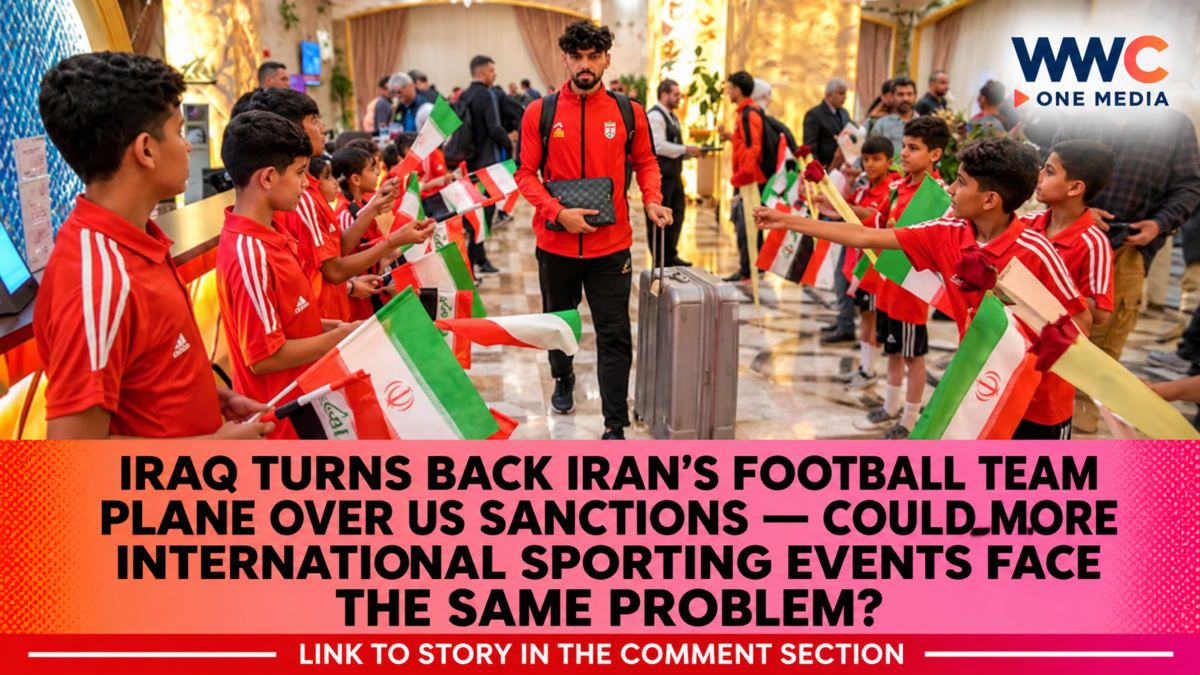
A diplomatic and sporting complication has emerged ahead of an international football tournament in southern Iraq after authorities refused permission for a plane carrying Iran’s national team to land at Basra International Airport.
The aircraft was forced to return to Iran and land in Abadan on Tuesday, November 10, after Iraq’s Civil Aviation Authority reportedly decided that allowing the flight to proceed could expose the country to penalties under US sanctions targeting Iranian airlines.
The Iranian delegation then continued its journey overland, crossing into Iraq and travelling to Basra by road.
The incident highlights how US sanctions are reaching beyond airlines and aviation companies, affecting even the travel arrangements of national sports teams. It also places Iraq in a difficult position as it tries to maintain sporting and diplomatic ties with neighbouring Iran while avoiding potential consequences from Washington.
The Iranian team was travelling to Basra for a four-nation tournament involving Iraq, Iran, Lebanon and Palestine, scheduled to begin on November 13.
Iran’s Team Reaches Basra by Road After Flight Is Turned Back
The aircraft returned to Iran and landed in Abadan, an Iranian consulate official in Basra told Reuters. The delegation then travelled overland to Iraq.
There was an important distinction between the initial local reporting and the later Reuters account. Shafaq News initially reported that the precise reason for the refusal was not confirmed, citing a security source who said sanctions may have been involved. Reuters subsequently reported that two Basra airport officials linked the decision to US sanctions, while an Iraqi civil aviation official said Iraq could not risk violating those restrictions.
Shafaq News later reported that the Iranian team had reached Basra after crossing the border at Shalamcheh.
The team’s journey was therefore disrupted, but the available reports indicate that it still reached its destination to take part in the tournament.
Why Iraq Refused the Landing
According to Reuters, two officials at Basra airport said the Iraqi Civil Aviation Authority’s decision was connected to US sanctions imposed on Iranian airlines.
An Iraqi civil aviation official said the country could not risk violating the restrictions.
The United States has expanded sanctions targeting Iran’s aviation sector and warned that foreign companies doing business with sanctioned Iranian airlines could also face penalties.
The measures are intended to restrict the ability of Iranian airlines to obtain international services and continue operating through overseas aviation networks.
One particularly significant warning came from US Treasury Secretary Scott Bessent, who said airports servicing sanctioned Iranian airlines could face consequences, including losing access to the US dollar financial system.
That threat creates a difficult situation for countries such as Iraq, which maintains extensive political, economic and cultural connections with Iran but also depends on access to international financial systems.
Iraq Had Already Suspended Some Iranian Flights
The Basra incident follows an earlier aviation restriction in September, when Iraq suspended Iranian flights to Baghdad after Washington warned that airports and service providers handling sanctioned Iranian carriers could face secondary sanctions.
Secondary sanctions are designed to pressure companies and organisations outside the United States by threatening restrictions on their ability to conduct business with the US financial system.
For Iraq, the consequences could extend beyond aviation. Access to international banking and dollar transactions is important to the country’s economy, making the threat of financial penalties a serious consideration.
The Basra decision therefore reflects a broader problem: even when a flight has a legitimate purpose, the airline operating it may still create sanctions-related risks for the destination country.
Reports Differed on Whether the Flight Had Initially Been Approved
Local reporting added another detail to the controversy.
BasNews reported that the aircraft was operated by Iranian carrier Varesh Airlines and had initially received approval from Iraq’s Civil Aviation Authority before that authorisation was withdrawn shortly before departure.
The airline reportedly said it was following up with the relevant authorities.
Shafaq News initially reported that the exact reason for the refusal had not been confirmed, although a security source suggested international sanctions could be involved.
Reuters later reported that two Basra airport officials linked the decision to US sanctions, providing a clearer explanation from Iraqi aviation sources.
The distinction matters because the initial reports described uncertainty, while the later Reuters account provided additional official-source confirmation of the sanctions connection.
Iran, Iraq, Lebanon and Palestine Set for Basra Tournament
The Iranian national team was travelling to Basra for a four-nation competition featuring:
- Iraq, the host nation.
- Iran.
- Lebanon.
- Palestine.
The tournament is scheduled to begin on November 13 at Basra International Stadium.
According to Shafaq News, Iraq is scheduled to face Lebanon in the opening match, while Iran is set to play Palestine on November 14.
Despite the disruption to the team’s original flight arrangements, Shafaq News reported that the Iranian delegation reached Basra by road after crossing the border at Shalamcheh.
The incident therefore did not automatically prevent Iran from participating in the competition.
A Sporting Disruption With Wider Political Implications
The blocked landing illustrates how international sanctions can affect activities that are not directly connected to military or political operations.
A national football team travelling for a regional tournament would ordinarily be considered a routine sporting delegation. However, when the aircraft is operated by an airline affected by international sanctions, the journey can become a diplomatic and financial issue.
Iraq must balance its relationship with Iran against the potential consequences of violating US restrictions. Washington, meanwhile, is using financial pressure to limit the international operations of Iranian airlines and the companies supporting them.
The situation also raises questions about future sporting travel involving Iranian teams. If restrictions continue to affect airlines, organisers and host countries may need to arrange alternative transportation, charter services or other travel solutions that comply with applicable sanctions.
For the Iranian team, the immediate problem was resolved through an overland journey. For Iraq, however, the broader challenge remains: maintaining regional sporting and diplomatic relationships while avoiding penalties that could affect its international financial connections.
The Basra incident shows that the impact of US sanctions is no longer confined to airline operations and commercial aviation. It can reach international sporting events, travel arrangements and the everyday movement of people across borders.
As the tournament approaches, attention will turn to Iran’s performance on the pitch. But the unusual journey to Basra has already exposed the growing influence of geopolitical tensions on international sport.