
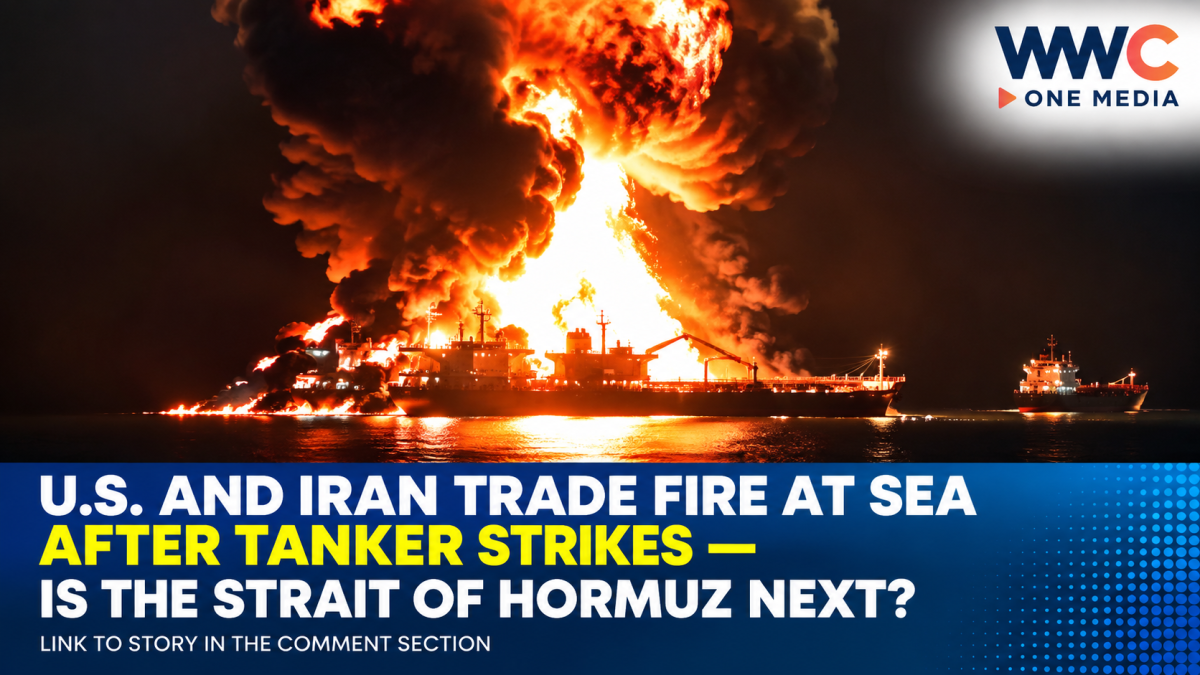
The latest exchange between the United States and Iran has sharply escalated tensions around the Strait of Hormuz, after U.S. forces struck three Iranian oil tankers and Tehran said it retaliated by targeting tankers and U.S.-linked vessels.
The confrontation unfolded Saturday, Sept. 5, after Iran’s Islamic Revolutionary Guard Corps launched ballistic missiles toward two U.S. Navy ships, according to U.S. Central Command. Washington said the American vessels avoided the attacks and that no U.S. personnel were injured.
U.S. forces subsequently struck three Iranian crude-oil carriers, including one near Kharg Island, Iran’s main oil-export hub. CENTCOM said two vessels were permanently disabled and a third, which was unladen, was destroyed.
The strikes mark one of the most serious recent confrontations at sea between the two sides and raise fresh concerns about the security of commercial shipping through one of the world’s most important energy chokepoints.
Iran warns of a tougher response
Iran’s response came quickly.
The IRGC Navy said it had targeted three oil tankers traveling through the Strait of Hormuz on what it described as an unauthorized route, while also claiming attacks against three U.S.-linked vessels elsewhere. Iranian forces warned other ships operating in the Gulf and around the strait against what they called suspicious movements.
Iran’s Revolutionary Guard also claimed that ballistic missiles had struck a U.S. aircraft carrier and destroyer, saying both ships were damaged and withdrew from the area.
The U.S. military disputed that version, saying its warships evaded the incoming missiles and that no American personnel were harmed.
The competing accounts could not immediately be independently verified.
Kharg Island becomes a major flashpoint
One of the most significant elements of the confrontation is the location of one of the U.S. strikes.
Kharg Island is the centerpiece of Iran’s oil-export infrastructure. Reuters reported that before the war, about 90% of Iran’s crude exports moved through the island. The island has already been a focus of U.S. military threats during the conflict.
Iranian state-linked media reported that a tanker near Kharg was hit by U.S. missiles and that its crew was being evacuated. Reuters said local reports indicated there were no casualties in that particular incident.
Washington, meanwhile, has described the targeted vessels as part of an Iranian “shadow network” that helps finance the Revolutionary Guard and its regional armed partners.
The Strait of Hormuz is the bigger concern
The immediate military exchange is only part of the story.
The Strait of Hormuz is one of the world’s most strategically important shipping routes, connecting the Persian Gulf with the Gulf of Oman and the wider Arabian Sea. Any sustained disruption can have consequences well beyond Iran and the United States because of the enormous volume of energy transported through the region.
Shipping traffic has already been running well below normal levels amid the conflict.
Reuters reported that Gulf shipping through Hormuz remained below its recent average, while oil prices climbed sharply as renewed U.S.-Iran fighting intensified concerns about global supplies.
Brent crude settled Friday at $96.28 a barrel, its highest level since July 24, as traders assessed the growing risk to Middle Eastern energy supplies.
That means another major escalation around Hormuz could quickly become an economic story as well as a military one.
Commercial ships are already being hit
The latest confrontation comes after a series of incidents involving commercial vessels.
On Sept. 1, two supertankers carrying Saudi crude were struck by unidentified projectiles while transiting out of the Strait of Hormuz, according to Reuters.
Earlier, the United Kingdom Maritime Trade Operations agency reported that another tanker was struck by three unidentified projectiles while leaving the strait near Oman’s Khasab. No casualties or environmental impact were reported in that incident.
The security situation became even more serious after a tanker incident on Sept. 1 that Saudi shipping company Bahri said resulted in the deaths of two Filipino sailors aboard the oil tanker SIDR. UKMTO separately confirmed two casualties from a tanker security incident but did not initially specify the identities of those involved.
For global shipping companies, the message is becoming increasingly difficult to ignore: the risk is no longer limited to military vessels.
U.S. warns it could go further
U.S. Central Command chief Adm. Brad Cooper said Washington’s response was intended to send a direct warning to Iran.
The United States, he said, would defend its forces and could target more of Iran’s exposed oil fleet if American ships were attacked.
U.S. Defense Secretary Pete Hegseth likewise warned that Washington would respond if Iran continued targeting American naval forces.
That raises the possibility of a dangerous cycle:
Iran attacks U.S. or U.S.-linked maritime targets → Washington strikes Iranian shipping → Tehran retaliates against more vessels → commercial shipping becomes increasingly risky.
If that cycle continues, pressure on the global energy market could intensify.
A conflict with consequences far beyond the Gulf
The latest confrontation follows months of intermittent fighting between Washington and Tehran after U.S. and Israeli attacks on Iran began in February.
Diplomatic efforts have also struggled to prevent renewed military escalation, while the United States has increased economic pressure on Iran and maintained restrictions affecting Iranian oil exports.
The stakes are therefore growing on several fronts at once: military confrontation, oil exports, commercial shipping and the security of the Strait of Hormuz.
And with both Washington and Tehran now signaling that they are prepared to respond more forcefully, the biggest question is no longer whether the confrontation can escalate.
It is how far it could go before the two sides step back.
WWC ONE MEDIA M.J.E



Leave a Reply