
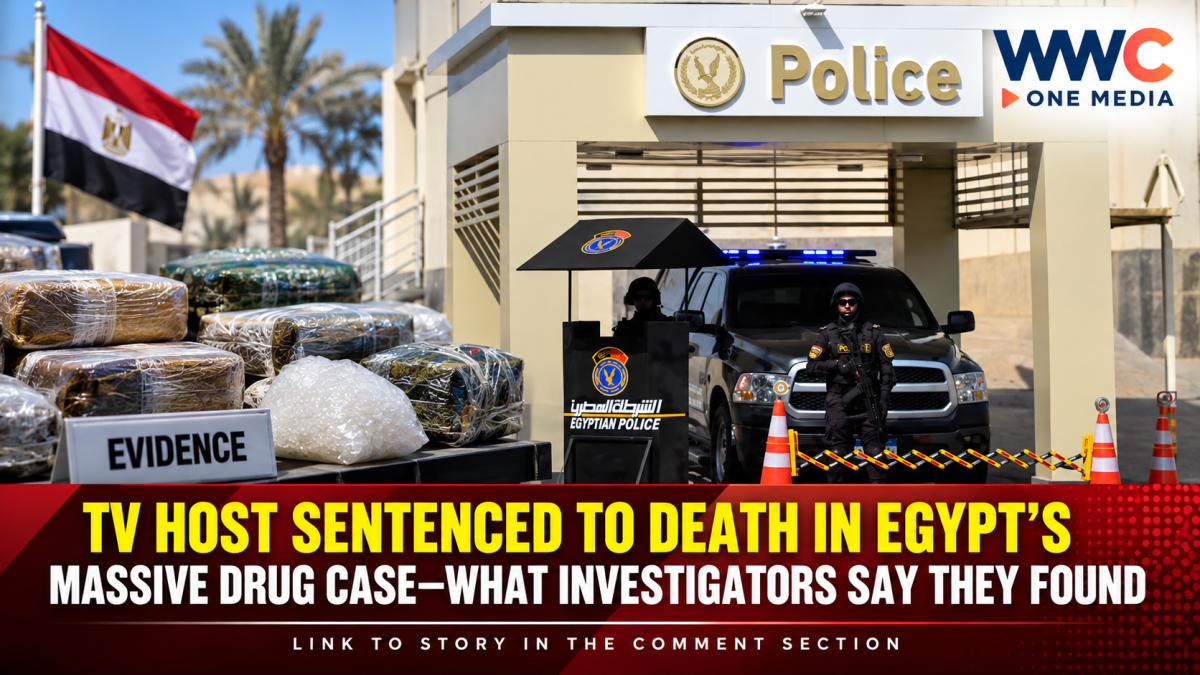
CAIRO, Egypt — Egyptian television presenter Sarah Khalifa, 39, has been sentenced to death by hanging along with 11 other defendants after a Cairo court found them guilty in a major narcotics case involving the alleged manufacture and trafficking of synthetic drugs.
Khalifa, who is known for hosting the crime and security-focused television program “Mission Impossible,” was convicted alongside the other defendants of forming an organized criminal group accused of obtaining materials used to manufacture narcotics for distribution. The case also involved allegations of possessing and carrying firearms and ammunition without licenses.
The sweeping case has attracted international attention because of Khalifa’s public profile and the scale of the alleged drug operation.
More than 750 kilograms of narcotics seized
According to Egypt’s state-linked Al-Ahram newspaper, authorities seized more than 750 kilograms of narcotics and raw materials during the investigation.
Investigators also reportedly discovered two apartments allegedly being used as laboratories, along with unlicensed firearms and ammunition.
State-run Akhbar Al-Youm reported that prosecutors accused the group of importing materials from abroad to manufacture synthetic drugs for trafficking.
The investigation reportedly described a division of roles within the alleged organization, including obtaining raw materials, manufacturing the drugs and distributing the finished products.
Khalifa’s alleged role
Khalifa was not simply identified as a peripheral defendant in the case.
Earlier proceedings reported by Egyptian media alleged that she helped finance and coordinate parts of the operation, including contacts with other alleged members of the group. However, those allegations form part of the prosecution’s case and should be distinguished from independently established facts.
Khalifa has denied the allegations. ABC News reported that she protested her innocence following the verdict, saying she had never even smoked a cigarette.
The television personality also owns a cosmetic surgery clinic and an events production company.
The case involved 28 defendants
The death sentences were not the only outcomes in the sprawling prosecution.
Reports from the proceedings indicate that 28 defendants were tried in the case. Twelve—including Khalifa—received death sentences, while nine others were sentenced to life imprisonment and seven were acquitted, according to reports on the proceedings.
Khalifa and several defendants also received five-year prison sentences in a separate case involving the kidnapping and assault of a young man.
Why the Grand Mufti was consulted
The death sentences followed a required legal procedure in Egypt.
Before a death sentence is formally issued, Egyptian courts refer capital cases to the country’s Grand Mufti for a religious opinion. The opinion is advisory rather than a substitute for the court’s judgment.
In Khalifa’s case, the court had already referred the matter for the Mufti’s opinion before issuing the latest ruling.
Importantly, the death sentences can still be appealed, meaning the ruling does not mean Khalifa or the other defendants are about to be executed.
Egypt continues to use the death penalty for drug trafficking
Egypt retains the death penalty for several serious offenses, including premeditated murder, terrorism, certain rape offenses and drug trafficking.
The case also comes amid continuing international scrutiny of Egypt’s use of capital punishment. According to figures cited by the Egyptian Commission for Rights and Freedoms, Egypt issued 541 death sentences in 2025.
The figure refers to sentences, not executions, an important distinction when assessing the country’s use of the death penalty.
What happens next?
For Khalifa and the other defendants, the legal battle is not necessarily over.
The Cairo court’s ruling remains subject to appeal, leaving open the possibility that the sentences could be challenged through Egypt’s judicial system.
The case has nevertheless become one of Egypt’s most closely watched recent drug prosecutions, combining allegations of a large-scale synthetic narcotics operation, illegal weapons possession and the involvement of a recognizable television personality.
For now, the most significant question is no longer simply why Sarah Khalifa was sentenced—but whether the death penalty imposed by the Cairo court will survive the appeals process.
WWC ONE MEDIA J.M.S




Leave a Reply