
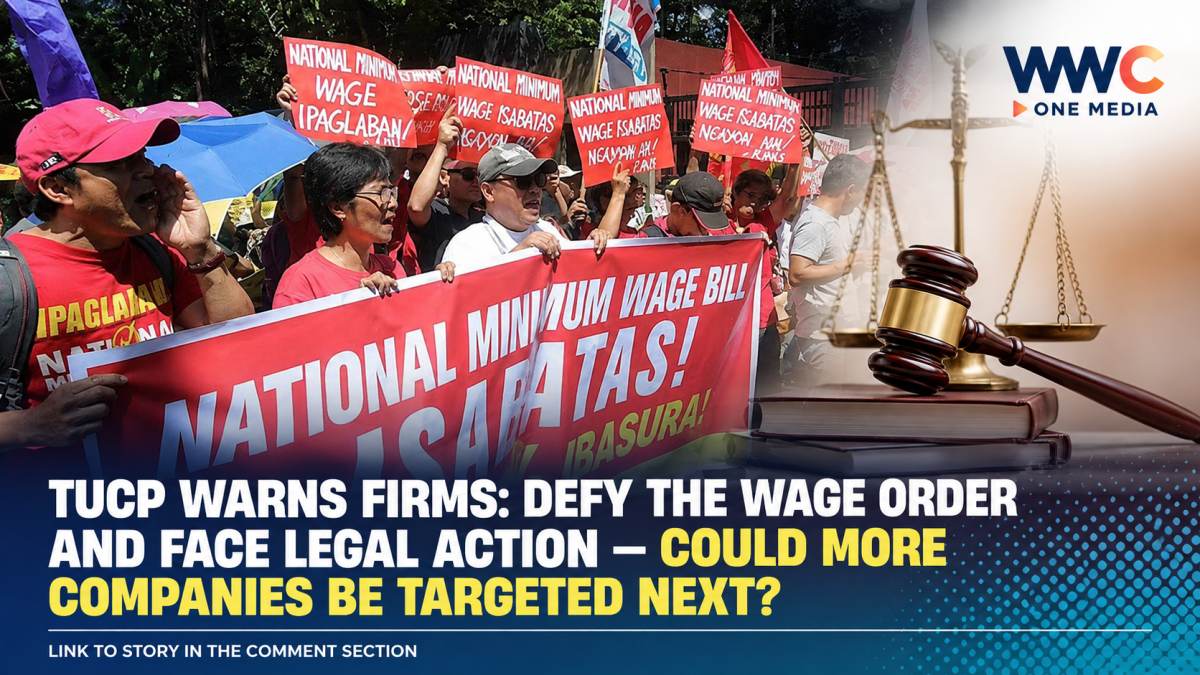
MANILA, Philippines — The battle over Metro Manila’s minimum wage is escalating, with the Trade Union Congress of the Philippines (TUCP) warning that companies that refuse to comply with a valid wage order could face legal action.
The warning comes as the implementation of Wage Order No. NCR-27, which provides a total P85 daily minimum wage increase, remains caught in a legal dispute before the courts.
The wage order originally called for a P60 increase in the first tranche, followed by another P25 increase in January 2027. For non-agricultural workers covered by the order, the first tranche would have raised the minimum daily wage from P695 to P755, with the full adjustment eventually bringing it to P780.
But the wage increase has been temporarily halted by court action.
On August 13, the Pasig City Regional Trial Court Branch 152 issued a writ of preliminary injunction, effectively suspending implementation of NCR Wage Order No. 27 while it considers the merits of a petition filed by construction companies Readycon Trading and Construction Corp. and R-II Builders Inc.
The companies had challenged the wage order, arguing against the increase and its impact on business costs. The case has triggered a broader confrontation between employer groups, labor organizations and government over how far courts can intervene in the regional wage-setting process.
TUCP fears a wave of copycat cases
TUCP has warned that the NCR dispute could go beyond Metro Manila.
The labor group said that if an approved wage order can be stopped through litigation after going through the statutory wage-setting process, similar lawsuits could potentially be filed against wage orders in other regions.
TUCP has therefore vowed to pursue available legal remedies and seek the dissolution of the injunction. The organization has also pushed for a P200 legislated wage increase, arguing that the current regional wage-setting system is vulnerable to prolonged legal challenges.
The concern is significant because regional wage boards operate under Republic Act No. 6727, or the Wage Rationalization Act, with representatives of workers, employers and government participating in the wage-setting process.
Under the Labor Code framework, wage orders normally take effect 15 days after complete publication, while an aggrieved party may appeal to the National Wages and Productivity Commission within the prescribed period.
DOLE steps up enforcement
The Department of Labor and Employment has separately moved to strengthen enforcement of wage orders nationwide.
On August 10, Labor Secretary Francis Tolentino signed Administrative Order No. 264, establishing unified guidelines for the implementation, monitoring and enforcement of wage orders.
The order directs DOLE regional offices and wage boards to monitor compliance and issue compliance orders to establishments found to have wage deficiencies. It also provides mechanisms for covered businesses, particularly qualified small and medium enterprises, to seek wage-order exemptions under applicable rules.
Before the court injunction, DOLE had reported an almost 95% compliance rate in Metro Manila, while saying visitorial inspections would be conducted to check whether employers were implementing the wage increase. Businesses unable to comply because of qualifying circumstances were given a period to apply for exemption.
The bigger fight: P85 or P200?
The dispute has also revived the long-running debate over whether regional wage adjustments are enough to keep up with the rising cost of living.
TUCP has consistently argued for a P200 nationwide legislated wage increase, saying the P85 NCR adjustment remains insufficient to restore workers’ purchasing power.
Malacañang, however, has emphasized the need to balance higher wages with employers’ capacity to absorb additional labor costs, warning that excessive increases could put jobs at risk.
For now, the legal battle over NCR Wage Order No. 27 has become about more than the P60 first tranche or the eventual P85 increase.
At stake is whether a wage adjustment already approved through the regional tripartite process can be effectively put on hold through court proceedings — and whether such a move could open the door to similar challenges elsewhere in the country.
With TUCP preparing to fight the injunction and DOLE saying it will use every lawful remedy available to defend the wage increase, the Metro Manila wage battle is far from over.
WWC ONE MEDIA MJE




Leave a Reply