
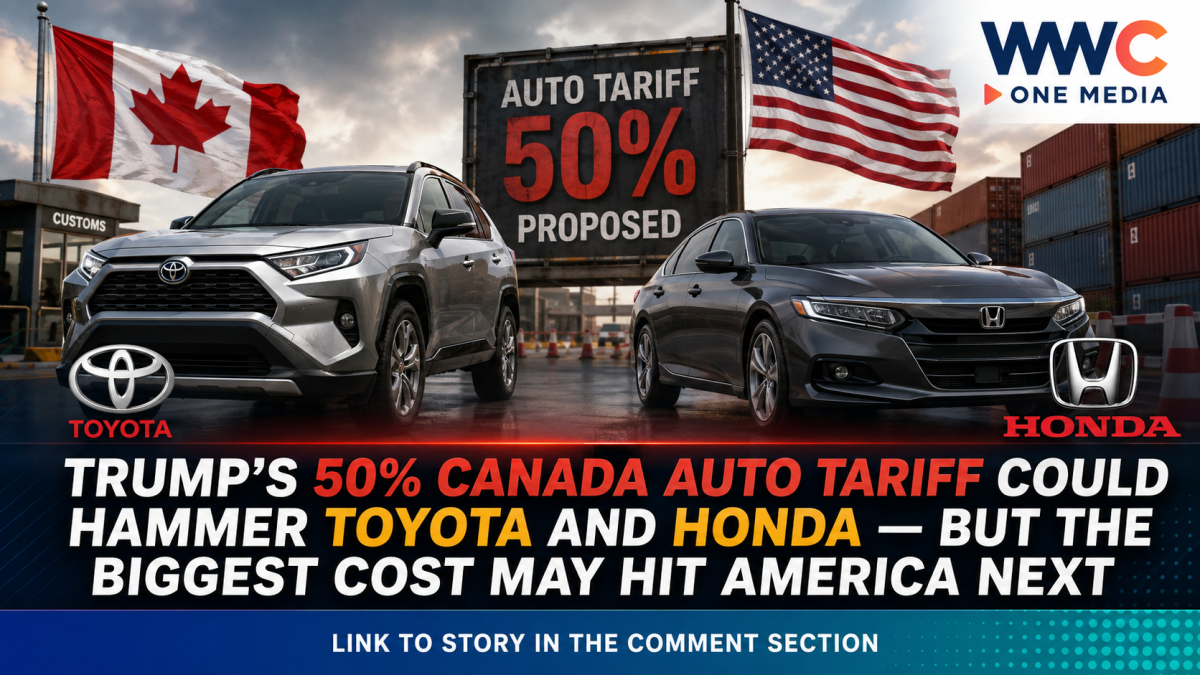
Toyota and Honda spent decades turning Canada into one of the most important links in their North American manufacturing networks.
Now that strategy could become an expensive liability.
U.S. President Donald Trump has threatened to raise tariffs on Canadian-made cars, trucks and automotive products to 50% beginning January 1, 2027, potentially doubling the current 25% levy and putting two Japanese automotive giants squarely in the firing line.
The target may officially be Canada. But Toyota and Honda could end up paying a large portion of the economic price.
Toyota and Honda Have More at Stake Than Most Automakers
Toyota and Honda together account for more than three-quarters of all vehicles manufactured in Canada, according to Reuters.
Their exposure to the U.S. market is equally striking.
Canadian-built vehicles represented almost one-quarter of Honda’s U.S. sales last year, while vehicles assembled in Canada accounted for around 17% of Toyota’s American sales — the highest exposure among major automakers, according to Barclays analysts cited by Reuters.
That matters because Canada is not producing obscure models destined for small markets.
Two of North America’s most important SUVs are involved.
Toyota manufactures the RAV4 in Canada, while Honda’s Ontario operations produce the CR-V. Both are major sellers in the United States.
Business Insider has also highlighted the extraordinary reach of the proposed tariff, noting that popular vehicles including the RAV4, CR-V, Chevrolet Silverado and Ford F-Series have Canadian production exposure.
For American consumers, that means this trade fight could eventually become more than a dispute between Washington and Ottawa.
It could become a question of vehicle availability, production decisions and potentially prices.
Toyota Just Made a Billion-Dollar Bet on Canada
Toyota’s dilemma is particularly striking because the company has recently doubled down on Canadian manufacturing.
In January 2026, Toyota announced the start of Canadian production of its sixth-generation RAV4 for the North American market.
The company said it invested more than $1.1 billion in the new RAV4 programme, bringing Toyota’s cumulative Canadian investment to more than $12 billion.
That investment was supposed to reinforce Canada’s position inside Toyota’s North American manufacturing system.
A 50% U.S. tariff could dramatically change the economics behind it.
Analysts told Reuters that if the duties are ultimately implemented, Toyota and Honda could be forced to close or scale back some Canadian production lines.
Their alternatives are hardly simple.
They could absorb more of the tariff themselves, attempt to raise prices, move additional production into the United States, or redirect Canadian-built vehicles to other countries.
Every option carries a cost.
Moving the Cars Somewhere Else Isn’t Easy
At first glance, Toyota and Honda could simply export Canadian-made vehicles to other markets.
In practice, analysts say that would be extremely difficult.
Vehicles built for the United States are configured around American regulations, specifications and customer preferences. Factories elsewhere may also lack enough unused capacity to suddenly replace hundreds of thousands of Canadian-built vehicles.
That means the proposed tariff could force something much larger than a temporary supply adjustment.
It could accelerate a restructuring of the North American automotive map.
Canada currently produces roughly 1.2 million vehicles annually, while its broader automotive industry directly and indirectly supports about 427,000 jobs, according to figures cited by Reuters.
A sustained 50% tariff would therefore put pressure not only on Toyota and Honda assembly plants, but also on parts suppliers, logistics companies and communities built around Canada’s automotive industry.
Toyota Is Already Spending Billions to Shift Toward America
Toyota is not waiting for the trade environment to stabilize.
Reuters reports that U.S. tariffs cost Toyota approximately 1.4 trillion yen, or about $8.8 billion, during its last financial year.
The automaker has responded with an aggressive expansion of American production.
Toyota has said it intends to invest as much as $10 billion over five years in its U.S. operations, including a planned $3.6 billion Texas plant where Tacoma pickup production is expected to be shifted from Mexico.
The message is difficult to miss: manufacturing inside the United States is becoming increasingly valuable as Washington raises the cost of importing vehicles from even its closest trading partners.
But moving factories is neither cheap nor fast.
A plant represents billions of dollars in machinery, supplier relationships, workforce training and logistics infrastructure. Companies cannot simply relocate that ecosystem every time tariff policy changes.
Honda Faces an Even Bigger Strategic Decision
Honda’s situation may be more complicated.
The automaker is approaching full production capacity in North America and has been considering whether it needs an eighth assembly plant in the region.
Honda Executive Vice President Noriya Kaihara recently warned that the company could reconsider that expansion if there is no long-term certainty surrounding the United States-Mexico-Canada Agreement, or USMCA.
Honda wants a decision on additional capacity within the next year or two, with a possible new factory operating around 2030.
The company has already demonstrated how quickly its Canadian investment strategy can change.
In May 2026, Honda indefinitely suspended its previously announced Canadian EV manufacturing project amid changing market conditions and a broader reassessment of its electric-vehicle strategy. Existing production at its Alliston, Ontario facilities was not affected.
A prolonged tariff battle could make Honda even more reluctant to commit billions of dollars until the rules governing North American trade become clearer.
This Is No Longer Just an Auto Dispute
The automotive threat is unfolding inside a much larger deterioration in U.S.-Canada trade relations.
The Trump administration has already imposed 50% duties on hundreds of other Canadian products covering roughly $20 billion in trade, according to AP reporting.
Canada, in response, has announced plans for retaliatory tariffs on U.S. products beginning September 8.
The Financial Times has similarly reported warnings that the escalating dispute could freeze investment and damage the deeply interconnected supply chains that developed across the United States and Canada under decades of free-trade agreements.
There is still time for negotiations.
The proposed 50% vehicle tariff is scheduled for January 1, leaving Washington and Ottawa several months to reach another agreement.
Automotive industry officials are hoping they do.
The Bigger Risk May Be What Happens After January
Toyota and Honda can survive another tariff shock.
The bigger question is what they will do afterward.
For decades, automakers treated the United States, Canada and Mexico less like three separate manufacturing markets and more like one enormous production system. Engines, transmissions, components and completed vehicles could cross borders multiple times before reaching a dealership.
A permanent 50% tariff on Canadian vehicles could undermine that model.
Toyota and Honda may respond by moving more future investment into the United States.
Canada could lose manufacturing capacity.
Suppliers could relocate.
And American consumers may ultimately discover that tariffs designed to protect U.S. manufacturing can also raise costs for vehicles built by companies employing thousands of workers across North America.
Trump’s tariff threat may have Canada written on the label.
But if the policy takes effect in January, Toyota and Honda could receive the first bill — and the North American auto industry may receive the next one.

Leave a Reply