
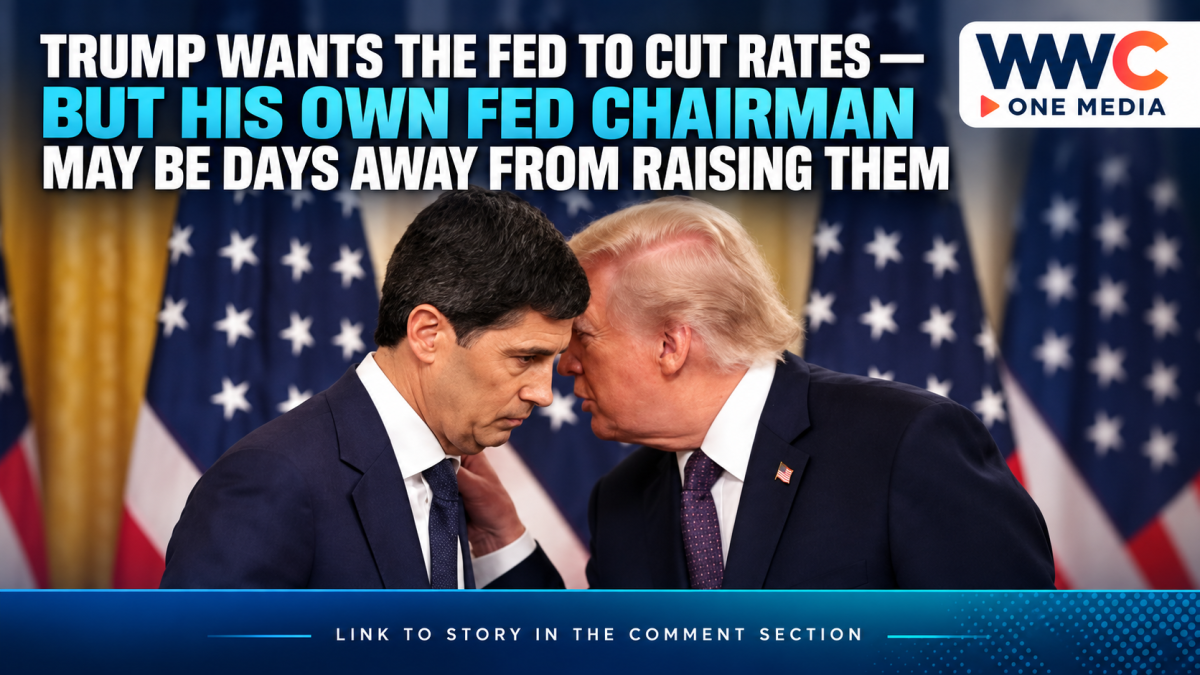
WASHINGTON — Donald Trump spent years demanding lower interest rates from Jerome Powell.
Now the president faces a potentially more uncomfortable confrontation.
The Federal Reserve chairman standing between Trump and cheaper money is Kevin Warsh — the man Trump personally nominated for the job only six months ago.
And instead of preparing to cut interest rates, Warsh is overseeing a Federal Reserve that may be preparing to raise them.
Financial markets increased their bets on a September rate hike after the U.S. economy unexpectedly added 162,000 jobs in August, far exceeding economists’ expectations and weakening the argument that the labor market urgently needs monetary-policy support. Reuters reported that futures markets pushed the probability of an increase to roughly 61%–62% after the report.
That has set up an extraordinary showdown less than two weeks before the Fed’s next decision.
Trump wants a cut.
Several members of his administration want a cut.
Three Fed policymakers already wanted a hike at the last meeting.
And Warsh has publicly warned that inflation has not fallen fast enough.
Something has to give.
Trump is no longer merely asking for lower rates
The president significantly escalated his campaign on Friday.
Trump said the United States should have the lowest interest rates in the world and threatened to stop trading with countries with which America runs trade deficits unless the Federal Reserve lowers rates.
That goes considerably beyond criticizing monetary policy.
The Fed is legally structured to make interest-rate decisions independently from day-to-day White House direction, and presidents traditionally avoid tying trade retaliation directly to central-bank decisions.
CNBC characterized the latest effort as a broad administration-wide campaign aimed at preventing the Fed from tightening monetary policy at its Sept. 15–16 meeting.
Trump has so far avoided attacking Warsh personally with the same intensity he directed at Powell.
But the pressure is unmistakable.
The rest of the White House has joined in
Trump is not acting alone.
Vice President JD Vance told reporters on Sept. 3 that the administration believes the Fed should be lowering rates, arguing that high borrowing costs are making homeownership more difficult for Americans.
Treasury Secretary Scott Bessent has also made the case for caution.
In a CNBC interview, Bessent argued that central banks traditionally avoid tightening monetary policy in response to a supply shock unless it begins producing broader secondary inflation effects. He also pointed to relatively restrained underlying inflation measures and the possibility that artificial intelligence investment could eventually boost productivity.
Then came one of the administration’s sharpest attacks.
Senior economic adviser Peter Navarro said a rate increase would damage factory construction, capital spending, machinery, housing and manufacturing, while disparaging Fed policymakers as “clowns.”
So heading into the September meeting, the message coming from Trump’s economic team is increasingly coordinated:
Do not raise rates. Preferably, cut them.
The problem is that the economy just handed Warsh an argument for doing the opposite
Friday’s employment report made the Fed’s choice harder.
The Bureau of Labor Statistics reported that employers created 162,000 jobs in August, while the unemployment rate remained unchanged at 4.1%.
The result was particularly striking because hiring had looked weak earlier in the summer.
BLS also revised June and July employment upward by a combined 55,000 jobs.
Average hourly earnings rose 0.3% in August and 3.1% over the previous year. That annual wage increase was moderate enough to reduce concerns about an explosive wage-price spiral, but the broader employment numbers showed an economy that is hardly collapsing.
That matters because the Fed has two main responsibilities:
maximum employment and stable prices.
If unemployment were rapidly rising, policymakers would have a stronger argument for cutting rates.
Instead, employment appears relatively stable while inflation remains above target.
That shifts the spotlight squarely onto prices.
Warsh has already told markets what worries him
At his first Jackson Hole address as Fed chairman on Aug. 28, Warsh delivered the clearest inflation warning of his young tenure.
He reaffirmed that the Fed’s 2% inflation objective is a firm target, not simply an aspiration.
Warsh pointed out that the Fed’s preferred PCE inflation measure had been running at 3.7% year over year, with six-month inflation even higher.
He also noted that 54% of the individual goods and services contained in the PCE basket had risen by more than 3% over the previous year, evidence that inflation remained broader than he considered comfortable.
His conclusion was deliberately not a promise of a September hike.
But it was clearly hawkish.
Warsh said policymakers need confidence that underlying inflation is moving toward 2% at an adequate pace — otherwise, the central bank still has work to do.
Markets immediately interpreted that as opening the door to tighter policy.
But Warsh did not actually promise a rate hike
This distinction is critical.
Warsh ended the Jackson Hole speech by stressing that he was committing himself to a policy discipline rather than a predetermined decision.
That means headlines saying:
“Warsh will raise rates in September”
would go beyond the evidence.
The Federal Open Market Committee has not voted.
August inflation data have not yet been released.
And several policymakers remain undecided.
What Warsh has done is make inflation control the dominant issue.
That is different from announcing an outcome.
The Fed’s last vote shows just how close this debate could become
At its July 28–29 meeting, the Fed kept its benchmark federal-funds target at 3.50% to 3.75%.
But the vote was unusually divided:
9 officials voted to hold.
3 officials wanted an immediate quarter-point increase.
Cleveland Fed President Beth Hammack, Minneapolis Fed President Neel Kashkari and Dallas Fed President Lorie Logan all dissented in favor of lifting the rate by 25 basis points.
Warsh himself voted with the majority to hold.
That is another useful safeguard.
He has since sounded more concerned about inflation, but Warsh did not vote for a hike in July.
If the Fed moves by the conventional quarter point this month, its benchmark target would rise from 3.50%–3.75% to 3.75%–4.00%.
Another powerful Fed official is not convinced
Governor Christopher Waller has complicated the story further.
In remarks on Sept. 3, Waller said inflation remains meaningfully above target but argued that recent data suggest genuine improvement may finally be emerging.
His position is essentially conditional.
If August inflation confirms that disinflation is continuing, Waller says he would be inclined to leave rates unchanged.
If inflation heats up again, he could support a hike.
Markets responded strongly to those comments.
Reuters reported that expectations for a September increase temporarily fell toward 50%, down from roughly 63%, as investors reconsidered whether Warsh would have enough support to move.
Then the unexpectedly strong jobs report arrived — and the odds moved upward again.
That volatility tells investors something important:
This decision is genuinely live.
Sept. 11 may matter more than anything Trump says
The most important event before the Fed meeting is not another presidential statement.
It is the release of the August Consumer Price Index on Friday, Sept. 11.
The Bureau of Labor Statistics has confirmed that date.
July’s CPI increased just 0.1% month over month, while annual inflation stood at 3.4%.
Core CPI, which excludes food and energy, rose 0.2% during the month and 2.5% from a year earlier.
Those numbers offered some evidence of cooling underlying price pressures.
But Warsh has argued that one or two encouraging reports are insufficient to establish that the inflation trend has fundamentally changed.
That makes the August reading potentially decisive.
A soft number would strengthen Waller’s case for patience.
A hot number could make a September increase much harder for the Fed to avoid.
So why is Trump demanding cuts when unemployment is low?
The administration’s argument is different from the traditional central-bank framework.
Trump and his advisers contend that higher rates are themselves harming the economy by making mortgages, factory investments, machinery purchases and business expansion more expensive.
Vance focused specifically on housing affordability when making the case for cuts.
That concern is not theoretical.
Freddie Mac reported that the average U.S. 30-year fixed mortgage reached 6.71% on Sept. 3, its highest level since July 2025.
The 15-year fixed rate averaged 6.04%.
For homebuyers, those rates can add hundreds of dollars a month to financing costs compared with significantly lower-rate environments.
Trump therefore sees cheaper money as part of the answer to the country’s affordability problem.
But cutting the Fed rate would not automatically send mortgages plunging
This is another point worth making clearly.
The Federal Reserve directly controls a short-term overnight interest rate.
Thirty-year mortgage rates are much more closely influenced by longer-term Treasury yields, expected inflation, financial-market risk and investors’ expectations about future economic conditions.
That is why mortgage rates can sometimes rise even when the Fed cuts — or fall before the Fed changes policy at all.
The 10-year Treasury yield recently climbed to around 4.8%, pressured by inflation concerns, high government borrowing requirements and strong demand for capital from the AI investment boom.
So even if Trump obtained the Fed rate cut he wants, there would be no guarantee that a 30-year mortgage would immediately become dramatically cheaper.
Trump’s trade threat could complicate the inflation problem
There is another contradiction embedded in the president’s latest threat.
Trump said he could halt trade with countries against which the U.S. runs deficits unless the Fed lowers rates.
But disrupting imports could itself restrict supply.
Reuters warned that a broad trade embargo of the kind Trump described could damage global growth and increase the risk of a U.S. recession.
Depending on how such restrictions were implemented, they could also push up prices for imported goods and components — precisely the type of inflationary pressure that would make the Fed less comfortable cutting rates.
The stakes are large.
Official government data show the U.S. goods-and-services trade deficit widened to $88.6 billion in July, with imports reaching $399.3 billion.
Capital-goods imports alone hit a record $140.3 billion, reflecting strong demand for computers, semiconductors and other investment equipment.
So using trade restrictions as leverage over monetary policy could produce complicated economic side effects.
The AI boom is part of the debate too
One of the strangest elements of the current rate argument involves artificial intelligence.
Trump officials argue that the enormous wave of investment in AI, factories and technology will eventually expand the economy’s productive capacity.
If American businesses can produce more efficiently, the administration argues, stronger economic growth does not necessarily have to generate more inflation.
There is economic logic behind that supply-side argument.
But timing matters.
Warsh said more than half of this year’s surge in equipment and intangible investment appears related to AI.
In the short term, however, hundreds of billions of dollars being poured into data centers, chips, power systems and other infrastructure also creates enormous demand for capital, labor and equipment.
That can push market interest rates higher even before the hoped-for productivity gains arrive.
Trump created this awkward situation himself
The political dimension is impossible to ignore.
Trump nominated Warsh on March 4.
The Senate confirmed him in May.
And Warsh took the oath as the 17th chairman of the Federal Reserve on May 22.
His term as chair runs through May 21, 2030, while his term as a Fed governor extends until 2040.
Warsh replaced Jerome Powell, whom Trump had attacked relentlessly over interest rates during both of his presidencies.
The expectation among many political observers was that Trump would finally have a Fed chairman more philosophically compatible with him.
But Warsh has also promised to defend the institution’s independence.
And his first 100 days have brought him into precisely the dilemma every Fed chair ultimately confronts:
the president who appointed him wants one thing, while the data may demand another.
The Fed’s credibility is now part of the decision
There is an additional problem for Warsh.
His Jackson Hole speech explicitly criticized the central bank’s failure to control inflation over the previous five-plus years.
Warsh said responsibility for prolonged above-target inflation belongs with the Fed itself.
That language raises the stakes for his own credibility.
Former Federal Reserve Vice Chair Roger Ferguson argued that markets are probably justified in expecting a hike, although he stressed that the decision is not settled.
He also warned that political pressure makes the situation more difficult: if the Fed pauses despite strong economic data, some investors may wonder whether policymakers were influenced by the White House rather than economic conditions.
That does not mean Warsh must hike simply to demonstrate independence.
Doing so for political theater would itself violate the principle of data-dependent policymaking.
But it illustrates the trap.
Every option will now be interpreted politically.
Even Jerome Powell still has a vote
There is another unusual subplot.
Warsh replaced Jerome Powell as Fed chairman, but Powell has not yet left the Federal Reserve Board.
His separate term as a governor runs until January 2028.
That means Powell continues to participate in FOMC decisions with one vote — the same formal vote held by Warsh.
The chair has enormous influence over discussion and consensus-building, but he does not unilaterally set U.S. interest rates.
The September decision is ultimately a committee vote.
That becomes particularly important after July’s 9–3 split.
Warsh needs a majority, not just a preference.
Markets have already changed their minds several times
The probabilities themselves tell the story of how uncertain the outcome remains.
After Warsh’s Jackson Hole speech, market-implied odds of a September hike surged from roughly the mid-30% range to around 55%–66%, depending on the point in time measured.
Waller’s more cautious comments knocked those expectations back toward 50%.
Then Friday’s 162,000-job report pushed them back above 60%.
Those are market prices, not Fed forecasts.
CME itself cautions that FedWatch probabilities are derived from federal-funds futures and do not represent official Federal Reserve guidance.
So saying the Fed is “expected” or “favored” to hike is defensible.
Saying a hike is “confirmed” is not.
The final decision could affect almost every corner of the economy
A quarter-point Fed increase may sound small.
But benchmark short-term rates influence:
credit cards,
home-equity lines,
business loans,
floating-rate debt,
bank deposit yields,
and financial-market valuations.
A move from 3.50%–3.75% to 3.75%–4.00% would signal something even more important than the 25-basis-point increase itself:
America’s rate-cutting cycle may be over, at least temporarily.
Citigroup has already pushed its forecast for the next Fed cut all the way into 2027 following Friday’s jobs report.
That is a dramatic change from the outlook earlier in the year, when many investors still expected borrowing costs to fall.
And that is why Sept. 16 could become the defining moment of Warsh’s first year
Kevin Warsh has been Fed chairman for barely more than three months.
He was chosen by a president who loudly demanded easier monetary policy.
He inherited inflation that has remained above target for years.
He has promised to rebuild the Fed’s credibility.
And now that same president is publicly demanding that Warsh do almost exactly the opposite of what financial markets increasingly believe the central bank may need to do.
The employment side of the equation just became clearer.
162,000 jobs.
4.1% unemployment.
3.1% wage growth.
The inflation side gets its next major update on Sept. 11.
Five days later, the Fed votes.
Trump can pressure Warsh.
Markets can price the outcome.
Economists can make forecasts.
But none of them gets the final word until the FOMC makes its decision.
Trump picked Kevin Warsh hoping for a different Federal Reserve.
September may reveal just how independent his pick intends to be.
WWC ONE MEDIA M.J.E



Leave a Reply