
MANILA, Philippines — Roads that end before reaching their intended destination. Bridges funded in one phase but left waiting for the next. Projects that change when administrations change. Structures that fail when extreme weather finally tests them.
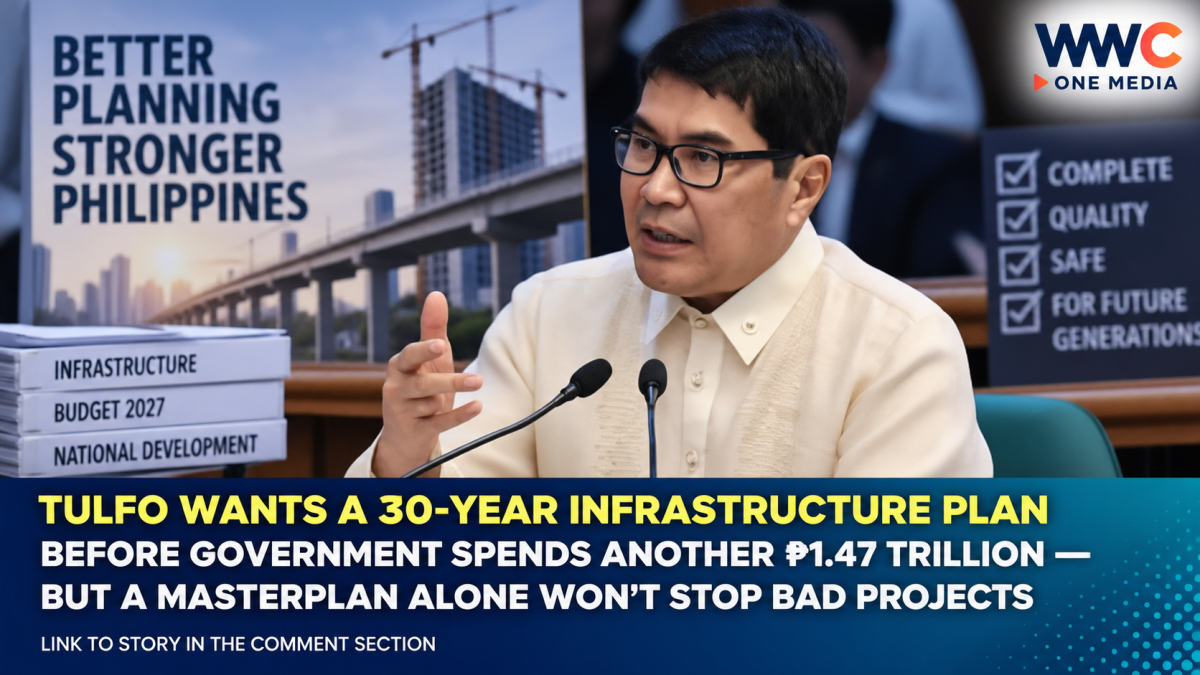
Sen. Erwin Tulfo says the Philippines needs to stop treating those problems as isolated failures and start fixing the system that decides which infrastructure projects get built in the first place.
As Congress begins examining the proposed 2027 national budget, the Senate Blue Ribbon Committee chairman is renewing his call for passage of Senate Bill No. 1360, or the proposed Masterplan for Infrastructure and National Development Act—better known as the MIND Act.
The proposal would require the government to develop a 30-year Comprehensive Infrastructure Development Masterplan, or CIDMP, intended to survive election cycles and connect national, regional and local infrastructure investments under one long-term framework.
The idea is straightforward:
Infrastructure should follow a national plan—not whoever happens to be in office when the budget is written.
But converting that idea into law may be the easy part.
Making every agency, local government, contractor and future administration follow it could be far harder.
Tulfo Says Rain Exposed What Government Planning Failed to Fix
Tulfo renewed his argument after weeks of heavy rainfall exposed damaged, unfinished and allegedly substandard infrastructure.
He said projects sometimes receive funding for an initial phase only to stall because later stages are not financed, leaving taxpayers with structures that cannot deliver their intended benefit.
Tulfo argued that government wastes money when infrastructure is funded piecemeal without guaranteeing that the entire project fits into a broader development plan.
His proposed remedy is to make infrastructure planning systematic and long-term.
Under the MIND Act, projects would have to fit within a national strategy extending beyond individual presidents, senators, governors or mayors.
That argument becomes particularly significant this year because the government is preparing to spend a huge amount on infrastructure.
The Stakes: ₱1.47 Trillion in Proposed 2027 Infrastructure Spending
The Marcos administration is proposing roughly ₱1.467 trillion for the Build Better More infrastructure program in 2027, equivalent to about 4.4% of gross domestic product.
That is around ₱178 billion more than the ₱1.29 trillion provided in the 2026 national budget.
The Department of Public Works and Highways alone is proposed to receive about ₱643.95 billion, up 21.29% from its ₱530.90-billion 2026 budget.
Rail investment is also accelerating dramatically.
DBM has proposed ₱197.3 billion for rail projects in 2027, more than triple the current year’s funding, with nearly ₱191.3 billion earmarked for the North-South Commuter Railway and Metro Manila Subway.
So Tulfo’s argument is arriving at a politically and financially important moment.
The question is no longer simply whether the Philippines should build more.
It is whether the country can make sure the projects receiving those hundreds of billions of pesos fit together—and actually get finished.
What the MIND Act Would Actually Do
The centerpiece of Senate Bill No. 1360 is a 30-year Comprehensive Infrastructure Development Masterplan.
The proposed plan would establish the country’s long-term infrastructure vision and guide which projects government should prioritize and finance. It would be formally reviewed every 10 years, or earlier when major emergencies, technological disruptions or new development trends require changes.
That is important because Philippine administrations normally operate within six-year presidential cycles.
Major railways, expressways, flood-control systems, ports and metropolitan transport networks often require far longer.
A 30-year plan is intended to reduce the risk that a project approved under one administration is abandoned, redesigned or deprived of funding after political leadership changes.
It Would Cover Far More Than Roads and Bridges
The proposed masterplan is considerably broader than a DPWH construction program.
The Senate bill requires integrated strategies covering:
land, air and sea transportation and logistics; energy; water; information and communications technology; housing, health and education infrastructure; agriculture and food logistics; and asset preservation and maintenance.
The bill also specifically calls for planning around economic growth and demographic changes.
That means decisions about a new highway, port or railway would theoretically be evaluated not merely as standalone construction projects but as part of a larger network.
A highway serving an industrial zone, for example, would need to make sense alongside ports, freight facilities, public transport, utilities and regional development plans.
The Masterplan Would Be Tied Directly to the National Budget
Perhaps the most consequential provision is not the 30-year timeline.
It is the connection to government budgeting.
The bill would require the Department of Economy, Planning and Development to integrate the CIDMP into major planning and budget documents, including the Philippine Development Plan, Regional Development Plans, Public Infrastructure Plan, Three-Year Rolling Infrastructure Plan, National Expenditure Program and ultimately the General Appropriations Act.
That could make the plan much harder to ignore.
A masterplan sitting on a government shelf has limited power.
A masterplan formally embedded in the process that determines which projects receive money is potentially much more influential.
Marcos Would Chair a New MIND Council
The bill would establish a MIND Council chaired by the President of the Philippines.
The DEPDev secretary would serve as vice chair, while Cabinet members overseeing public works, finance, budgeting, transportation, energy, ICT, agriculture, housing, tourism, local government, trade and the environment would participate.
Presidents of LGU leagues and four industry representatives would also sit on the council.
The council would be required to meet at least quarterly and coordinate infrastructure investments across agencies and regions.
Its responsibilities would include monitoring projects for timely completion, reviewing infrastructure policies and submitting the long-term masterplan to Congress.
That structure attempts to solve one of the biggest difficulties in Philippine infrastructure planning: different agencies often control different pieces of the same development problem.
A road may belong to DPWH.
Rail to DOTr.
Water to another agency.
Land-use decisions to local governments.
Budget approval to Congress.
Environmental clearance to DENR.
The MIND Council is designed to put those decisions inside one planning framework.
Climate Resilience Is Written Into the Proposal
Tulfo has argued that infrastructure should withstand extreme weather rather than merely survive under ordinary conditions.
That principle already appears explicitly in the bill.
Senate Bill No. 1360 requires infrastructure priorities to consider environmental sustainability, climate resilience, safety, implementation readiness and value for money.
It also calls for disaster-resilient infrastructure, risk-management measures and green and sustainable design.
The bill specifically requires updated strength, safety, health and environmental standards in infrastructure design and construction and calls for strict monitoring of whether projects are completed with all intended functional features.
That language makes the proposal particularly relevant after repeated floods and storms raised questions about whether some Philippine infrastructure has been designed for the climate conditions it now faces.
But a Masterplan Cannot Guarantee Good Concrete
This is where the political messaging needs an important reality check.
The MIND Act could improve planning, continuity, prioritization and coordination.
It cannot by itself guarantee that contractors use the correct materials.
It cannot automatically prevent bid-rigging.
It cannot independently inspect concrete.
And it cannot eliminate ghost projects simply because a project appears on a 30-year map.
Those problems still require procurement controls, engineering supervision, auditing, transparency, contractor accountability and criminal enforcement where wrongdoing is proven.
The bill does include project monitoring, standards, value-for-money principles and congressional oversight mechanisms, but its central purpose remains long-term planning and coordination.
So describing the MIND Act as a direct “anti-corruption law” would go further than the bill itself.
A more accurate description is:
It is an infrastructure-planning reform that could make waste and politically driven project selection harder—but only if the institutions implementing it enforce the plan.
Tulfo’s Corruption Claim Remains a Claim
Tulfo has said unfinished or substandard infrastructure can indicate corruption because government budgets are supposedly sufficient to construct projects according to standards.
That may be true in specific cases.
But it should not be treated as a blanket factual conclusion.
Infrastructure can also fail or stall because of poor engineering, right-of-way problems, procurement disputes, delayed appropriations, contractor insolvency, design changes, extreme weather or weak project management.
Proving corruption requires evidence showing that money was diverted, specifications deliberately violated, contracts manipulated or public officials or contractors committed unlawful acts.
The Senate Blue Ribbon Committee says it intends to investigate questionable public works individually.
That distinction matters in responsible reporting.
The EDSA-Ayala Wall Is More Complicated Than Some Headlines Suggested
One incident frequently cited by Tulfo and other officials involved the collapse of a wall along EDSA-Ayala northbound in Makati during heavy rain in August.
DPWH Secretary Vince Dizon inspected the structure and said the collapsed portion appeared to use Hardiflex or drywall rather than concrete, raising concerns about its construction.
But subsequent reporting also noted that the collapsed section appeared to be an addition to an existing property wall and was not established as a government-owned DPWH structure.
Authorities said they needed to determine who commissioned the addition and when it had been constructed.
That makes it a valid illustration of weak construction—but not yet proof of a defective government infrastructure contract.
The Proposal Is Not New
Tulfo’s bill also did not emerge only because of the recent flood-control controversy.
A similar MIND Act was already pursued during the 19th Congress.
Senate Bill No. 2605 consolidated several earlier infrastructure-masterplan proposals and reached the stage of a committee report and special-order status for second reading, but it did not become law before that Congress ended.
Tulfo refiled the concept as Senate Bill No. 1360 on September 9, 2025 during the 20th Congress.
Another similar measure, Senate Bill No. 1652, was subsequently filed by Sen. Win Gatchalian in January 2026.
That shows the concept has support beyond one senator.
But support is not the same as passage.
Tulfo’s Senate Bill Is Still Pending
Despite renewed calls for urgency, the official Senate legislative record lists SB 1360 as pending in committee.
It was referred to the Senate committees on Economic Affairs, Public Works and Finance on September 24, 2025.
So Bombo Radyo’s description of the proposal as pending with the Economic Affairs committee captures the lead committee but does not tell the entire legislative story.
The bill still has to move through the Senate process before it can reach plenary approval.
And even Senate passage would only be part of the journey.
The House Version Is Moving on a Parallel Track
The House of Representatives has several separate bills proposing essentially the same long-term infrastructure framework.
Those measures have been consolidated into a substitute MIND bill being handled in House committees.
The substitute proposal was placed on the House Committee on Ways and Means agenda on September 2, and related committee work continued into September 3.
That means both chambers currently have versions of the idea under consideration.
If each chamber eventually approves different texts, they would still have to reconcile those differences before a final bill could be sent to the President.
Why the 2027 Budget Makes the Debate More Urgent
The timing explains Tulfo’s renewed push.
The Philippines is preparing a ₱7.2-trillion national budget for 2027, the final full-year spending plan of the Marcos administration.
Roughly ₱1.467 trillion is proposed for infrastructure under Build Better More.
DBM itself says projects proposed for inclusion in the National Expenditure Program are supposed to be evaluated according to national and regional priorities, implementation readiness, project maturity, absorptive capacity, historical utilization, expected outcomes and value to citizens.
That means the government already has infrastructure-planning mechanisms.
The MIND Act’s real innovation would be to institutionalize a longer-term hierarchy above those mechanisms and make continuity across administrations a legal requirement rather than simply a policy preference.
The Philippines Already Has Plans — The Problem Is Making Them Stick
The country is not starting from zero.
The government already uses the Philippine Development Plan, Public Investment Program, Three-Year Rolling Infrastructure Program and Infrastructure Flagship Project lists.
The MIND bill itself acknowledges those existing mechanisms by requiring the future CIDMP to be integrated directly into them.
That reveals the real problem the legislation is trying to solve.
It is not that the Philippines has never planned infrastructure.
It is that infrastructure planning can become fragmented across agencies, geographic areas, budgets and political administrations.
One administration prioritizes one corridor.
The next changes direction.
A local project receives Phase 1 funding.
Phase 2 waits.
Another project duplicates infrastructure already proposed elsewhere.
And government can end up paying for structures that never produce their intended economic benefit.
The MIND Act is intended to make those departures more difficult.
The Real Test Is Political Discipline
A 30-year infrastructure blueprint sounds powerful.
But it creates its own question.
What happens when an influential official wants a project that is not in the plan?
What happens when Congress inserts funding for a politically attractive project that scores poorly on technical readiness?
What happens when local leaders demand infrastructure that conflicts with national priorities?
And what happens when a future administration decides it dislikes the priorities established by its predecessor?
The bill allows the masterplan to be reviewed every 10 years—or earlier when circumstances justify changes.
That flexibility is necessary.
But too much flexibility could also undermine the very continuity the legislation is trying to create.
Ultimately, the strength of the law would depend less on the existence of the document than on whether budget officials, lawmakers and implementing agencies are genuinely required to justify deviations from it.
Building More Is Not the Same as Building Better
The Philippines is entering another period of enormous infrastructure spending.
Railways are expanding.
New bridges are being planned.
Flood-control systems are being upgraded.
Road networks are being extended.
The government says the goal of its proposed 2027 infrastructure program is not simply higher spending but projects that deliver measurable economic and social returns.
Tulfo’s proposal asks essentially the same question from another angle.
Before the government spends another trillion pesos, does the country know how every major project fits into the infrastructure system it wants 10, 20 and 30 years from now?
The MIND Act offers one possible answer.
It would create the blueprint.
It would establish the council.
It would connect that blueprint to the budget.
And it would require government to look beyond a single political term.
But no masterplan can substitute for competent engineering, honest procurement and strict oversight.
The Philippines may need a 30-year infrastructure map. The harder challenge is making sure every peso—and every project—actually follows it.
WWC ONE MEDIA M.J.E




Leave a Reply