
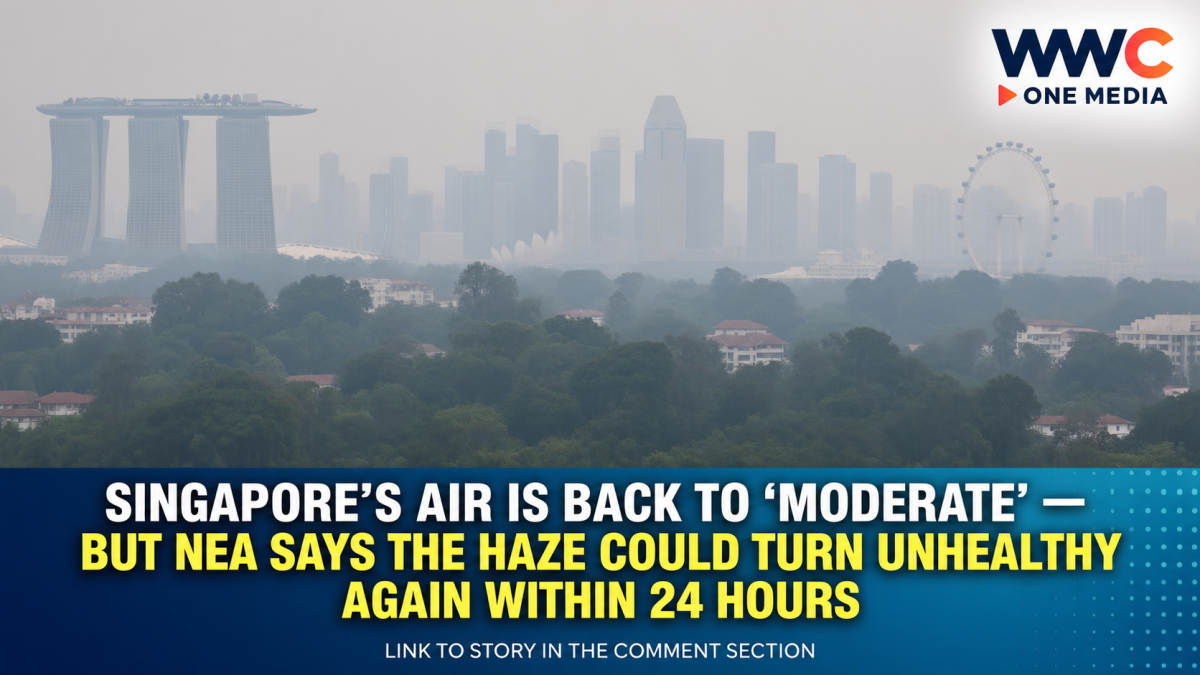
SINGAPORE — Singapore’s skies looked better on Sunday, September 6, after parts of the island briefly slipped into unhealthy air quality earlier in the weekend.
But authorities are warning residents not to assume the haze episode is over.
As of 7 p.m. Sunday, Singapore’s 24-hour Pollutant Standards Index, or PSI, stood between 72 and 87 across the island, keeping all five regions within the Moderate range.
That was a noticeable improvement from Friday and early Saturday, when air quality in the central, eastern and western parts of Singapore crossed into the Unhealthy band.
Yet the National Environment Agency is still forecasting conditions between the high end of Moderate and the low end of Unhealthy over the next 24 hours.
The reason is simple:
The fires feeding the haze have not gone away.
Singapore’s Air Improved — But the Smoke Plumes Are Still There
NEA said fair and windy conditions helped Singapore on Sunday.
At 6 p.m., one-hour PM2.5 concentrations ranged from 38 to 66 micrograms per cubic metre, placing them between the agency’s Normal and Elevated bands, while the 24-hour PSI stood between 73 and 87.
But satellite observations continued to show moderate to dense smoke plumes from fires in southern and central Sumatra and West Kalimantan drifting toward Singapore.
Prevailing winds were blowing mainly from the southeast or south, meaning smoke could again be carried directly toward the city-state if fires remain active.
That is why Sunday’s improved readings do not necessarily mean the haze crisis is ending.
They mean Singapore has entered a temporary period of better air.
Whether that lasts depends heavily on what happens hundreds of kilometres away.
Friday Was Singapore’s First Unhealthy PSI Reading Since 2023
The change over the past few days has been sharp.
On Friday morning, September 4, the 24-hour PSI in central Singapore crossed 101, entering the Unhealthy range for the first time since October 8, 2023.
The central region later climbed to around 123, while eastern and western Singapore also moved into unhealthy territory.
By early Saturday, the central region was still recording a PSI of about 120, while the east and west also briefly remained above 100.
Conditions then began to improve throughout Saturday, with all five regions eventually returning to Moderate levels.
Sunday continued that improvement.
But NEA’s decision to continue issuing daily haze advisories shows that officials do not consider the episode finished.
What ‘Moderate’ Actually Means
A PSI reading between 51 and 100 is classified as Moderate in Singapore.
For healthy people, elderly people, pregnant women and children, NEA says normal activities can generally continue while PSI remains Moderate.
Once PSI enters the Unhealthy range of 101 to 200, the advice changes.
Healthy individuals are encouraged to reduce prolonged or strenuous outdoor physical exertion.
Children, pregnant women and the elderly should minimise prolonged or strenuous exertion.
People with chronic heart or lung conditions should avoid prolonged or strenuous outdoor physical activity.
That does not mean everybody must remain indoors whenever PSI exceeds 100.
The health risk depends on three things:
how polluted the air is, how long somebody is exposed, and that person’s health condition.
PSI and PM2.5 Are Not the Same Thing
One reason haze advisories can appear confusing is that Singapore publishes both the 24-hour PSI and one-hour PM2.5 readings.
They serve different purposes.
The 24-hour PSI is based on a rolling daily measurement of six pollutants:
PM2.5, PM10, ozone, sulphur dioxide, nitrogen dioxide and carbon monoxide.
During regional haze episodes, however, PM2.5 is usually the dominant pollutant.
NEA recommends checking the one-hour PM2.5 reading when deciding what to do immediately — for example, whether to exercise outside in the next hour.
The 24-hour PSI forecast, by contrast, is more useful when planning activities for the next day.
That explains how the sky can sometimes appear clearer even while the 24-hour PSI remains relatively high.
The PSI still incorporates pollution accumulated over the previous 24 hours.
Why the Haze Came Back in 2026
The problem begins largely with a combination of dry weather, forest and land fires, peatland burning and wind direction across Indonesia.
Indonesia is experiencing one of its most serious fire seasons in years.
Between January and July, about 202,000 hectares of land burned, according to figures cited by CNA from Indonesia’s Forestry Ministry. Nearly 95,000 hectares burned in July alone.
That is considerably worse than recent years, though still far below Indonesia’s catastrophic 2015 fire season, when roughly 2.6 million hectares burned.
Conditions have been worsened by El Niño, which has contributed to hotter and drier weather across parts of Southeast Asia.
Indonesia’s meteorological authorities have said the dry season is expected to peak around August and September, making this month particularly important.
Indonesia’s Forestry Minister Raja Juli Antoni has described September as a crucial period because more meaningful rainfall may not arrive until early October.
That is a major reason Singapore cannot yet assume the haze risk has passed.
The Region Is Already Seeing Much Worse Air Than Singapore
Singapore’s readings have attracted attention because the PSI crossed into the Unhealthy range for the first time in nearly three years.
But elsewhere in Southeast Asia, conditions have been dramatically worse.
In Serian, Sarawak, Malaysia declared a local state of emergency on September 4 after the Air Pollution Index surged above 500, a level considered extremely hazardous.
Schools were also shut in affected parts of Sarawak.
Meanwhile, roughly 1.4 million Indonesian students across six provinces shifted to remote learning because of wildfire haze and dangerous air quality.
Those developments are important for Singapore because the same broad fire system is producing smoke capable of moving across national borders depending on wind patterns.
This is why haze remains fundamentally a regional problem rather than a purely Singaporean one.
Indonesia Is Investigating Companies Linked to Fires
Jakarta has also intensified enforcement.
Reuters reported that Indonesian authorities were inspecting 19 companies with fires detected inside concession areas, covering more than 11,000 hectares.
Officials said companies could be held responsible for fires occurring inside their concessions even while investigators determine whether the blazes were deliberately set or accidental.
Indonesia has deployed tens of thousands of personnel, firefighting aircraft, water-bombing operations and cloud-seeding efforts in an attempt to contain the fires.
But peatland fires are especially difficult.
Once peat has been drained and dried, fires can burn underground for long periods and produce large quantities of fine particulate matter.
That means visible flames may be extinguished while smoke-generating fires continue beneath the surface.
Singapore’s Haze Task Force Has Already Activated
Singapore began preparing before conditions entered the Unhealthy range.
The government’s 28-agency Haze Task Force said in August that agencies were ready to activate their respective plans if the PSI exceeded 100.
After the PSI crossed that threshold on September 4, the government began issuing daily haze advisories.
The task force includes agencies responsible for health, schools, workplaces, transport and other essential services.
Its response is designed to become progressively stronger as air quality deteriorates.
For now, Singapore has not approached the Very Unhealthy range of 201 to 300, much less the Hazardous level above 300.
That is an important distinction.
This is a genuine haze event, but Singapore is not currently experiencing the extreme pollution levels seen during some historic episodes.
Do Singaporeans Need N95 Masks Right Now?
Not necessarily.
NEA says N95 masks are generally not required for short exposure, such as commuting to work or school or moving between indoor locations.
Mask use becomes more relevant for healthy people who must spend several hours outdoors when pollution becomes significantly worse.
Vulnerable people — particularly those with severe heart or lung conditions — should seek medical advice if they are unsure whether prolonged mask use is appropriate.
The broader advice remains simpler:
Check air-quality readings, reduce strenuous outdoor activity when the PSI becomes unhealthy, stay hydrated and seek medical attention if symptoms become significant.
The Bigger Concern Is What Happens Next
Sunday’s numbers offer some relief.
Singapore is no longer sitting in the Unhealthy band.
But the meteorological conditions behind the episode remain largely intact.
Dry weather continues across much of the surrounding region.
Fires remain active.
Smoke plumes are still being observed.
And prevailing winds remain capable of transporting that smoke directly toward Singapore.
NEA’s forecast therefore matters more than Sunday evening’s snapshot.
The agency expects the next 24 hours to range from the high end of Moderate to the low end of Unhealthy.
That means Singapore could move back above PSI 100 relatively quickly if thicker smoke reaches the island.
The Clearer Sky May Be Temporary
There is a natural tendency during haze episodes to judge conditions by what can be seen outside the window.
If Marina Bay looks sharper, people assume the problem has passed.
But haze does not behave in a straight line.
Wind direction changes.
Smoke concentrations fluctuate.
Rain can temporarily clean the air.
Then another plume can arrive.
That is why Singapore’s air quality can move from Moderate to Unhealthy and back again within a relatively short period.
Sunday’s improvement is therefore good news.
It is not yet an all-clear.
Because as long as the fires continue burning in Sumatra and Kalimantan — and the winds continue pointing toward Singapore — the next haze plume may already be on the way.
WWC ONE MEDIA M.J.E

Leave a Reply