
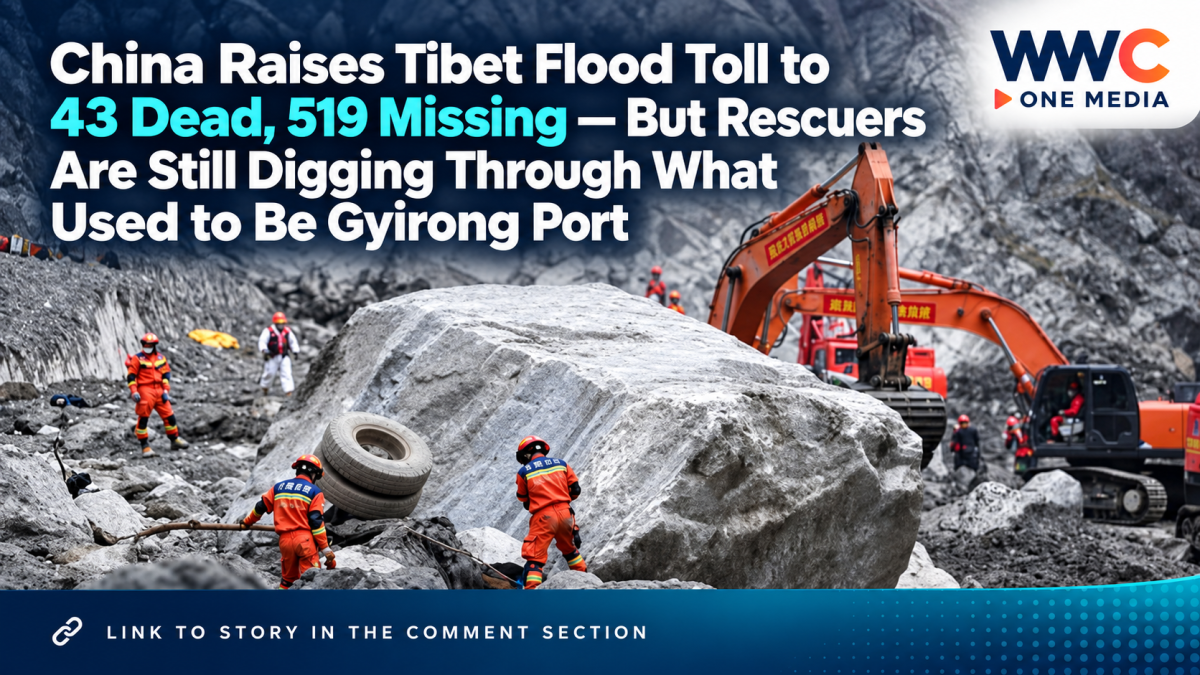
GYIRONG, Tibet — Eleven days after a massive ice-and-rock collapse high in the Himalayas sent a wall of mud, water and debris racing toward the China-Nepal border, the disaster is still giving up its dead.
China on Sunday raised the confirmed death toll on the Tibetan side from 31 to 43, while 519 people remain missing, according to the latest count announced by Chinese authorities and carried by Xinhua.
The numbers alone are grim.
But what rescuers are confronting at Gyirong Port helps explain why the gap between the confirmed dead and the missing remains so enormous.
Reuters journalists allowed into the disaster zone described a border crossing that had been virtually erased.
The five-storey Chinese customs building was gone. The huge border gate had disappeared. Only part of a water-tower installation remained recognisable from the structures that stood there before the Aug. 26 disaster.
Where an important international crossing once handled traders, vehicles and religious pilgrims, rescue teams are now digging through mud, twisted metal and boulders looking for hundreds of people.
And the search is nowhere near simple.
261 foreigners are still missing
The missing are not only Chinese residents and workers.
Authorities say 261 foreign nationals from 23 countries remain unaccounted for on the Tibetan side.
Earlier Chinese figures provided the following breakdown among the foreign missing:
104 Nepali nationals, 49 Indians, 33 Latvians, 18 Americans and 15 British citizens, with smaller numbers from Canada, Australia, South Africa, Malaysia, Germany, Russia and several European countries.
Many were reportedly traveling through the region as Hindu pilgrims heading to or returning from Mount Kailash, one of Hinduism’s holiest destinations and a sacred site in Buddhism as well.
That makes the catastrophe an international missing-person crisis stretching far beyond Tibet.
Families across several countries are still waiting to learn whether their relatives survived.
China has received more than 500 calls from foreign families
At a Sunday briefing, Chinese officials said a special 24-hour hotline established for families of missing foreign nationals had received 509 calls.
Chinese authorities say information concerning the 261 missing foreigners has also been passed through diplomatic channels to embassies representing the affected countries.
Another hotline for Chinese families had received 675 calls, while authorities said they had assisted hundreds of relatives who traveled to the disaster region seeking information.
But some foreign families say the communication has not been enough.
Reuters reported that relatives of missing pilgrims have complained of receiving little useful information from China about what is happening at the disaster site or how victims will be identified.
China rejects accusations that it has been withholding information.
Beijing says it has briefed embassies from affected countries and maintains that information about the disaster has been released in a “transparent and timely” way.
Both points should be reported together: families have raised serious transparency concerns, while Chinese authorities dispute the suggestion of an information blackout.
What actually happened on Aug. 26?
Chinese experts say the catastrophe began across the border in Nepal.
According to official findings reported by CCTV and Xinhua, a glacier on the southern slope of Langtang Lirung fractured at high altitude on Aug. 26.
The collapse triggered a huge ice-rock avalanche, which picked up more rock, earth and water as it moved downhill, transforming into an extremely destructive debris flow.
The mass then traveled through river valleys toward the border.
By the time it reached populated areas, eyewitness footage showed something closer to a tsunami of mud than an ordinary landslide.
Buildings disappeared within seconds.
Vehicles were swept away.
Roads and communications were severed.
Entire communities on both sides of the border were hit.
Authorities and scientists continue to study the full mechanics of the disaster, so headlines should avoid simplifying it to an ordinary “flood.” It involved a glacier collapse, ice-rock avalanche, debris flow and flash flooding in rapid sequence.
Gyirong Port took a direct hit
Few places illustrate the destructive force better than Gyirong.
The port had grown into one of the most important overland gateways between Tibet and Nepal after the 2015 Nepal earthquake badly damaged another major border crossing farther east.
It served both trade and tourism.
Chinese goods—including vehicles—passed through the crossing into Nepal.
Pilgrims used it on journeys toward Mount Kailash.
Now much of it has effectively vanished.
Reuters said a Chinese flag had been placed near the location where the nearly 20-meter-high border gate once stood.
The symbolism is difficult to miss:
rescuers are searching for hundreds of people in a place where even major concrete structures could not survive.
Search teams have divided the ruins into seven zones
China has deployed a massive rescue operation.
Officials said more than 2,500 rescuers had participated by Saturday evening, supported by hundreds of vehicle deployments, thousands of pieces of equipment and more than 1,000 drone sorties.
The core disaster zone has been divided into seven search areas.
Reuters was told Sunday that four had been searched and three remained.
Chinese officials say teams are repeatedly searching the same ground as debris is removed layer by layer.
By Saturday evening, authorities said two people had been rescued alive in the Chinese operation and 993 personal belongings had been recovered.
Those personal items may eventually become important in reconstructing where missing people were located and identifying victims.
Why is it taking so long?
The problem is not simply the amount of debris.
Gyirong is surrounded by difficult Himalayan terrain.
Officials describe deep valleys, high mountains, glaciers and glacial lakes, while continuing rain and unstable slopes create risks of additional landslides and falling rocks.
Reuters reporters saw workers using excavators, shovels and ground-penetrating radar.
In some places, the mud is so deep that rescue workers can sink far into it, according to state-media accounts from the search zone.
Gyirong County averages more than 4,000 meters in elevation, although the border port itself sits much lower, at roughly 1,800 meters.
Temperature changes, unstable hillsides and river conditions compound the danger.
So rescuers are operating inside the remains of one disaster while constantly assessing whether another slope could fail.
The only road to the port was destroyed
The G216 highway—the principal land connection into Gyirong Port—was badly damaged.
For days, rescuers could not simply drive heavy machinery into the center of the disaster zone.
Teams instead approached by water, trekked through mountain routes and relied on helicopters and drones.
Chinese authorities said 24 helicopter sorties were used to deliver personnel, equipment and supplies before road access was restored. Some ground teams reportedly faced a 12-hour mountain detour to reach the core area.
The road was reopened on Sept. 2, allowing excavators and other heavy machinery to move much closer to the center of the search.
That could prove critical.
Finding hundreds of victims beneath enormous deposits of mud and rock is vastly different once rescue teams have access to industrial equipment.
More than 100 specialists are watching the mountains above rescuers
China has also deployed more than 100 technical specialists to monitor the surrounding geology.
Officials say they are watching for further collapses, landslides, mudflows and changes around glacial areas and a barrier lake.
More than 150 specialized pieces of monitoring equipment have been deployed, including radar systems, cameras, drones and instruments tracking mud movement and water levels.
That detail shows how unstable the rescue environment remains.
The operation is not just a search for the missing.
It is also an effort to ensure that rescuers themselves do not become casualties.
The disaster is much worse on Nepal’s side
The scale becomes even more devastating when both sides of the border are considered.
Nepal’s Foreign Ministry said in its Sept. 5 update that 1,344 bodies had been recovered and roughly 5,000 people were still missing, including about 600 foreigners from 35 countries.
Adding China’s latest confirmed 43 deaths puts the known death toll across the two sides at at least 1,387.
The true figure could still rise substantially because thousands remain unaccounted for.
Nepal says more than 13,000 people have been rescued since the disaster.
Some of the most remarkable rescues have come more than a week after the flood.
Then survivors started emerging after nine and ten days
On Nepal’s side, rescuers pulled two Nepali workers alive from a hydropower tunnel after nine days underground.
A day later, Chinese worker Lu Haitao was found alive inside a 225-meter tunnel at the Upper Trishuli-1 Hydropower Project after surviving 10 days.
A Nepali woman was also rescued alive from her flood-damaged home.
Those cases have challenged assumptions about how long survivors might remain alive in protected underground spaces.
They are particularly important because hundreds of workers are believed to have been trapped around hydropower projects in Nepal.
But the Tibet search presents different conditions.
Much of Gyirong was buried beneath a massive open debris field, rather than protected inside intact tunnels.
That reduces the usefulness of directly comparing survival chances.
Still, the extraordinary Nepal rescues help explain why teams on both sides continue searching rather than treating every missing person as presumed dead.
Families in China and abroad are demanding answers
As the days pass, the search is increasingly becoming an identification operation as well as a rescue mission.
Reuters spoke with relatives of foreign pilgrims who said they were frustrated by what they regarded as insufficient information from the Chinese side.
One British family had already provided a relative’s DNA sample through UK police in hopes it could eventually help identify remains.
Diplomats told Reuters they wanted clearer information on China’s victim-identification procedures and greater access to imagery that might help establish who was at the border crossing before the mudslide struck.
China says it is willing to work internationally on identification and has itself sent DNA specialists to Nepal.
Sunday’s decision to allow reporters from several countries into Gyirong is also notable.
Chinese authorities said media representatives from countries including the United States, Britain, India, Pakistan, Russia, Singapore and Brazil were invited to visit the site and attend the official briefing.
Reuters described it as the first foreign-media trip to the devastated land port organized by China’s Foreign Ministry.
The missing number is finally falling — but for the worst possible reasons
China’s official numbers show an unsettling pattern.
On Aug. 30, authorities reported 16 dead and 546 missing.
By Friday, the toll was 31 dead and 531 missing.
Now it is 43 dead and 519 missing.
The combined total of dead plus missing remains almost unchanged.
That suggests much of the changing count is not necessarily because large numbers of people are suddenly being found safe.
Instead, some people previously listed as missing are being moved into the confirmed-dead category as bodies are recovered and identified.
That is one reason the decline from 531 missing to 519 should not be interpreted as 12 successful rescues.
The official reporting reviewed here does not say that.
Gyirong’s real toll may take much longer to establish
CNA previously cited specialists warning that the true casualty figure could take significant time to determine.
The debris flow was capable of burying victims beneath thick deposits of mud, while floodwaters may have carried people considerable distances downstream.
That makes simple visual searches inadequate.
Recovering the missing may require:
heavy excavation;
DNA identification;
analysis of personal possessions;
searches farther downstream;
and repeated examination of areas already cleared once.
China says its teams are doing precisely that—searching, excavating and then searching again.
The operation could therefore continue long after the dramatic television images disappear.
From border gateway to mass-casualty site
Before Aug. 26, Gyirong represented connectivity.
It linked two countries.
It carried trade.
It moved pilgrims.
It helped reconnect Nepal and Tibet after previous earthquakes and floods damaged other crossings.
Eleven days later, the same location is marked by excavators, rescue dogs, radar equipment and families waiting for names.
The confirmed death toll has risen again.
The missing count remains above 500.
More than half of the missing foreigners are Nepalis and Indians, while families across Europe, North America and elsewhere are also waiting.
And rescuers still have sections of the devastated zone to work through.
That leaves the most painful reality unchanged:
the latest rise to 43 deaths may not represent the end of the disaster’s casualty count—it may simply reflect how slowly Gyirong is revealing what lies beneath the mud.
WWC ONE MEDIA M.J.E




Leave a Reply