
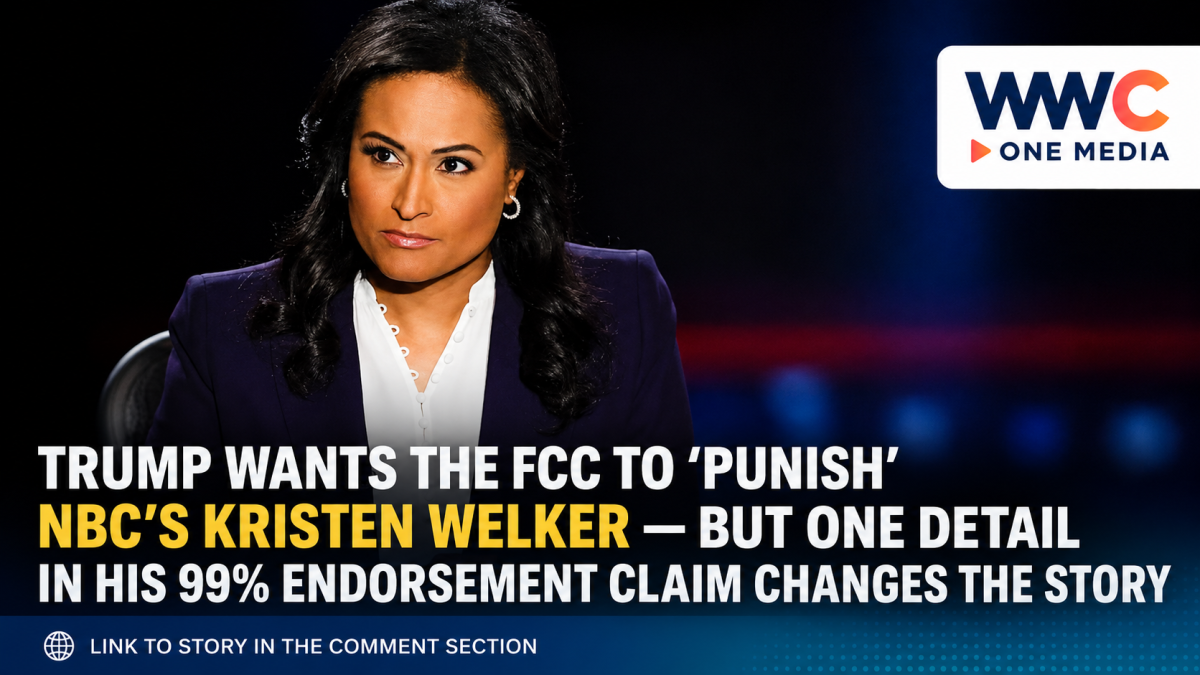
WASHINGTON — President Donald Trump has opened another front in his long-running battle with the American media, this time targeting NBC News journalist and “Meet the Press” moderator Kristen Welker over just two words: “mixed results.”
Trump said Sunday, August 30, that Welker would be reported to the Federal Communications Commission for possible “rebuke or punishment,” accusing the veteran journalist of deliberately misrepresenting his record of endorsing Republican candidates ahead of the November 2026 midterm elections.
But behind the explosive accusation lies a more complicated argument over statistics, political influence—and how far a federal regulator can legally go when a president objects to news coverage.
What Kristen Welker Actually Said
Welker made the remark during an appearance on Washington NBC affiliate WRC-TV ahead of Sunday’s “Meet the Press,” rather than during the main national broadcast itself.
Discussing Trump’s influence over the Republican Party and the coming midterm elections, Welker said the president would “loom large” over the contests and noted that his endorsements had produced “some mixed results.”
She also specifically acknowledged one of Trump’s latest successes, the Republican primary victory of South Carolina Senate candidate Darline Graham.
Trump quickly fired back on Truth Social.
He argued that describing his endorsement record as mixed was deliberately misleading and cited figures showing overwhelming success among candidates he supported in Republican congressional primaries.
The statistics attached to Trump’s post showed 239 victories among 243 endorsed House and Senate candidates, an overall congressional-primary success rate of approximately 98.35%. His figures showed 215 wins from 219 House endorsements and 24 victories from 24 Senate endorsements.
Trump characterized his endorsement record as historically unmatched and argued that major victories by candidates he backed were receiving insufficient media attention.
So Was Welker’s ‘Mixed Results’ Description Wrong?
That depends heavily on which races are included.
Trump’s chart presents an exceptionally strong record when measuring his endorsements in Republican House and Senate primaries.
But that is not the complete universe of candidates he has endorsed during the 2026 election cycle.
CNA, citing a Ballotpedia tally, reported that at least 10 Trump-backed candidates have lost this cycle, including four House candidates and six gubernatorial candidates. Among those defeats was Minnesota gubernatorial contender Mike Lindell.
Recent congressional losses also include Trump-backed Republican incumbents Andy Ogles of Tennessee and Cory Mills of Florida, according to Ballotpedia. Ogles lost his August 6 primary, while Mills was defeated in Florida’s August 18 Republican primary.
The Washington Post separately highlighted losses involving Republican gubernatorial candidates Burt Jones in Georgia and Randy Feenstra in Iowa.
In other words, Trump can accurately point to an extraordinarily high congressional-primary win rate while journalists can also accurately note that some of his endorsed candidates have lost.
The disagreement is therefore partly about which races should count when judging Trump’s overall endorsement power.
Trump Wants the FCC Involved
Trump went significantly further than simply disputing Welker’s political analysis.
He said she would be reported to the FCC for what he called a purposeful inaccuracy and urged FCC Chairman Brendan Carr to take the matter seriously.
NBC News immediately defended its journalist.
An NBC spokesperson said Welker was “one of the best in the business” and that the network stood behind her.
As of August 31, there has been no announcement that the FCC has imposed—or decided to pursue—any punishment against Welker.
And whether the agency could legally punish a journalist merely because the president disputes her characterization is a much bigger question.
The FCC’s Powers Have Clear Limits
The FCC regulates television and radio broadcast licensees, but its authority over journalism is sharply constrained by the First Amendment and federal law.
Long-standing FCC policy says the agency generally does not intervene merely because someone believes a news report was inaccurate, one-sided or unfair.
A genuine “news distortion” case requires much more than disagreement over wording. FCC precedent has generally required evidence of deliberate falsification or manipulation involving a broadcast licensee or its management, backed by evidence beyond simply disputing the accuracy of the story.
In a January 2025 enforcement decision involving a complaint about broadcast journalism, the FCC itself emphasized that the Communications Act prohibits the commission from exercising censorship powers and that the First Amendment protects editorial judgment.
Democratic FCC Commissioner Anna Gomez has also publicly argued that the commission cannot constitutionally punish broadcasters over their editorial choices. In July 2026, she criticized Trump’s calls to revoke ABC and NBC licenses after the networks declined to air one of his prime-time speeches.
Part of a Much Bigger Trump-Media Battle
The Welker confrontation is not happening in isolation.
Trump has repeatedly attacked major television networks and newspapers, accused journalists of spreading “fake news” and urged regulators to take action against broadcasters he considers unfair.
Reuters reported that his administration has already been involved in disputes over broadcast-license reviews, including cases involving ABC and Comcast-owned properties.
Disney, ABC’s corporate parent, has challenged FCC actions in court, arguing that regulatory pressure against the network amounts to political retaliation over protected speech.
Trump and Welker also have their own increasingly tense history. A June 2026 interview ended abruptly after a contentious exchange between the president and the NBC journalist.
That context makes Sunday’s clash about much more than an argument over political endorsements.
The Bigger Question
Trump remains an extraordinarily influential force in Republican primaries, and his congressional endorsement statistics provide substantial evidence of that power.
But political endorsements are not undefeated, and broader election results show that candidates carrying Trump’s backing can—and do—lose.
The larger issue now is whether an argument over how a journalist summarizes those results should ever become a matter for federal regulators.
Trump wants the FCC to treat Welker’s wording as something deserving official scrutiny.
American free-speech protections, FCC precedent and decades of broadcast law create a much higher bar.
And with the 2026 midterm campaign accelerating, the confrontation could become another major test of the increasingly volatile boundary between presidential power, federal regulation and a free press.




Leave a Reply