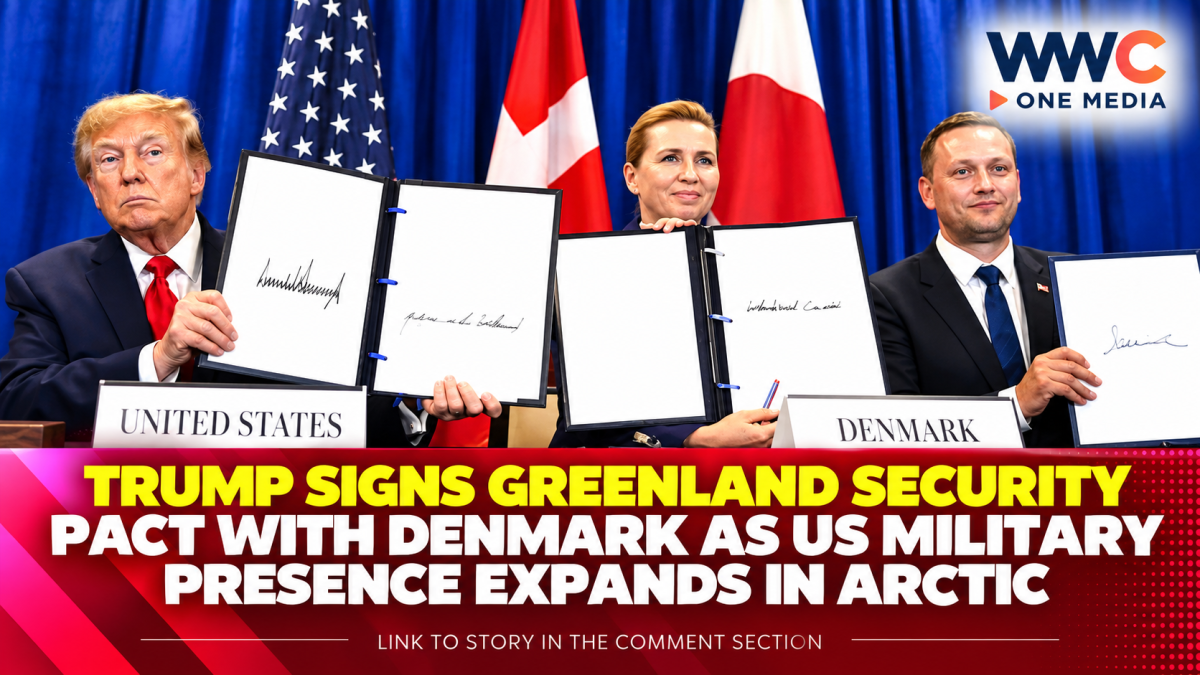
US President Donald Trump has signed a new security agreement with Denmark and Greenland that expands the US military presence on the strategically important Arctic island while reaffirming Danish sovereignty and Greenland’s right to self-determination.
The trilateral agreement was signed on September 22 on the sidelines of the United Nations General Assembly in New York, following months of tensions over Trump’s repeated calls for the United States to acquire Greenland. The pact amends and supplements the existing 1951 US-Danish defense agreement covering Greenland.
Under the agreement, the United States can modernize and expand its activities at Pituffik Space Base, its existing military installation in northwest Greenland. It also provides for new US defense areas at Narsarsuaq in southern Greenland and Mestersvig in the east, with the possibility of establishing additional defense areas in the future.
The pact grants US military aircraft broad rights to fly over and land across Greenland and provides US public vessels with undersea access and movement through Greenland’s territorial waters, subject to the terms agreed by the parties. The agreement does not specify a troop number or a timetable for establishing the additional facilities.
The agreement also places restrictions on potential military activity by countries outside NATO. Non-NATO states would not be permitted to establish military installations or maintain a persistent military presence in Greenland without agreement from the United States, Denmark and Greenland. The pact also provides for consultation over certain sensitive investments.
The deal does not transfer sovereignty over Greenland to the United States. Denmark and Greenland retain sovereignty, while Greenland continues to have the right to pursue independence. If Greenland becomes independent, however, the agreement requires the new state to remain in NATO and assume the relevant rights and obligations under the defense arrangements.
Trump had repeatedly argued that Greenland was important to US national security because of its location between North America, Europe and the Arctic and concerns about potential Russian and Chinese activity in the region. His campaign to acquire the territory strained relations with Denmark and other European allies, with Danish officials previously warning against any US takeover.
The agreement followed months of negotiations aimed at addressing US security concerns while preserving Danish and Greenlandic control. Greenland Prime Minister Jens-Frederik Nielsen described the accord as a “win-win-win,” while Danish Prime Minister Mette Frederiksen said the arrangement strengthens security cooperation while maintaining the existing political framework.
The Arctic has become increasingly important to NATO and the major powers as melting sea ice opens new shipping possibilities and competition over strategic resources and access grows. The agreement also strengthens the role of Greenland in North Atlantic defense and formally emphasizes cooperation among the United States, Denmark and Greenland.
The pact has eased a major dispute between Washington and Copenhagen, but questions remain over how quickly the expanded US military presence will be implemented and how Greenland’s population will respond to the changes. The agreement has no fixed end date and can only be amended by mutual consent under its terms.