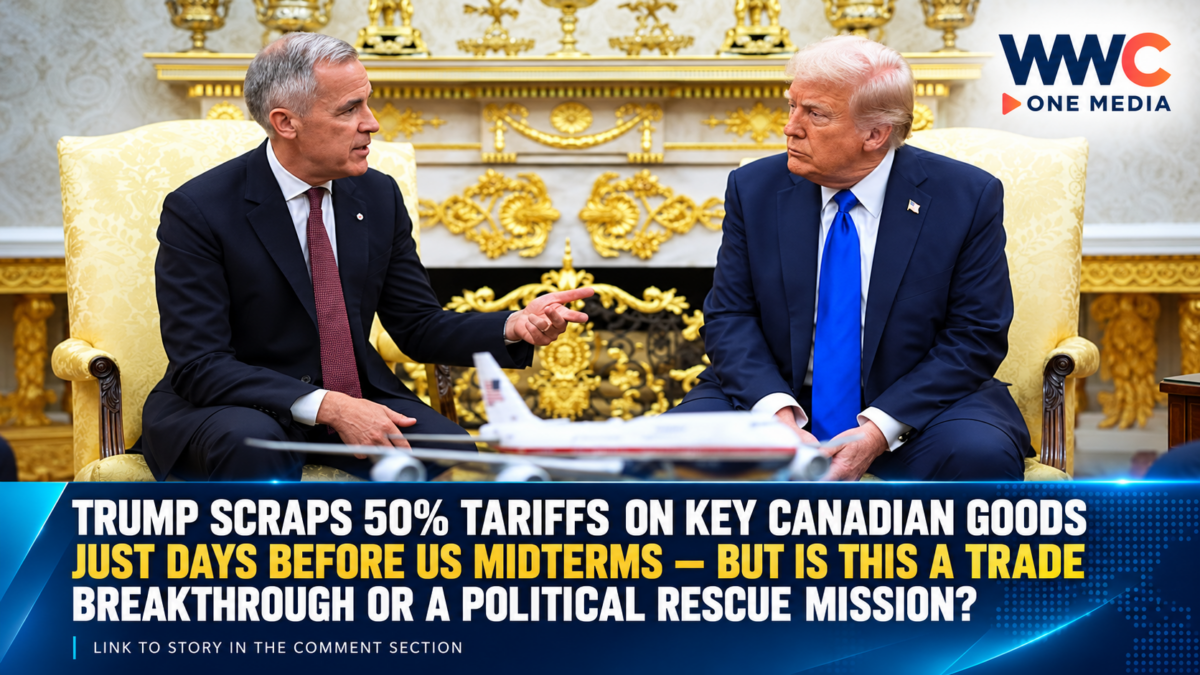
Washington, October 24, 2026 — US President Donald Trump has unexpectedly rolled back sweeping 50% tariffs on selected Canadian imports just days before the November 3 midterm elections, raising questions about whether the administration is responding to mounting economic pressure or attempting to protect vulnerable Republican candidates.
The decision, announced on Friday, October 23, offers relief to American farmers, manufacturers and businesses that depend on Canadian products. But the timing has immediately attracted political scrutiny, particularly as Republicans battle to maintain control of Congress.
Also Make a facebook ad ready image for this headline, follow the every single facebook rules no violation. Aspect ratio: 16:9 (or 1.91:1 for Facebook/Instagram news cards) Top right corner: place the exact WWC ONE MEDIA logo (dark navy blue “WW” + gradient orange-to-red “C”, with the orange play-button triangle and “ONE MEDIA” text underneath in navy). Logo should be clean and prominent but not oversized. Position it in the upper-right corner with slight transparency or clean white background if needed.
Bottom section: Create a dark blue-to-teal gradient bar that covers the lower ~18–20% of the image.
Add a subtle dotted/halftone pattern on the right side of the bar (matching the original).
On top of the banner 1/4 of the whole art-card box. no exception, large bold, any color that suite uppercase headline any appropriate font for the story text that reads: “HD Hyundai and Kiewit Unveil US Shipyard Plan With 3,000 Jobs — But Can They Revive America’s Struggling Shipbuilding Industry?” Small white text at the very bottom of the banner: “LINK TO STORY IN THE COMMENT SECTION” Overall style: sharp photo with soft vignette, professional news graphic design, high contrast, clean and polished, no clutter, same visual language as major southeast asia digital news pages, make it more authentic and accurate, check multiple times. make the style in different random gradient color themes that suits the headline. MAKE IT LANDSCAPE White House confirmed that the exemptions cover selected Canadian products, including plywood sheets, paper materials, specialized machinery, refrigeration equipment, packaging crates and boxes.
However, the apparent breakthrough comes with a significant catch: Washington is also preparing to impose tariffs on additional Canadian goods, meaning the escalating trade dispute between the neighboring countries is far from resolved.
A sudden tariff reversal with an election approaching
The tariff adjustment follows lobbying by Republican Senator Susan Collins of Maine, who is fighting a closely contested reelection campaign.
Collins has repeatedly warned that Trump’s aggressive trade measures have placed additional financial pressure on Maine businesses, agricultural producers and families.
Maine’s economy is closely connected to Canada, with businesses relying heavily on cross-border shipments of equipment, agricultural supplies, packaging materials and forestry products.
According to Collins, the exemptions will benefit important industries in her state, including blueberry, potato, apple and seaweed producers.
Many agricultural businesses depend on specialized Canadian products that are difficult to obtain domestically or significantly more expensive to replace.
The senator has presented the exemptions as a victory for Maine businesses and workers, arguing that additional tariff costs have made it increasingly difficult for local industries to operate competitively.
For Collins, the timing could prove politically significant.
She is facing Democrat Troy Jackson in one of the closely watched Senate contests as Republicans attempt to defend their congressional majority.
With the November 3 elections approaching, the administration’s decision gives Collins an opportunity to demonstrate that she can influence White House economic policy.
Not a complete victory: New tariffs are coming
Despite the positive reaction from businesses that may benefit from the exemptions, the White House has made clear that the United States is not abandoning its confrontational trade strategy toward Canada.
Under the latest changes, the administration will remove certain Canadian products from the tariff list while introducing additional duties on other categories.
Among the newly targeted products are certain valves, carpets and waste materials.
Both the exemptions and the newly imposed tariffs are scheduled to take effect on October 30, 2026, only four days before Americans head to the polls.
The administration says the changes are intended to reduce unnecessary burdens on American commerce while maintaining pressure on Canada over trade policies it considers discriminatory.
The tariff adjustments were made under Section 338 of the Tariff Act of 1930, which the administration has used in its ongoing dispute with Ottawa.
Importantly, the latest announcement does not eliminate existing American trade restrictions on Canadian automobiles, steel, aluminum and lumber.
For Canadian exporters, the relief is therefore limited rather than a comprehensive settlement.
Canada’s economy has already taken a major hit
The escalating US-Canada trade conflict has created serious challenges for one of the world’s most closely integrated trading relationships.
Approximately 70% of Canadian exports are destined for the United States, making American trade policy a critical factor in Canada’s economic performance.
Since the breakdown of trade negotiations in August, Washington and Ottawa have imposed competing trade restrictions that have disrupted cross-border commerce.
Canadian industries ranging from automobiles and forestry to manufacturing have faced higher costs, reduced competitiveness and growing uncertainty.
Canada has also experienced a technical recession in 2026, recording two consecutive quarters of economic contraction.
The economic slowdown has intensified concerns about the country’s exposure to sudden changes in US trade policy.
Although the latest tariff exemptions could provide targeted relief, economists and businesses remain concerned that continuing trade tensions will discourage investment and weaken supply chains.
The political stakes are rising for Trump’s Republicans
Beyond the economic consequences, the tariff announcement highlights a major political dilemma facing Republicans.
Trump has consistently defended tariffs as a way to protect American industries, promote domestic manufacturing and strengthen Washington’s negotiating position.
But in states with close commercial relationships with Canada, those same measures have become a political liability.
Maine, Michigan and New Hampshire are particularly sensitive to disruptions in cross-border trade.
Businesses operating in these regions often depend on Canadian suppliers, customers and transportation networks.
As tariffs increase expenses, politicians face pressure from voters concerned about rising consumer prices, manufacturing competitiveness and employment opportunities.
Republican candidates are therefore caught between supporting Trump’s broader economic agenda and addressing complaints from businesses and households affected by his policies.
In Michigan, Republican Senate candidate Mike Rogers has also called for an end to the tariff confrontation with Canada, arguing that the dispute is increasing economic pressure on businesses and consumers.
With control of Congress at stake, the administration’s tariff adjustments could become an important issue in the final days of campaigning.
Are Americans paying the price for the trade war?
A central controversy surrounding Trump’s tariff strategy concerns who ultimately bears the financial burden.
Although tariffs are imposed on imported foreign goods, American importers generally pay those duties when products enter the country.
Companies may absorb part of the additional cost, negotiate lower prices with suppliers or pass expenses on to consumers.
That means tariffs designed to pressure foreign governments can also increase operating costs for American businesses.
For farmers and manufacturers purchasing specialized Canadian products, these added costs can be particularly difficult to avoid.
The exemptions announced on October 23 recognize some of those commercial pressures.
However, critics argue that selective tariff relief does not resolve the underlying uncertainty created by broader trade restrictions.
Could the tariff rollback influence the November elections?
The political implications of the announcement extend beyond Maine.
The November 3 midterm elections will determine control of the House of Representatives and the Senate, shaping Trump’s ability to advance his legislative agenda during the remainder of his presidency.
A loss of congressional control could complicate the administration’s policy priorities and increase political scrutiny of White House decisions.
For vulnerable Republican candidates, securing economic relief before election day offers a potential campaign advantage.
But whether voters will reward the administration for easing tariffs — or criticize it for imposing them in the first place — remains uncertain.
Democrats have questioned the timing of the exemptions, arguing that the changes appear designed to benefit politically vulnerable Republicans.
The White House, meanwhile, maintains that the adjustments are intended to protect American economic interests.
There is no evidence that the tariff changes alone will determine the outcome of the Senate races.
What happens next for the United States and Canada?
Attention now turns to October 30, when the modified tariff rules are scheduled to take effect.
Businesses on both sides of the border will be watching closely to determine how much relief the exemptions provide and whether the newly targeted Canadian products face significant disruption.
Another major question is whether Washington and Ottawa can return to meaningful negotiations.
Without a broader agreement, companies may continue dealing with unpredictable trade costs, regulatory uncertainty and shifting supply chains.
The latest development demonstrates that tariff policy has become deeply intertwined with domestic American politics.
For Trump, the immediate challenge is balancing his aggressive trade agenda against growing concerns about its effects on American businesses and voters.
For Canada, the greater challenge is finding a path toward more stable economic relations with its largest trading partner.
And with the US midterm elections rapidly approaching, one question now looms over the White House’s unexpected reversal:
Is Trump preparing to soften his trade war with Canada — or is this merely a last-minute political maneuver to protect Republicans before voters deliver their verdict on November 3?