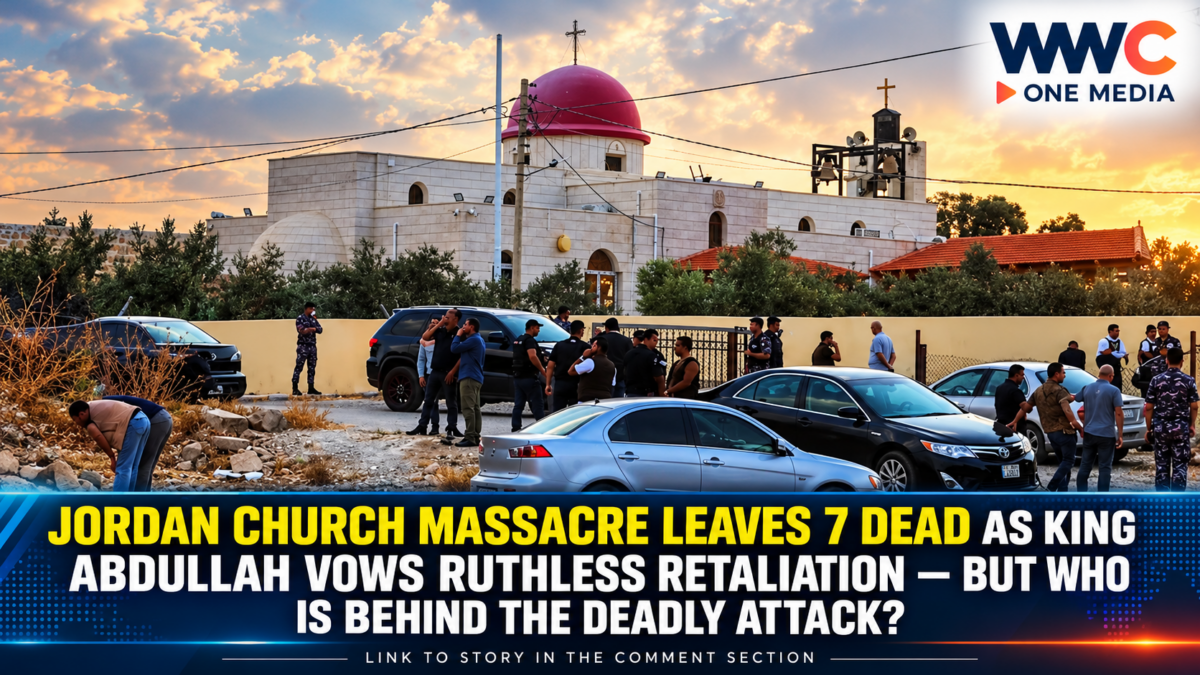
Jordan, October 24, 2026 — A funeral gathering turned into a scene of terror in southern Jordan after armed attackers opened fire at a Greek Orthodox church, killing seven people and injuring dozens in one of the country’s deadliest attacks on a Christian community in recent years.
The October 23 shooting in the village of Hammoud, in Karak governorate, has triggered national mourning, an intensive security operation and a furious response from King Abdullah II, who promised severe punishment for those responsible.
The attack has also raised serious questions about extremism, religious coexistence and security in a country that has long presented itself as a relatively stable nation in a volatile Middle East.
Funeral turns into deadly shooting
According to Jordanian authorities, the attackers arrived in a vehicle near a Greek Orthodox church, approximately 180 kilometers south of the capital, Amman.
The gunmen reportedly exited the vehicle and began firing at people gathered for a funeral procession, transforming a moment of mourning into a deadly emergency.
Footage broadcast by Jordanian state television showed three armed men approaching the church entrance. Two appeared to be carrying handguns, while another held a longer firearm.
An eyewitness told local broadcaster Al-Mamlaka that the attackers fired repeatedly for approximately five minutes before fleeing.
Authorities initially reported six fatalities, but the confirmed death toll subsequently increased to seven.
Early official figures indicated 34 injuries, while subsequent reporting by The Associated Press placed the number of injured at 40, including two people in critical condition.
Between 150 and 200 mourners were reportedly gathered at or near the church when the shooting occurred.
King Abdullah promises an iron-fist response
Jordan’s King Abdullah II reacted strongly, condemning the killings as terrorism and pledging decisive action against the attackers.
“The terrorist attack against Karak will be met with the harshest retaliation,” the monarch declared.
“We will strike with an iron fist against those who dare to threaten our nation.”
The king traveled to Karak following the shooting and visited wounded victims receiving hospital treatment.
His visit underscored the government’s determination to demonstrate solidarity with the victims and reassure communities shaken by the violence.
Prime Minister Jafar Hassan ordered three days of national mourning, with flags lowered at government buildings and public institutions.
Security forces launch hunt for attackers
Jordanian authorities described the shooting as a terrorist attack carried out by extremists.
Interior Minister Mazen Al-Faraya condemned the violence and said security agencies were working continuously to identify and capture those responsible.
Investigators are examining security footage, eyewitness testimony and evidence collected from the church compound.
Authorities had not publicly established the attackers’ identities or confirmed responsibility by a specific extremist organization in the initial reports.
That distinction is critical: although officials characterized the shooting as terrorism, the precise motive, organization and possible wider network behind the operation remained unresolved.
The investigation will seek to determine whether the attack was an isolated operation or part of a broader extremist threat.
Why Jordan’s Christian community is shaken
The shooting has sent shock waves through Jordan’s Christian minority, which accounts for approximately 2% to 3% of the country’s population.
Christians have a long-established presence in Jordan, where churches, religious institutions and Christian communities form part of the kingdom’s historical and cultural identity.
The attack on a funeral procession is particularly disturbing because it targeted a gathering traditionally associated with mourning, compassion and communal solidarity.
The Greek Orthodox Archdiocese in Jordan strongly condemned the violence and reaffirmed the community’s determination to remain rooted in the country.
Church representatives also expressed confidence that Jordanian society would reject extremist ideology and protect coexistence between religious communities.
Karak has faced deadly extremist violence before
The attack has revived memories of another deadly episode in Karak in December 2016.
During that incident, armed militants launched attacks against security forces, resulting in 10 deaths, including seven security personnel and a female tourist.
The attackers later barricaded themselves inside Karak’s historic castle, prompting a prolonged security operation.
Although the two incidents occurred in the same governorate, authorities have not established a connection between the 2016 violence and the October 2026 church shooting.
Nevertheless, the latest attack has renewed scrutiny of security threats in southern Jordan.
International leaders condemn the killings
The violence has drawn condemnation beyond Jordan.
Lebanese President Joseph Aoun denounced the shooting as a terrorist atrocity and warned that such attacks seek to undermine religious coexistence and create divisions within society.
The United Nations also condemned the attack, with Secretary-General António Guterres calling for those responsible to be brought to justice.
The international reaction reflects concerns that violence against religious communities can have consequences extending far beyond the immediate location of an attack.
Could the attack lead to tougher security measures?
The massacre now presents Jordanian authorities with several urgent challenges.
The immediate priority is locating the attackers, securing vulnerable communities and providing medical and humanitarian support to victims and their families.
But a broader question remains: how will the kingdom respond to extremist violence without allowing the attack to undermine its tradition of religious coexistence?
Additional security measures around religious institutions, intelligence-led investigations and greater coordination among national security agencies are possible responses, although the full extent of any new government measures remains to be announced.
The investigation will also need to establish how the perpetrators planned and carried out the shooting and whether warning signs were missed.
A nation mourns as the search for answers continues
For the families affected, the tragedy is measured not in political statements or security policies but in lives lost during what should have been a peaceful farewell.
Seven people are dead, dozens have been injured and an entire community is confronting the aftermath of an attack that has shaken Jordan.
King Abdullah has promised justice, security agencies are pursuing the perpetrators and religious leaders are urging national unity.
Yet one crucial question remains unanswered: Who orchestrated the deadly attack on a Christian funeral, and will Jordan’s security forces uncover the full network, if any, behind the killings before another tragedy occurs?