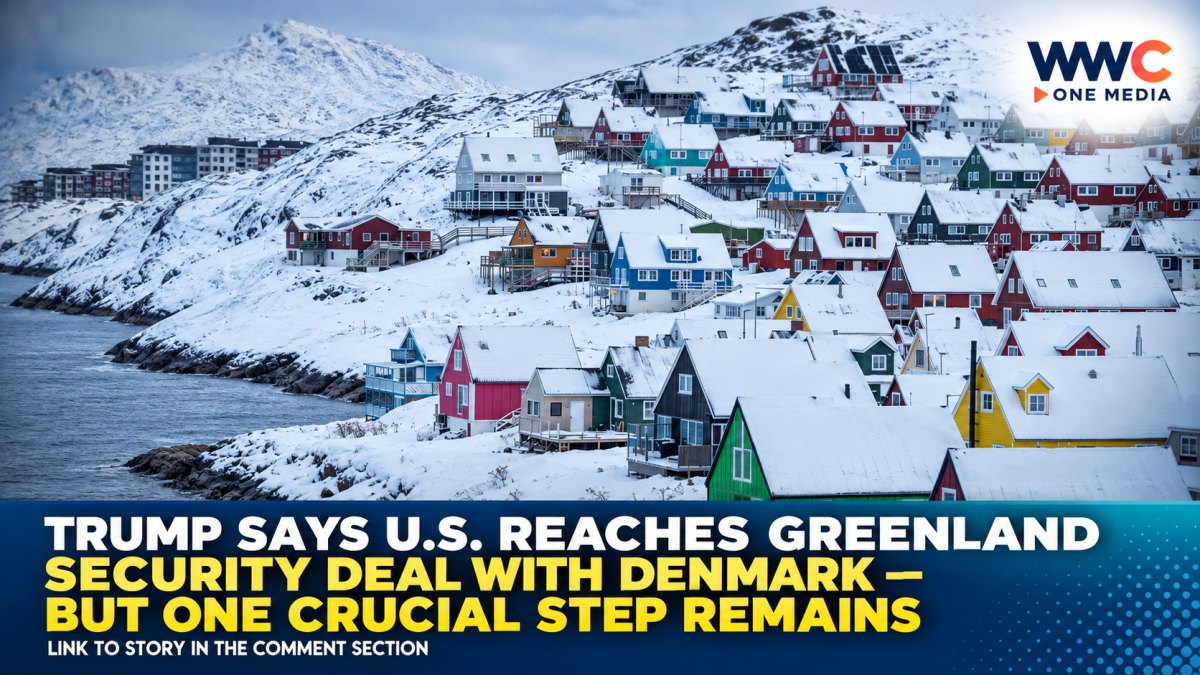
WASHINGTON — A months-long dispute over Greenland has taken a dramatic turn after the United States, Denmark and Greenland reached an agreement aimed at strengthening security in the Arctic — while stopping short of Washington’s earlier push to acquire the strategically important island.
U.S. President Donald Trump announced the agreement on September 18, saying it would give Washington what he described as permanent control over security and other U.S. security needs in Greenland.
The announcement followed an earlier Reuters report that Washington and Copenhagen were closing in on an arrangement that could significantly expand the American military presence on the island. At the time, sources said the emerging agreement would not amount to a U.S. takeover of Greenland.
The Danish government subsequently confirmed that Greenland, Denmark and the United States are expected to sign an agreement on strengthened security in the Arctic and North Atlantic region during next week’s United Nations General Assembly in New York.
However, the pact still requires the necessary parliamentary procedures before it can enter into force.
What does the Greenland deal actually do?
The precise text of the agreement has not yet been publicly released, leaving important questions about its implementation unanswered.
According to Reuters, the arrangement would allow the United States to establish a significantly larger military presence in Greenland and would prevent non-NATO adversaries from establishing military bases on the island. A U.S. official also said the agreement would provide Washington with permanent access, basing and overflight rights.
The arrangement could remain applicable even if Greenland eventually becomes independent from Denmark, according to the official cited by Reuters.
Trump said the United States would begin the process of developing a larger military presence in Greenland.
It remains unclear, however, whether the agreement will result in construction of entirely new American military bases or primarily expand existing facilities and operations. Reuters reported that the United States already has extensive military rights in Greenland under a longstanding defense agreement with Denmark.
Greenland is not being transferred to the United States
Despite Trump’s description of the agreement as giving Washington permanent control over Greenland’s security, Denmark and Greenland have emphasized that the arrangement does not amount to a transfer of sovereignty.
Danish Prime Minister Mette Frederiksen said the agreement recognizes the sovereignty and territorial integrity of the Kingdom of Denmark as well as the Greenlandic people’s right to self-determination.
Greenland’s Prime Minister Jens-Frederik Nielsen said the agreement would strengthen the security of Greenland, Denmark, the United States and the wider Western alliance.
That distinction is significant.
Greenland is a self-governing territory within the Kingdom of Denmark. Under Denmark’s Self-Government Act, Greenland has broad authority over domestic matters, while foreign, defense and security policy remain areas handled at the kingdom level. The same framework provides a pathway toward independence if Greenland’s people choose it.
Why Greenland matters to Washington
Greenland occupies a strategically important position between North America and Europe and sits astride important Arctic and North Atlantic approaches.
The island is also home to Pituffik Space Base, the U.S. military installation formerly known as Thule Air Base. The facility has played a role in missile warning, space surveillance and broader U.S. defense operations.
Washington’s interest in Greenland has intensified as the Arctic becomes increasingly important to the United States, Russia, China, Denmark and other Arctic and NATO countries.
The latest agreement also comes as the Trump administration pursues its proposed Golden Dome missile-defense system.
Reuters reported before the final announcement that U.S. and Danish negotiators had discussed ways for Greenlandic territory to support the missile-defense initiative. The negotiations also included efforts to limit Chinese presence and influence on the island.
A major shift from Trump’s earlier Greenland campaign
The agreement represents a significant change from the more confrontational phase of Trump’s Greenland policy.
Earlier in 2026, Trump repeatedly argued that Greenland was vital to U.S. national security and pushed for American control of the territory. Those demands triggered a serious diplomatic dispute with Denmark, a fellow NATO member.
Denmark had rejected the idea of transferring Greenland to the United States, while European governments emphasized Greenland’s sovereignty and the principle that its future should be determined by Greenland and Denmark.
By September, however, Copenhagen was publicly signaling a willingness to pursue a negotiated security arrangement with Washington.
On September 14, Frederiksen said she was optimistic that Denmark and the United States could find a peaceful way forward over Arctic security and Greenland.
Four days later, the Danish government announced that the three governments were preparing to sign the security agreement.
China and Russia are part of the strategic picture
The Greenland negotiations are also taking place against growing competition among major powers in the Arctic.
Reuters reported that the emerging arrangement would restrict adversaries from establishing military bases on Greenland and impose restrictions involving sensitive investments. A U.S. official said the agreement would prevent non-NATO countries from establishing military bases on the island.
That has particular significance for Washington because the Arctic is increasingly viewed as an area of strategic competition involving Russia and China.
The United States already regards the Arctic as critical to North American defense, while Russia maintains substantial military infrastructure in its Arctic territories and China has sought a greater economic and scientific presence in the region.
The agreement therefore extends beyond the immediate U.S.-Denmark dispute. It potentially establishes a new framework for how Greenland’s strategic position will be managed within the broader Western security system.
The next test comes in New York
The agreement is expected to be formally signed during the United Nations General Assembly next week.
But the announcement does not mean every detail is settled.
The Danish government has explicitly said the agreement must go through the required parliamentary procedures before taking effect.
That leaves several important questions unanswered: how large the expanded U.S. military presence will become, where additional facilities could be established, how sensitive investments will be regulated, and how the arrangement would operate if Greenland eventually becomes independent.
For now, the political dispute over whether the United States should own Greenland appears to have been replaced by negotiations over how deeply the United States can defend and operate from Greenland.
And that distinction could prove crucial.
The island remains under Danish sovereignty, Greenland retains its right to self-determination, and the United States is positioned to obtain substantially greater strategic access to one of the world’s most important Arctic territories — if the agreement clears the remaining legal and parliamentary hurdles.