
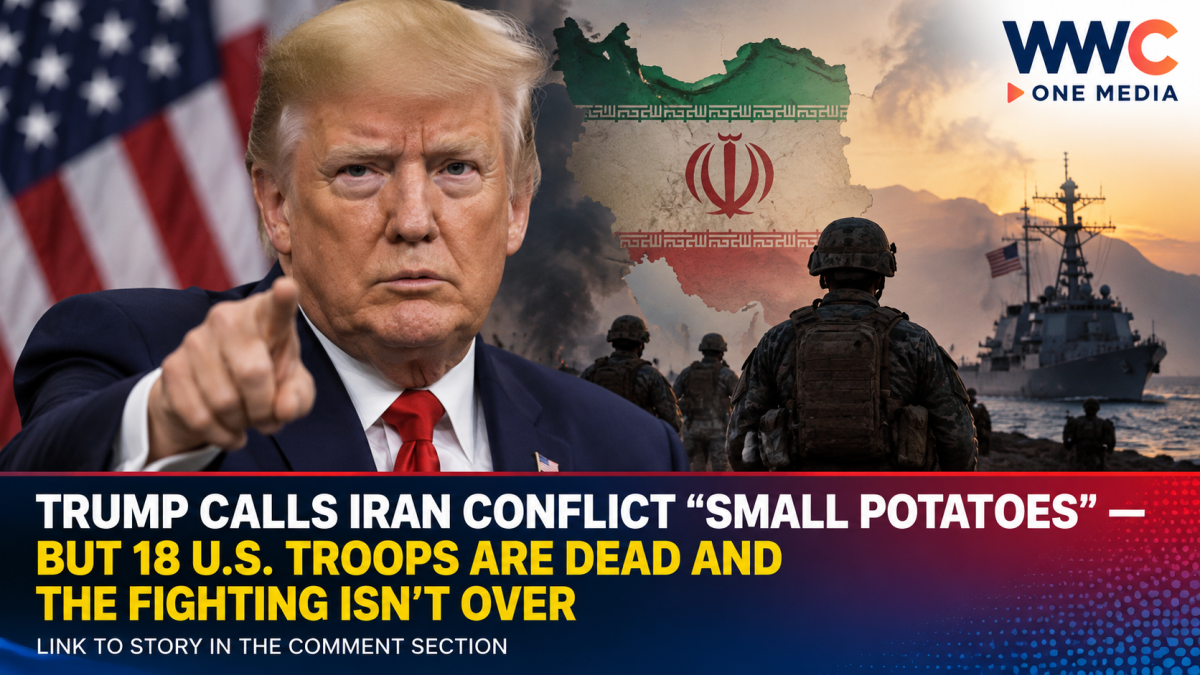
WASHINGTON — U.S. President Donald Trump is downplaying the months-long conflict with Iran, calling the confrontation “small potatoes” for the United States while backing Vice President JD Vance’s controversial position that the ongoing fighting should not be described as a war.
Trump made the remarks Friday, September 4, as reporters questioned him about Vance’s comments a day earlier. Vance had said he “wouldn’t call it a war,” arguing that there was currently no active shooting despite repeated flare-ups between U.S. and Iranian forces.
Trump said he understood Vance’s position and preferred to describe the situation as a “military conflict.” He pointed to the intermittent nature of U.S. strikes and the absence of American ground troops fighting inside Iran.
But the administration’s language comes as the confrontation enters its seventh month, with American casualties, billions of dollars in costs, attacks around the strategically vital Strait of Hormuz and renewed Iranian retaliation keeping tensions high.
18 U.S. service members killed
Trump defended his description of the conflict by comparing the current American death toll with casualties suffered during much larger and longer U.S. wars.
The conflict has left 18 U.S. service members dead, according to the latest figures cited by AP, while U.S. taxpayers have spent more than $37.5 billion on the operation. ABC News separately reported that the number of wounded U.S. troops had risen to 767 as of September 3.
Trump argued that the casualties remain far below those suffered during conflicts such as Vietnam, while acknowledging that every American death is significant.
His remarks have nevertheless drawn attention because the conflict he described as relatively minor has continued for roughly six months and has created consequences far beyond the battlefield.
Vance: ‘I wouldn’t call it a war’
Vance’s comments Thursday triggered the latest debate over how the administration is characterizing the conflict.
During a White House briefing, Vance said major combat operations had ended after roughly six weeks and that the United States was now dealing with intermittent flare-ups, particularly involving Iranian attacks on commercial shipping.
“I wouldn’t call it a war,” Vance said, while declining to predict when the confrontation would finally end.
Vance also rejected the idea of establishing a firm deadline for ending the conflict, saying the United States could not simply set a timetable while Iran continued to threaten commercial vessels.
That leaves a major unanswered question: if Washington does not consider the situation a war, what will determine when it is actually over?
Strait of Hormuz remains the critical flashpoint
Much of the latest confrontation centers on the Strait of Hormuz, one of the world’s most important energy chokepoints.
The United States says its military operations are aimed in part at protecting commercial shipping after Iran repeatedly disrupted maritime traffic.
Vance said U.S. forces escorted about 15 million barrels of oil through the strait on September 2, while Energy Secretary Chris Wright previously cited 17 million barrels moving with U.S. Navy assistance on September 1.
However, independent shipping data indicates traffic remains substantially below pre-conflict levels. Reuters reported that more than 50,000 U.S. troops remain in the broader Middle East, while the United States has deployed nearly 20 warships as part of efforts surrounding the blockade and protection of shipping.
Before the conflict, roughly 20 million barrels of Gulf oil a day moved through the waterway.
Oil prices add pressure on Washington
The conflict is also being felt in global energy markets.
Brent crude was trading around $95 a barrel in the latest reporting, substantially above the roughly $72 level recorded before the conflict began. Shipping disruptions through Hormuz have raised concerns about global oil supplies and contributed to higher fuel costs.
Reuters reported that Iran’s economic pressure has intensified as the U.S. blockade dramatically reduced its oil exports, while the renewed military confrontation has added another layer of uncertainty to already strained energy markets.
Conflict is becoming a political problem
The timing is particularly sensitive for Trump.
The U.S. midterm elections are scheduled for November 3, with Republicans fighting to maintain their narrow congressional majorities.
Reuters reported that only 25% of Americans in a recent Reuters/Ipsos poll said the war with Iran was worthwhile, highlighting the political risk for the administration.
The White House has maintained that the conflict is not being shaped by the approaching elections. Trump has also said the renewed military campaign will not continue for much longer.
But Vance’s refusal to provide an end date underscores the uncertainty surrounding that claim.
Iran conflict enters another dangerous phase
The latest developments also show why calling the confrontation “small potatoes” could prove politically and strategically contentious.
The United States and Iran have exchanged attacks following a period of relative calm. Reuters reported that the renewed escalation began with U.S. strikes earlier in the week, followed by Iranian retaliation, including attacks involving U.S. allies in the Gulf.
On September 5, Reuters also reported that Iran’s semi-official Tasnim news agency said an Iranian oil tanker near Kharg Island had been hit by four U.S. missiles. There were no reported casualties, but the report had not been independently confirmed by U.S. authorities at the time.
Kharg Island is particularly important because it has historically handled the overwhelming majority of Iran’s crude exports.
That means the conflict is no longer simply a question of terminology.
For Washington, the bigger questions are whether Iran’s nuclear capabilities have truly been neutralized, whether commercial shipping through Hormuz can return to normal, how much longer U.S. forces will remain engaged — and whether the Trump administration can prevent the conflict from becoming an even bigger economic and political liability before Americans head to the polls.
For now, Trump says it is “small potatoes.” But with U.S. casualties mounting, oil markets under pressure and Iran continuing to retaliate, the confrontation appears far from finished.
WWC ONE MEDIA J.M.S



Leave a Reply