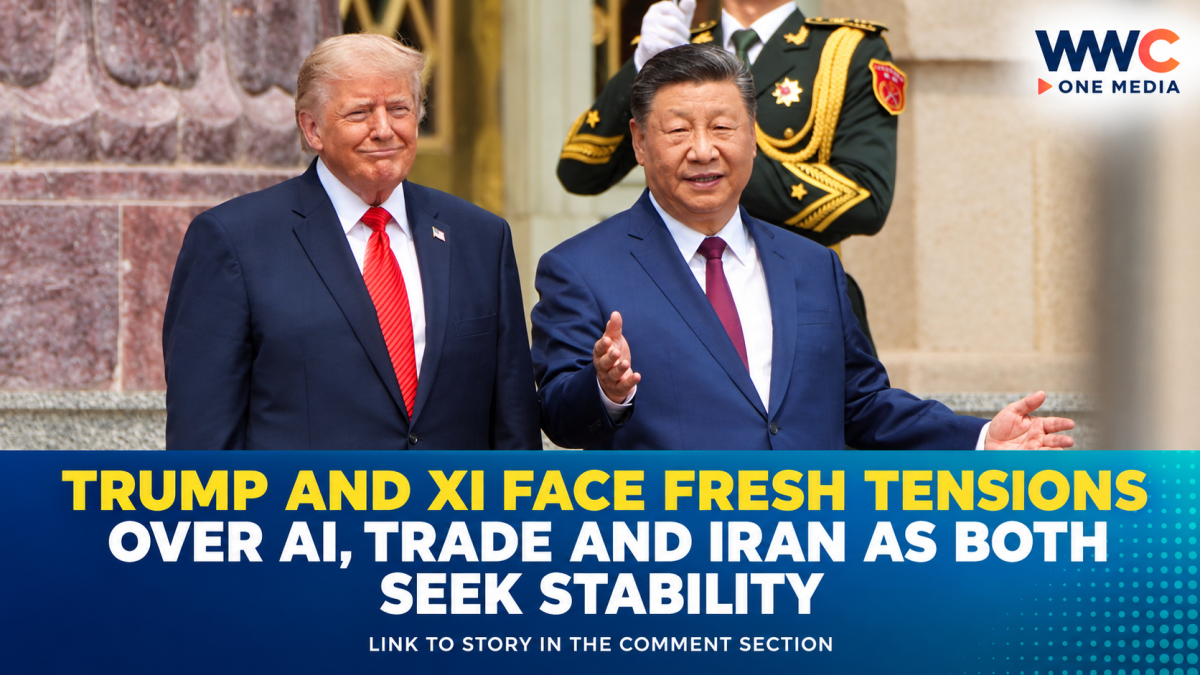
US President Donald Trump and Chinese President Xi Jinping are preparing for a closely watched meeting in Washington on Sept. 24, with artificial intelligence, trade, Taiwan and the war involving Iran placing new pressure on an already complicated relationship.
Despite the growing list of disagreements, both governments have signalled an interest in keeping relations from deteriorating further. The summit is expected to focus less on a sweeping breakthrough and more on managing areas of competition while preserving dialogue between the world’s two largest economies.
Trade remains one of the central issues. The United States and China are operating under a fragile tariff truce that is due to expire on Nov. 10. Washington is seeking progress on issues including Chinese purchases of US goods and access to critical minerals, while Beijing has pushed for further tariff relief and greater access to American technology.
China’s exports have remained strong despite the earlier tariff confrontation, adding to the economic backdrop of the summit. Reuters reported that China’s trade surplus is on track to exceed US$1 trillion for a second consecutive year, while Beijing continues to expand trade with markets beyond the United States.
Artificial intelligence has emerged as another major fault line. Washington and Beijing are competing over advanced AI models, chips and computing infrastructure, while both sides are also discussing ways to prevent AI-related incidents from escalating into national-security crises.
US Treasury Secretary Scott Bessent said recent talks with Chinese Vice-Premier He Lifeng included a proposal for an AI safety notification mechanism. The proposed system would provide a channel for the two governments to alert each other about AI incidents involving national-security risks.
The technology dispute extends beyond AI itself. The United States has imposed restrictions on China’s access to some advanced technologies, while Beijing has sought relief from technology controls and has strengthened its domestic semiconductor and AI industries.
Critical minerals and rare-earth materials are also part of the negotiations because they are essential to industries ranging from electronics to advanced military systems. US officials have pressed China over the availability of rare-earth magnets, while Beijing has used its control over parts of the supply chain as an important economic lever.
Iran adds another layer of complexity. The conflict in the Middle East has created energy and geopolitical pressures for Washington, while China maintains economic ties with Iran. US officials have raised concerns over China’s purchases of Iranian oil and alleged sanctions-evasion activities, making the issue another potential source of disagreement between Trump and Xi.
Taiwan remains one of the most sensitive subjects. Beijing regards Taiwan as part of China and opposes US arms sales to the island, while Washington maintains its longstanding policy framework toward Taiwan and is bound by US law to provide Taiwan with the means to defend itself.
Ahead of the summit, Reuters reported that Xi is expected to raise the issue of US arms sales to Taiwan and may invoke the 1982 US-China joint communiqué, which included language about gradually reducing US arms sales. A separate US$14 billion potential arms package for Taiwan remains under consideration.
The two leaders are therefore entering their Sept. 24 meeting with several overlapping disputes rather than a single issue to resolve. Trade and critical minerals are tied to economic security, AI is becoming a strategic technology contest, and Taiwan and Iran connect the relationship to wider geopolitical tensions.
The immediate objective described by officials and analysts is to manage those differences without allowing them to trigger another major deterioration in US-China relations. Whether the summit produces concrete agreements or simply maintains the current period of relative stability will depend on the negotiations in Washington.