
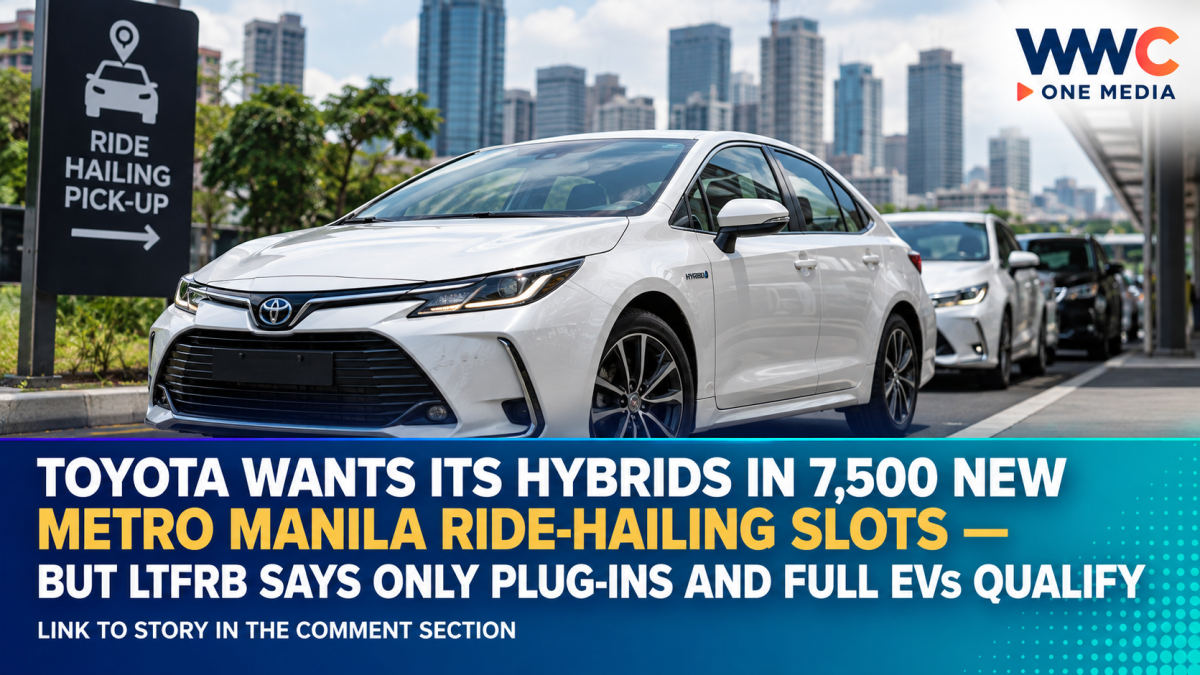
MANILA — Toyota Motor Philippines is challenging one of the government’s biggest new ride-hailing electrification measures after the country’s largest automaker found itself effectively shut out of 7,500 new Transport Network Vehicle Service slots in Metro Manila with the hybrid technology it sells most heavily.
Under LTFRB Memorandum Circular 2026-084, all 7,500 new TNVS slots for Metro Manila and the wider MUCEP area are reserved exclusively for battery electric vehicles, or BEVs, and plug-in hybrid electric vehicles, or PHEVs.
Conventional gasoline and diesel vehicles are excluded.
So are ordinary hybrid electric vehicles, or HEVs, including the self-charging hybrids that form the backbone of Toyota’s Philippine electrified lineup.
Toyota’s objection is straightforward:
Why is a technology legally classified as an electric vehicle under Philippine law being treated as ineligible for an allocation specifically designed to promote electric mobility?
The automaker has formally raised that question with the Land Transportation Franchising and Regulatory Board and is asking regulators to reconsider the rule.
But the issue is bigger than Toyota.
It cuts directly into an emerging debate over how quickly the Philippines should electrify public transport — and whether the transition should favour only technologies capable of plugging into the grid.
Toyota says the LTFRB circular does not explain why HEVs were excluded
Toyota Motor Philippines senior vice president Sherwin Chua-Lim said the memorandum does not provide a detailed explanation for limiting eligibility to BEVs and PHEVs.
Toyota has already formally communicated its concerns to the LTFRB and discussed the matter with agency officials.
According to Chua-Lim, the regulator indicated that it was prepared to consider the company’s concerns.
But as of September 17, the rule has not been changed.
That means anyone seeking one of the 7,500 new Metro Manila TNVS slots must still use a vehicle officially classified by the Land Transportation Office as either a BEV or PHEV.
Toyota’s non-plug-in hybrids remain outside.
The legal definition is where Toyota’s argument gets interesting
Republic Act 11697, better known as the Electric Vehicle Industry Development Act or EVIDA, defines an electric vehicle as a vehicle with at least one electric drive for propulsion.
The law explicitly says that definition includes:
battery electric vehicles;
hybrid-electric vehicles;
light electric vehicles;
and plug-in hybrid-electric vehicles.
EVIDA separately defines an HEV as a vehicle using both a rechargeable energy-storage system and a fueled power source.
A PHEV is an HEV whose battery can additionally be charged using an external electricity source.
That makes Toyota’s central factual point correct:
Under EVIDA, a non-plug-in HEV is legally an electric vehicle.
But that does not automatically settle the dispute.
EVIDA calling HEVs “EVs” does not necessarily mean every EV programme must include them
This is the most important legal-policy distinction in the story.
EVIDA provides a broad statutory definition of an electric vehicle.
LTFRB’s new TNVS circular creates a specific eligibility rule for a specific batch of franchises and expressly narrows eligibility to BEVs and PHEVs.
The circular states that ordinary HEVs and conventional combustion vehicles are not eligible for the new Metro Manila allocation.
Toyota argues that this is inconsistent with the government’s broader electrification policy.
But there has been no court ruling or published regulatory determination establishing that LTFRB’s narrower eligibility requirement violates EVIDA.
So the accurate description is:
Toyota is challenging the policy distinction — not announcing that LTFRB has been legally found to have breached EVIDA.
The government itself also gives HEVs other EV benefits
Toyota’s argument is strengthened by the way other agencies already implement EVIDA.
The Department of Energy has said its Electric Vehicle Recognition Guidelines classify BEVs, HEVs, PHEVs and light electric vehicles as recognised EV categories.
That recognition is used for incentives including exemption from Metro Manila’s number-coding scheme.
EVIDA itself also provides different registration-related discounts for various EV types.
BEVs receive a 30% discount on specified vehicle charges and fees, while HEVs receive a 15% discount for the period provided by law.
So an ordinary Toyota hybrid can qualify as an EV for one government incentive while failing the technology test for these particular new TNVS franchises.
That is the inconsistency Toyota wants regulators to explain.
The newest national EV incentive programme includes hybrids too
Only weeks before the LTFRB controversy, President Ferdinand Marcos Jr. signed Executive Order No. 121 on July 29, formally establishing the Electric Vehicle Incentive Strategy programme.
The EVIS programme can provide up to ₱60 billion in fiscal support aimed at expanding domestic production of electrified vehicles and components.
Importantly, the manufacturing programme covers both hybrid and battery-electric passenger and commercial vehicles.
Government information on the programme says qualified investments in HEV manufacturing may receive fixed-investment support, although the rates and conditions differ from those offered for BEVs.
That creates an unusual situation.
The national industrial policy is willing to subsidise the production of hybrids.
EVIDA legally recognises hybrids as EVs.
DOE recognises them for EV benefits.
But LTFRB has decided that this particular batch of Metro Manila ride-hailing franchises should go only to BEVs and plug-in hybrids.
LTFRB says it wants the new slots to push cleaner public transport faster
The regulator has its own rationale.
Acting LTFRB Chairman Greg Pua Jr. said the 7,500-slot allocation supports the government’s push toward a more modern and environmentally friendly transport system.
The administration has set a broader goal of having half of vehicles on Philippine roads electrified by 2040, which officials cited when announcing the new slots.
A BEV operates entirely on battery electricity and produces no tailpipe emissions while being driven.
A PHEV can operate on external electrical energy for at least part of its use, although it also has a combustion engine.
A conventional HEV still depends on gasoline for its primary energy source. Its battery is replenished through regenerative braking and the vehicle’s own system rather than being charged from the grid.
That technical difference helps explain why a regulator seeking a stronger push toward grid-powered mobility might favour BEVs and PHEVs.
However, LTFRB’s circular itself does not set out a detailed emissions comparison explaining why those two categories were selected and ordinary HEVs were excluded.
That missing explanation is exactly what Toyota is questioning.
Toyota is not asking only for hybrids
There is another important twist.
Toyota’s appeal goes further than asking LTFRB to admit HEVs.
The company also wants the regulator to consider some modern conventional internal-combustion vehicles, particularly smaller-displacement cars that it argues have become substantially more fuel-efficient and lower-emitting.
Toyota said allowing more efficient technology choices could benefit operators and passengers.
That reveals the broader philosophy behind its appeal.
The company favours what it calls a multi-pathway approach to reducing transport emissions rather than relying solely on one propulsion technology.
Under that strategy, Toyota sells ordinary hybrids, plug-ins where available, battery EVs and efficient combustion vehicles based on local infrastructure and customer needs.
The LTFRB circular takes a much narrower approach:
For these 7,500 slots, only BEVs and PHEVs count.
Why Toyota has so much at stake
Toyota dominates the Philippine automotive market.
Through July 2026, Toyota Motor Philippines sold 118,706 vehicles, giving it about 49.1% of sales reported by CAMPI and the Truck Manufacturers Association.
Its position inside the hybrid market is even stronger.
During the first half of 2026, Philippine automakers belonging to CAMPI and TMA sold 17,148 conventional HEVs.
Toyota accounted for 11,129 of them — roughly two-thirds of the reported HEV segment.
So when a government programme excludes ordinary hybrids, Toyota has far more to lose than most established manufacturers.
It is the dominant HEV supplier in the market.
Hybrids are currently the biggest electrified-vehicle category in the Philippines
That is another reason the policy has attracted attention.
Philippine sales of electrified vehicles have been rising extremely quickly despite weakness in the wider automotive market.
CAMPI-TMA members sold 31,381 electrified vehicles in the first half of 2026, up nearly 133% from a year earlier.
The breakdown was:
17,148 HEVs;
8,702 BEVs;
and 5,531 PHEVs.
Conventional hybrids were therefore still the single largest electrified category during the period.
By July, HEV sales had climbed to 20,716 units, while PHEVs reached 7,094 and BEVs 10,476 among CAMPI-TMA members.
So the LTFRB rule does not merely exclude a fringe propulsion technology.
It excludes what is currently the country’s largest xEV segment by unit sales.
Plug-in hybrids, however, are growing much faster
The other side of the market is changing rapidly.
PHEVs remain smaller in absolute volume but have posted exceptionally rapid growth from a low base.
CAMPI-TMA reported 7,094 PHEVs sold from January through July 2026, compared with only a few hundred during the comparable period a year earlier.
BEVs are also expanding.
That means LTFRB may be trying to use a valuable regulatory asset — a ride-hailing franchise — as an incentive to push the market further toward technologies capable of substantial electric-only operation.
That is a policy choice.
Toyota’s argument is that the transition should allow a wider mix of technologies.
Why TNVS matters more than an ordinary private-car purchase
Ride-hailing vehicles can travel much farther each day than a typical privately owned car.
A TNVS driver may spend hours continuously moving through dense urban traffic.
That means any reduction in fuel consumption or tailpipe emissions can accumulate over significantly greater mileage.
It also means operating cost matters enormously.
Fuel and electricity prices, purchase price, financing, maintenance, charging availability and vehicle downtime all directly affect driver earnings.
This is why technology eligibility matters to operators rather than merely automakers.
A BEV may offer lower energy costs under suitable charging conditions.
But charging time and access become operational considerations.
A self-charging HEV can refuel quickly at existing gasoline stations, but it still burns fossil fuel.
A PHEV sits between the two, although its environmental performance depends heavily on whether the operator actually charges and uses its electric range rather than relying predominantly on the gasoline engine.
Those trade-offs are central to the policy debate, but the LTFRB circular uses a technology-based eligibility rule rather than an individual vehicle’s measured real-world emissions or operating efficiency.
Charging infrastructure has grown — especially in Metro Manila
One argument for concentrating the BEV/PHEV programme in Metro Manila is infrastructure.
The Department of Energy reported 1,876 available EV charging points nationwide as of the end of August 2026, supported by 422 accredited charging-station providers.
More than 250 DOE-registered charging stations were reported in Metro Manila alone by mid-September.
Earlier DOE data from March recorded 1,569 charging points nationwide, showing continuing infrastructure expansion during the year.
The network remains far from gasoline-station ubiquity, but Metro Manila is the part of the country where charging infrastructure is most concentrated.
That may make the capital region a more practical place to test a large BEV- and PHEV-focused TNVS programme.
The rule outside Metro Manila is much less strict
Another detail strengthens Toyota’s request for clarification.
The new TNVS policy does not apply the same drivetrain requirement everywhere.
LTFRB opened 8,750 slots nationally across the three covered areas.
Of those:
7,500 are in Metro Manila and are exclusively for BEVs and PHEVs;
650 are in the Ilocos Region, with only half reserved for electrified/non-ICE vehicles;
and 600 are in Bicol, also with half allocated for EVs.
Conventional vehicles can therefore still compete for part of the new allocation outside Metro Manila.
Toyota is effectively asking why Metro Manila requires an all-BEV/PHEV fleet while the other regions allow a mixed transition.
LTFRB says it needs thousands of additional cars because demand is rising
The electrification debate sits on top of a more immediate transport problem:
Metro Manila needs more ride-hailing capacity.
LTFRB says its monitoring shows existing TNVS allocations are insufficient to cover the region’s geographic spread and increasing passenger volumes, with commercial expansion and tourism contributing to demand.
A recent survey commissioned by ride-hailing company inDrive found 74% of surveyed Metro Manila residents had used a ride-hailing app during the previous three months, with users averaging roughly three bookings a week.
Because that survey comes from an industry operator, it should not be treated as an official government measure of total demand.
But it supports the broader picture described by LTFRB:
ride-hailing has become an important layer of Metro Manila transportation.
There is also a historical twist: LTFRB has accepted ordinary hybrids before
LTFRB rules have not always drawn such a sharp distinction between hybrids.
A 2019 agency memorandum setting vehicle standards for some public-transport categories explicitly allowed hybrid vehicles as alternative vehicles alongside electric models under specified requirements.
That does not control the new 2026 TNVS allocation.
Regulators are free to revise eligibility standards through later issuances within their legal authority.
But it illustrates that hybrids themselves are not historically foreign to the agency’s public-transport framework.
The current exclusion is a deliberate feature of MC 2026-084, not a longstanding universal rule that all non-plug-in hybrids are unacceptable as public-service vehicles.
Toyota now sells more electrified choices than it did even a few years ago
Toyota’s local electrified lineup has expanded quickly.
It includes hybrid versions of models such as the Corolla Cross, Yaris Cross, Zenix, RAV4, Land Cruiser and its more affordable ATIV HEV, while the company has also introduced battery-electric products such as the Urban Cruiser BEV and bZ4X.
Toyota therefore is not arguing that BEVs should be excluded.
Its stated position is that regulators should allow more technology choices, particularly ordinary HEVs and potentially modern efficient ICE models.
That nuance matters.
This is not a Toyota-versus-electric-cars dispute.
It is a dispute over how narrowly “electric transport” should be defined for one specific government franchise programme.
The policy could also reshape what ride-hailing operators buy
A 7,500-slot allocation is large enough to influence vehicle-purchasing decisions.
An operator who wants one of those new Metro Manila franchises cannot simply buy whichever vehicle offers the lowest upfront cost.
The propulsion system now determines whether the application is eligible.
That creates a regulatory advantage for automakers selling BEVs and PHEVs.
Companies heavily invested in conventional hybrids face the opposite.
Toyota is the clearest example because it dominates Philippine HEV sales, while brands such as Jetour, Geely and Chery have been prominent in the rapidly growing PHEV category.
The new slots could therefore alter competitive dynamics inside the local car market as well as the ride-hailing industry.
There is an unresolved affordability question
Going electric is not determined by technology alone.
TNVS operators have to finance the vehicle.
They need somewhere practical to charge it.
They have to consider battery warranties, maintenance, resale values and downtime.
And the numbers must still produce a workable daily income.
That helps explain Toyota’s argument for retaining technology choice.
A conventional HEV requires no external charging infrastructure and can reduce fuel consumption relative to a comparable combustion-only vehicle, although the degree of savings varies by model, driving conditions and driver behaviour.
BEVs eliminate fuel-station dependence but require charging.
PHEVs offer both systems, but generally carry more complex dual-powertrain hardware.
Which option is economically best for a TNVS driver will differ by vehicle, financing package, driving distance and access to charging.
LTFRB has chosen to use the new slots to favour one end of that transition.
Toyota wants the field widened.
Toyota is also fighting this battle from a position of extraordinary market strength
Toyota sold a record 229,447 vehicles in the Philippines in 2025, capturing 46.7% of the market and generating a record ₱19 billion in net income, according to company figures reported by Manila Standard.
Electrified vehicles already represented 8.5% of Toyota’s Philippine sales in 2025, up from just 0.33% in 2020.
The hybrid share has grown even further in 2026.
That makes Toyota both a stakeholder in government electrification and one of the companies most exposed to decisions about which technologies qualify.
Its commercial interest is obvious.
That does not invalidate its legal-policy argument.
But it should be part of the context.
And LTFRB also has a policy objective beyond Toyota’s sales
The regulator’s stated priority is public transport.
It says the additional slots are intended to address ride-hailing shortages while helping advance cleaner transport.
That means the central policy question is not simply whether HEVs are legally classified as electric vehicles.
It is whether allowing them into this specific programme would advance the environmental and transport goals LTFRB has set for the new allocation.
Toyota says yes.
LTFRB has so far chosen a stricter standard.
As of September 17, that is still the rule.
The outcome could set a precedent far beyond 7,500 cars
This may be why Toyota is pressing the matter now.
The Philippine government is rapidly building out its EV policy.
EVIDA is in force.
EVIS now provides up to ₱60 billion in manufacturing support.
Charging points are expanding.
Electrified vehicle sales have more than doubled.
And regulators are beginning to use permits and franchises themselves as tools for shaping what technologies enter public transportation.
If the government begins defining “green” TNVS programmes primarily around BEVs and PHEVs, future franchise allocations could gradually shift the ride-hailing fleet away from conventional hybrids.
If Toyota persuades LTFRB to include HEVs, the transition becomes much broader — but also less exclusively electric in terms of energy source.
That is why this is more than a dispute over one memorandum.
Toyota’s strongest argument is written into Philippine law — but LTFRB still controls the slots
EVIDA could hardly be clearer on one point:
A hybrid-electric vehicle falls inside its definition of an electric vehicle.
Toyota can therefore accurately say HEVs are part of the country’s official electrification framework.
Yet MC 2026-084 is equally clear:
For these 7,500 Metro Manila TNVS slots, an HEV that cannot plug in does not qualify.
Both statements can be true at the same time unless a legal or administrative review says otherwise.
And that is now the question Toyota has put in front of the regulator:
If Philippine law recognises hybrids as electric vehicles, should a government programme designed to accelerate electric mobility be allowed to leave the country’s biggest EV category outside the queue?
For now, LTFRB’s answer remains yes.
Toyota is trying to change it.



Leave a Reply