
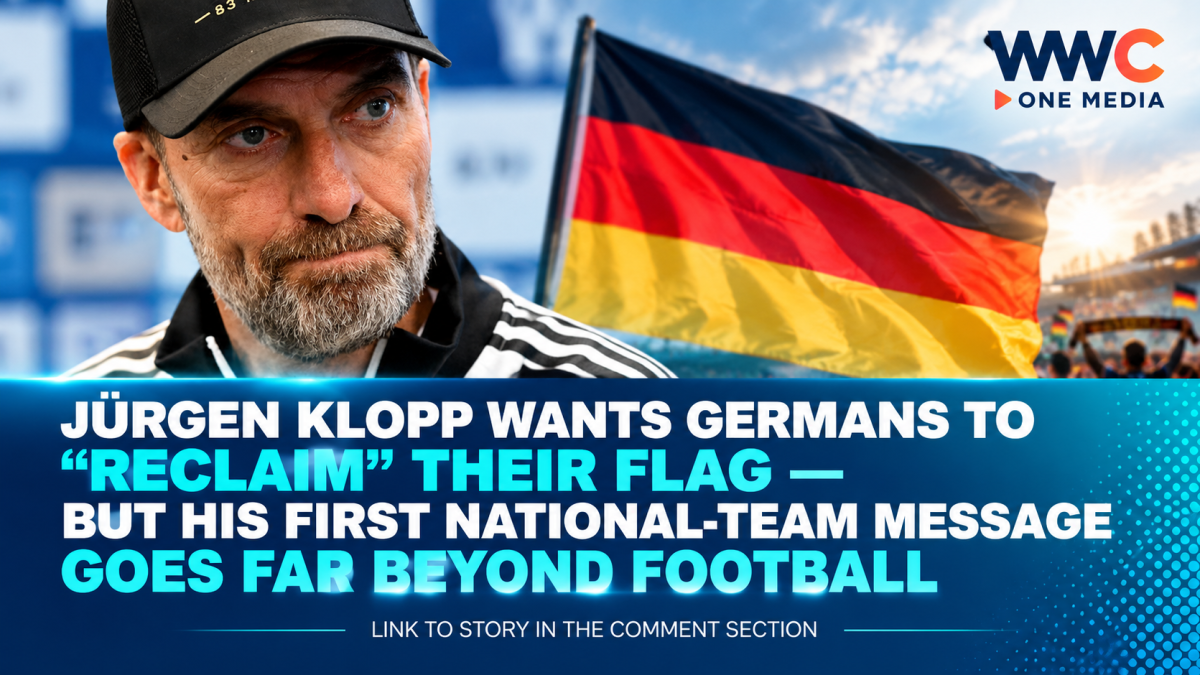
FRANKFURT — Jürgen Klopp was supposed to be talking about goalkeepers, formations and the 44 players who will launch his tenure as Germany’s new national-team coach.
Instead, one of Germany’s most famous football figures opened a much wider debate about identity, patriotism and who gets to define what waving the German flag means.
At his first squad announcement on Thursday, September 17, Klopp said he did not want expressions of national pride to be left to what he called the “wrong people.”
He said he wanted Germans to feel comfortable displaying their national colours without others automatically assuming something was wrong with them. Klopp said his preferred expression was “positive patriotism” — pride in Germany combined, in his description, with openness, diversity, friendliness and compassion.
That choice of words is particularly significant in Germany, where overt nationalism and displays of national pride carry unusual historical sensitivities because of the Nazi era and World War II.
But Klopp’s message was also unmistakably contemporary.
Just 11 days earlier, voters in the eastern state of Saxony-Anhalt had delivered a historic election result.
Klopp never actually named the AfD
That distinction matters.
Reuters described Klopp’s comments as widely interpreted as a response to Germany’s political moment following the strong result of the Alternative for Germany, or AfD, but Klopp himself did not mention the party by name.
He referred instead to a recent election that some people had welcomed while others had reacted to with alarm.
The AfD won nearly 44% of the vote in Saxony-Anhalt on September 6 and secured 39 of the state parliament’s 83 seats, according to Reuters and the state’s official preliminary results. It fell short of an outright majority and has been seeking enough support to form a government.
Reuters describes the AfD as a far-right party. The AfD disputes hostile characterisations of the party and states in its own statutes that it supports Germany’s free democratic constitutional order.
Klopp did not tell Germans how to vote.
His argument was instead that national symbols should not become the exclusive property of any political movement.
“Can you be proud to be German and still be open?”
That was effectively the central question in Klopp’s remarks.
The DFB’s own account of the press conference records him saying he wanted Germans to be able to display the flag while also being open, diverse, friendly and compassionate.
He also said Germany is, in his view, a “wonderful country” and argued that people should appreciate being born there, growing up there or moving there.
That last point is important.
Klopp’s idea of patriotism was explicitly framed to include both native-born Germans and people who had immigrated to the country.
In other words, he was not proposing ethnic nationalism.
He was describing a civic form of national belonging.
Why a German football coach talking about the flag is not a trivial matter
Germany’s relationship with patriotism is unusually complicated.
After World War II, conspicuous displays of national sentiment were treated far more cautiously than in many other countries.
The modern black-red-gold flag has democratic roots stretching back to the 19th century and was used by the Weimar Republic before being discarded under the Nazis. It was later restored after World War II.
But for decades, mass flag-waving remained relatively unusual.
Football helped change that.
The 2006 World Cup was a turning point
When Germany hosted the 2006 FIFA World Cup, black-red-gold suddenly appeared everywhere.
German flags hung from balconies.
They flew from cars.
Supporters painted the colours on their faces.
Stadiums filled with them.
Historians and commentators described the tournament as an important turning point in Germany’s postwar relationship with its national symbols.
The tournament became known in Germany as the Sommermärchen, or “summer fairy tale”.
It presented an image of patriotism that many Germans viewed as celebratory, democratic and outward-looking rather than aggressive.
DW has described the 2006 tournament as the emergence of a more optimistic form of German patriotism, while also noting that the meaning of national symbols has remained politically contested.
Klopp’s comments clearly echo that history.
And football may be the one place where Klopp thinks Germany can recreate it
When Klopp was appointed national-team coach in July, he made a striking statement.
“Few things can bring us Germans together like the national team,” he said in the DFB announcement confirming his appointment.
That now looks less like ceremonial language and more like part of his actual plan.
Klopp is not merely trying to rebuild a football team after Germany’s disappointing World Cup.
He appears to want the national side to recover some of its cultural role as a shared institution capable of bringing together people who otherwise disagree profoundly.
That is a much larger assignment than choosing a starting XI.
Because Germany’s football team itself needs rebuilding
The timing of Klopp’s appointment was not accidental.
Julian Nagelsmann stepped down on July 3 after Germany was eliminated by Paraguay at the 2026 World Cup.
Klopp was appointed on July 24 and formally took over on August 15 under a four-year contract running through Euro 2028 and the 2030 World Cup.
The DFB described Klopp as its clear first choice.
For Klopp, the attraction appeared to go beyond trophies.
At his unveiling, he said successful football could help change the national mood and argued that the national team had an unusual capacity to connect people.
Thursday’s patriotism remarks therefore fit into a theme that has been present since his first day.
His first squad is enormous: 44 players
That cultural message almost overshadowed an unusual football decision.
Klopp selected 44 players across two separate squads for Germany’s first four Nations League matches under his management.
The first group contains 24 players and will face:
Netherlands in Amsterdam — September 24
Greece in Augsburg — September 27
A second group of 20 players then joins for:
Serbia in Munich — October 1
Greece in Thessaloniki — October 4.
Klopp stressed that these should not be interpreted as A and B teams.
He said the split is designed partly around an unusually congested international schedule and his desire to assess as many players as possible.
Six players received first senior call-ups in the opening group
Klopp immediately showed that reputation alone will not determine his selections.
The first squad includes senior-team newcomers such as Hennes Behrens, Max Rosenfelder, Philipp Treu, Yannik Engelhardt, Bambasé Conté and Younes Ebnoutalib.
The second group contains more first-time selections, including Finn Jeltsch, Felix Keidel, Vitaly Janelt, Mika Baur and Derry Scherhant.
Klopp said some names might surprise supporters but that he and his staff had identified qualities they want to develop over the next two or three years.
That makes the 44-player experiment part rebuilding project and part audition.
Ter Stegen is Klopp’s first No. 1
Klopp also settled one immediate question.
He said Marc-André ter Stegen will start the opening Nations League match against the Netherlands.
Klopp described the goalkeeper as an important source of stability and experience around which younger players can be introduced.
Ter Stegen is now with Ajax and is returning to Germany’s squad after injury problems.
Klopp argued that experience through the centre of the team will allow him to take greater risks elsewhere.
Joshua Kimmich returns to midfield
Another clear tactical decision concerns Joshua Kimmich.
Klopp said he sees the Bayern Munich veteran primarily as a midfielder and expects him to provide leadership and stability.
That may sound like a minor positional decision, but Kimmich has repeatedly switched between right-back and central midfield during his Germany career.
Klopp appears to want the uncertainty removed.
His stated priority is defensive stability first, then using that platform to unlock Germany’s attacking talent.
Klopp says Germany must learn to enjoy pressure again
Perhaps the most recognisably Klopp-like football line from Thursday involved pressure.
His first lesson for the squad, he said, is learning to enjoy playing under it.
Pressure means the game matters, in his view, and should sharpen focus rather than paralyse players.
That mentality became a defining characteristic of his club teams.
At Borussia Dortmund, his high-energy football helped produce back-to-back Bundesliga titles.
At Liverpool, he won the Champions League in 2019 and Premier League in 2020, among other trophies.
Now Germany is asking whether that emotional intensity can be reproduced in international football, where coaches have dramatically less training time.
Klopp openly acknowledges that difficulty.
He has far less time than he had at Liverpool
A club manager sees players almost every day.
A national coach may get only several training sessions before a competitive match.
Klopp said he would naturally prefer more preparation time but argued every international coach faces the same constraint.
His response has been unusually personal.
Before selecting his first squad, he travelled to meet numerous Germany players individually, trying to understand their personalities and football thinking before bringing them into camp.
That fits with Klopp’s reputation as a relationship-based coach.
But whether it produces immediate results is another question.
Germany’s first test could hardly be more symbolic
Klopp’s first match will be against the Netherlands in Amsterdam on September 24.
Germany will even wear its green 1990 retro away shirt, another deliberately nostalgic football symbol. The DFB confirmed the kit choice alongside its Nations League preparations.
So Klopp’s first week now combines several themes at once:
Germany’s football past.
A new generation of players.
A national-team rebuild.
And a much broader conversation about what displaying German national identity should mean in 2026.
His remarks immediately crossed into politics — even though he did not endorse a party
Franziska Hoppermann, secretary-general of Chancellor Friedrich Merz’s Christian Democrats, welcomed Klopp’s argument and told Reuters that Germans should be able to display their national colours confidently as symbols of freedom.
That political reaction demonstrates how quickly a national-team coach’s words can move beyond sports.
But Klopp himself stopped short of endorsing a party, candidate or government.
His message was framed around the meaning of national symbols rather than an electoral recommendation.
That distinction should remain clear in reporting.
Germany’s current political context is nevertheless impossible to ignore
The September 6 Saxony-Anhalt result was extraordinary.
The AfD won nearly 44%, while Reuters reported the CDU finished far behind. The AfD secured 39 seats in the 83-seat legislature — strong enough to dominate the new parliament but short of a majority needed to govern alone.
The party has since been exploring possible arrangements with other lawmakers or parties, while Germany’s major established parties have generally maintained policies against governing with it.
That is the immediate political background against which Klopp spoke.
But it would still be inaccurate to report his comments as an explicit attack on AfD voters.
He did not say that.
Klopp’s phrase “wrong people” therefore needs careful handling
The Reuters headline understandably focuses on that phrase.
But stripped from context, it could imply Klopp explicitly identified particular voters or a named political party as the “wrong people.”
He did not.
His fuller point was that he does not want national pride or the German flag monopolised by groups whose interpretation of patriotism differs from the inclusive version he advocates.
That is still a political statement in the broad sense.
But it is not identical to endorsing a political party or instructing supporters how to vote.
The football strategy and the social message actually connect
Klopp’s first squad contains established veterans, young players, newcomers and footballers from a wide range of family backgrounds.
His stated ambition is to build a national side that people across Germany feel belongs to them.
That echoes what he said when he accepted the job: Germany’s national team should fight together, enjoy its football and become something people throughout the country can support.
His patriotism comments take the same idea beyond the dressing room.
His argument is essentially that supporting Germany and embracing diversity do not have to be opposing concepts.
Whether that message resonates outside football will be determined by the public.
Whether the football part works will be easier to measure.
There will be a scoreboard.
The first four games will tell Germany more about Klopp the coach
Netherlands.
Greece.
Serbia.
Greece again.
They arrive within just 11 days.
Klopp says the unusual split squad gives him the chance to see more players without pretending four games in such a short period can be managed like an ordinary international window.
The Nations League results will provide the first evidence of whether his tactical reset is working.
But Germany may be watching something else too:
whether Klopp can reconnect a frustrated football public to the national team after another disappointing World Cup.
Because that may be the real job he thinks he accepted
Klopp is one of Germany’s most internationally recognisable sporting figures.
He could have limited Thursday’s message to pressing systems, midfield combinations and upcoming opponents.
Instead, on the day he announced his first Germany squad, he spoke openly about the flag.
He talked about belonging.
He acknowledged that even the phrase “national pride” can be uncomfortable in Germany.
And he tried to offer an alternative phrase:
positive patriotism.
That does not settle Germany’s debate over national identity.
A football coach cannot do that.
Nor does an election result mean every German interprets national symbols in the same way.
But Klopp has now made clear that his project is about more than rebuilding a team that crashed out of the World Cup.
Twenty years after the 2006 World Cup helped make black-red-gold flag-waving feel unusually natural for millions of Germans, Germany’s new national coach appears to want football to create that kind of shared space again.
The first test comes against the Netherlands on September 24.
And if Klopp succeeds, he is aiming for something larger than three Nations League points: a German national team that people with very different backgrounds and politics can still feel comfortable supporting together.



Leave a Reply