
JOHANNESBURG — The discovery of a ninth woman’s body east of Johannesburg has deepened fear across one of South Africa’s largest urban areas, as police race to determine whether a string of killings over just two months is the work of a serial killer, multiple attackers or even copycat offenders.
The latest victim was found on Thursday, September 17, in the Ekurhuleni metropolitan area, bringing to nine the number of women’s bodies discovered in the region since July.
The cases have triggered an intensified police operation, roadblocks, a major reward for information and growing demands for answers from residents already living in a country struggling with exceptionally high levels of violence against women.
But despite escalating public fears, investigators are making one distinction clear:
Nine bodies do not yet prove there is one serial killer.
Deputy National Police Commissioner Tebello Mosikili said investigators must determine whether Thursday’s discovery is connected to the earlier deaths or potentially represents a copycat case. Police have similarly cautioned against prematurely declaring that one person committed all the killings.
NINTH BODY FOUND BESIDE A ROAD
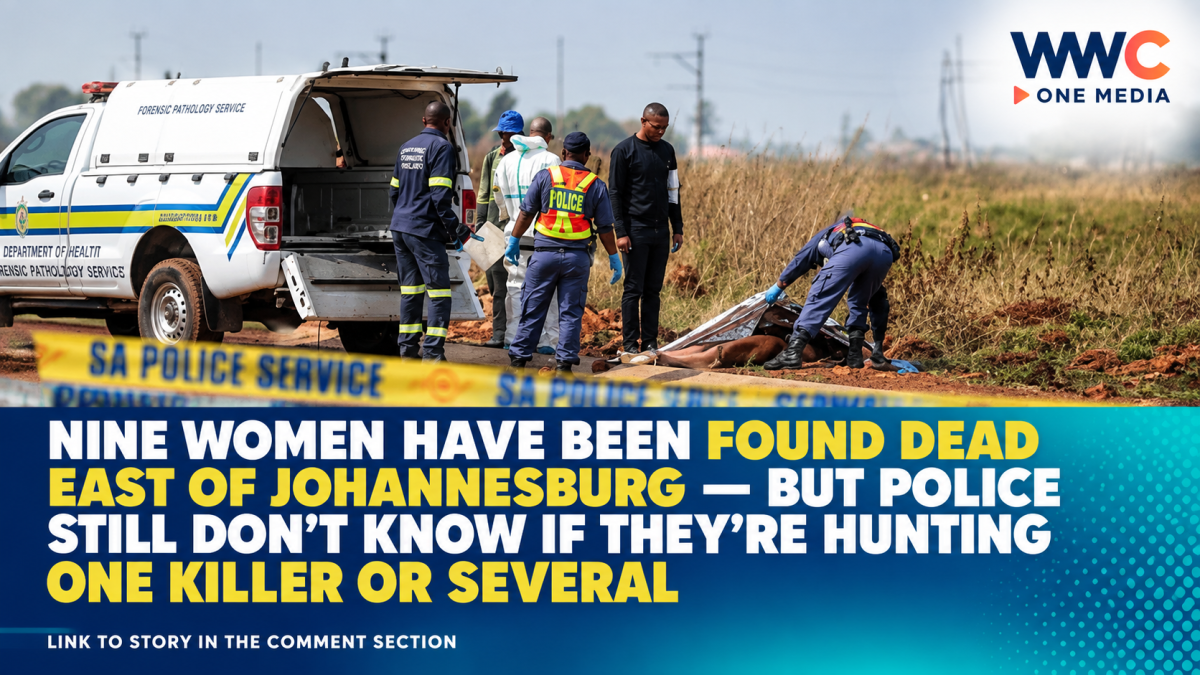
Police and forensic investigators descended on the latest scene in Boksburg on Thursday after another woman’s body was discovered beside a road.
Photographs from the scene showed forensic teams working behind police cordons as residents gathered nearby.
Authorities said the location suggested that the body may have been dumped there, but investigators had not established whether the woman was killed at that spot or elsewhere.
The discovery came only days after several other bodies were found across Ekurhuleni, the sprawling municipality immediately east of Johannesburg that includes Kempton Park, Boksburg, Benoni and other communities.
Police have intensified operations around Kempton Park and mounted roadblocks while detectives, forensic specialists, intelligence personnel and other units investigate possible connections between the deaths.
THE PATTERN IS WHAT HAS POLICE AND RESIDENTS ALARMED
The victims have largely been women in their 20s and 30s.
Several were discovered naked or partially clothed, some showed visible bruising, and authorities are examining evidence of possible sexual violence in some cases.
Many of the earlier discoveries were concentrated around Kempton Park and the R21 corridor.
IOL reported that the first five cases between July 15 and September 14 shared striking geographical and victim-profile similarities, although police had not conclusively linked them to a single offender.
TimesLIVE reported that specialists were increasingly concerned about the concentration of killings over a relatively short period.
Former SAPS investigative psychologist Gerard Labuschagne said the cases should be approached as a potential serial-murder investigation until evidence establishes otherwise.
That is an expert assessment, however — not a police finding that a serial killer has been confirmed.
ONE CASE BEGAN WITH A WOMAN BOUND WITH CABLE TIES
The earliest case now associated with the wider investigation dates to July 15.
A 37-year-old woman was found naked and restrained with cable ties.
A suspect was arrested two days later and has remained in custody in connection with that case. CNA reported that the man appeared in court this week. Police described him as a foreign national but did not identify his country of origin.
Crucially, authorities have not established that the suspect is responsible for the other deaths.
That distinction matters because the rapid accumulation of cases has generated speculation on social media about an individual “Kempton Park serial killer.”
Police have urged the public not to circulate unverified claims that could generate unnecessary panic or interfere with the investigation.
THEN THE BODIES KEPT APPEARING
A second woman, aged 32, was found partially clothed near the R21 on August 24 with visible injuries.
Another unidentified woman was discovered on September 10 in an advanced stage of decomposition.
A further body was recovered on September 12 in Rhodesfield, Kempton Park.
Additional discoveries then followed in Olifantsfontein, KwaThema and other parts of Ekurhuleni as police broadened their investigation.
By September 16, authorities were investigating eight deaths.
Less than a day later, another body had been found.
The tally was nine.
ONE VICTIM’S DISAPPEARANCE TURNED THE CASE INTO A NATIONAL STORY
Among the women was 38-year-old Elizabeth Moselakgomo, whose disappearance drew intense public attention.
Moselakgomo left her eight-year-old daughter at home before going out for a run and failed to return.
Fellow runners and community members circulated appeals on social media as relatives searched for her.
Her body was subsequently found behind a hotel on September 12.
Her case connected what had until then appeared to many residents to be separate killings and intensified scrutiny of other bodies found around Kempton Park.
Runners later gathered for a memorial event in Rhodesfield as fear spread among women who regularly exercise outdoors.
POLICE HAVE PUT R400,000 ON THE TABLE
South African police have offered a 400,000-rand reward, roughly US$25,000, for information that could help identify and arrest those responsible.
The opposition Democratic Alliance separately announced an additional reward of R500,000 tied to information leading to a successful prosecution.
That potentially brings the rewards announced by police and the party to R900,000, although the two offers have different conditions.
Police have deployed a multidisciplinary team including murder and robbery detectives, investigative psychology specialists, forensic personnel, K9 units, tracing teams and intelligence officers.
South Africa’s government news agency reported that a high-level team was assembled specifically to investigate the Ekurhuleni murders.
POLICE ARE ALSO WORRIED ABOUT COPYCATS
The possibility of a copycat attack complicates the investigation.
Even where victims are found in similar circumstances, investigators must establish whether forensic evidence, timelines, victim profiles, locations and potential offender behaviour actually connect the deaths.
That is why police have stopped short of officially labeling the case a serial-killing spree.
Mosikili said investigators were assessing whether the latest body was connected to the earlier murders or whether authorities were confronting someone imitating details already widely reported in the media.
The distinction could determine whether police are hunting one offender, several perpetrators or suspects responsible for separate crimes that merely appear similar.
THE KILLINGS COME DESPITE A RECENT NATIONAL DROP IN MURDER
The Ekurhuleni cases are unfolding against a complicated national crime picture.
Official South African figures show that overall murder has recently declined.
Between January and March 2026, South Africa recorded 5,181 murders, down 9.5% from 5,727 during the same quarter a year earlier.
The previous quarter, October through December 2025, recorded 6,351 murders, an 8.7% year-on-year decline.
Those decreases are significant.
But the absolute numbers remain extremely high, and South Africa continues to record thousands of killings every quarter.
Reuters reported that the country averages roughly 60 homicides a day, underscoring why improvements in national statistics have not eliminated public fears around violent crime.
The latest Ekurhuleni killings demonstrate the gap that can exist between improving national statistics and the reality experienced by an individual community.
SOUTH AFRICA’S MUCH BIGGER CRISIS: VIOLENCE AGAINST WOMEN
The deaths have also reopened one of the country’s most painful social issues: gender-based violence and femicide.
CNA, citing United Nations data, reported that about one in three South African women experiences physical or sexual violence during her lifetime.
The South African government now classifies gender-based violence and femicide as a national disaster, and President Cyril Ramaphosa recently appointed members of the statutory National Council on Gender-Based Violence and Femicide.
The council is tasked with coordinating national efforts to combat violence against women and strengthen survivor support, prevention and law enforcement.
That broader context has turned the Ekurhuleni investigation into more than a conventional murder case.
For activists and residents, it has become another test of whether years of promises to protect women can translate into safety on streets, running routes and public spaces.
RAMAPHOSA PROMISES A FULL INVESTIGATION
President Ramaphosa has pledged that investigators will pursue every lead, acknowledging the fear that the killings have created, particularly among women.
Gauteng Premier Panyaza Lesufi also vowed that provincial authorities would push back aggressively against whoever is responsible.
Meanwhile, police have urged women in affected areas to remain vigilant, avoid isolated locations where possible and exercise or travel in groups while the manhunt continues.
Those warnings illustrate just how deeply the killings have changed everyday life around Kempton Park.
THE MOST IMPORTANT QUESTION IS STILL UNANSWERED
Nine women have now been found dead.
Several bodies share disturbing similarities.
The discoveries are geographically concentrated.
Specialist detectives and forensic investigators have been deployed.
One suspect is already in custody in connection with the first known case.
But investigators have not yet produced the evidence needed to say that all nine women were killed by the same person.
That leaves Ekurhuleni confronting two frightening possibilities.
Either one offender has been able to keep killing — or police could be dealing with several killers whose crimes have converged into one terrifying pattern.
Until forensic evidence establishes which explanation is correct, the central question remains unanswered:
Who is killing women east of Johannesburg — and are police hunting one person or several?



Leave a Reply