
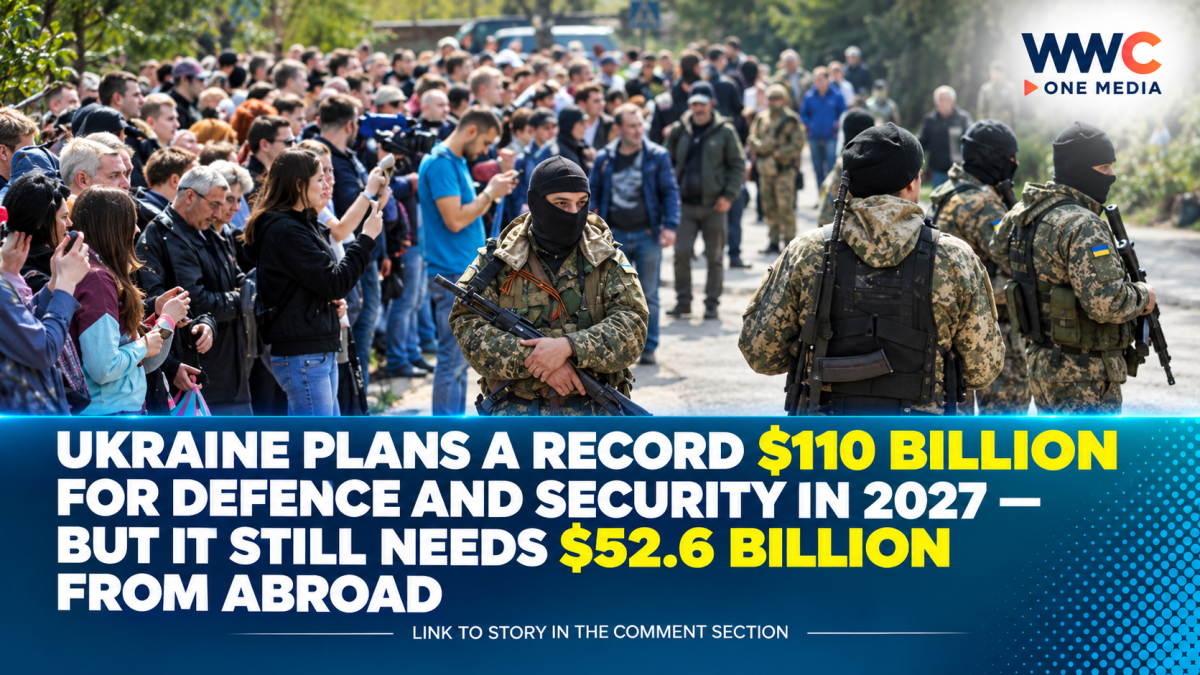
KYIV — September 17, 2026 — Ukraine is preparing to spend nearly US$110 billion on defence and security in 2027, an unprecedented wartime allocation that would consume roughly two-thirds of all central-government spending as the cost of fighting Russia continues to climb.
But the record number comes with an equally important warning:
Kyiv says it still needs US$52.6 billion in international financial support next year to keep the wider state budget functioning.
Ukraine’s government has proposed 4.885 trillion hryvnias for defence and security in its draft 2027 state budget — 11.9% more than the amended 2026 plan and equivalent to an extraordinary 43.8% of projected GDP. Total proposed state spending stands at 7.272 trillion hryvnias, while revenues are expected to reach only 5.648 trillion hryvnias.
That means the war is no longer merely Ukraine’s largest budget item.
It has effectively become the financial system around which almost every other government priority must be constructed.
Nearly ₴2.3 Trillion Is Going to Weapons and Military Equipment
The breakdown shows where the money is going.
Ukraine’s Finance Ministry has proposed:
₴1.792 trillion for military and security-sector pay and related costs;
₴2.299 trillion for weapons and military equipment;
about ₴500 billion for other defence and security expenses;
nearly ₴265 billion in reserve funds;
and ₴30 billion in state guarantees for weapons and military equipment.
The weapons allocation alone is roughly equivalent to the entire annual budgets of some European governments.
But the biggest year-on-year increase is actually in personnel spending, which rises by around ₴337.5 billion compared with the amended 2026 plan.
That reflects one of the underlying pressures on Ukraine’s war finances: maintaining a very large military requires not only ammunition, drones and missiles, but wages and continuing support for service members and their families.
Ukraine Says One Day of War Now Costs $190 Million
Perhaps the most striking measure of how the conflict has changed is the estimated daily cost.
Roksolana Pidlasa, chair of Ukraine’s parliamentary Budget Committee, said the war is costing the state about US$190 million every day in 2026, excluding weapons supplied directly by international partners.
In 2024, she estimated the daily cost at US$140 million. Reuters reported that the comparable figure at the beginning of Russia’s full-scale invasion in 2022 was about US$116 million per day.
Pidlasa attributed the increase to inflation, expansion of the armed forces, greater support requirements for military families and demand for more weapons — particularly longer-range strike capabilities.
The result is a war that has become progressively more expensive even without a decisive change in the front line.
And Ukraine Already Has a $27 Billion Hole in This Year’s Defence Funding
The financial strain is not only a 2027 problem.
Finance Minister Sergii Marchenko told lawmakers that Ukraine still faces an unfunded additional defence requirement of about US$27 billion for 2026, as the military seeks additional money for weapons production and personnel costs.
During the first eight months of this year, Ukraine spent roughly US$42 billion on national security and defence, excluding military assistance supplied directly by partners.
Yet domestic revenues and borrowing raised only about US$39 billion over the same period, according to Ukraine’s parliamentary Budget Committee.
That represents an important change.
Earlier in the full-scale war, Kyiv generally tried to finance its defence spending from domestic tax revenue and borrowing while using foreign budget support to pay for pensions, salaries, healthcare and other civilian government functions.
The scale of the war is making that separation increasingly difficult. Reuters reported that Marchenko said intensifying Russian attacks on Ukrainian companies and infrastructure are simultaneously damaging government revenues and increasing spending requirements.
$52.6 Billion From Abroad Is Built Into the 2027 Plan
Ukraine’s proposed budget assumes it will receive US$52.6 billion in international support in 2027.
Kyiv expects money from the European Union, G7 members, the IMF, World Bank, Britain and other partners.
Marchenko told parliament that roughly US$20 billion of the full-year requirement was already covered by partner commitments, leaving Kyiv negotiating over the remainder.
The precise financing figures need to be read carefully because different programs cover different time periods.
For example, the IMF said in its August assessment that Ukraine had firm assurances for about US$52.3 billion over the 12-month period from the third quarter of 2026 through the second quarter of 2027. That is not the same measurement period as Ukraine’s US$52.6 billion requirement for the full calendar year 2027.
Either way, both sets of numbers underline the same reality:
Ukraine cannot currently finance the state at wartime levels without continuing large-scale external support.
Europe Has Already Created a €90 Billion Funding Program
The European Union is now central to that equation.
Earlier this year, the EU established a €90 billion Ukraine Support Loan covering 2026 and 2027.
Around €60 billion is intended for defence procurement and defence-industrial capacity, while approximately €30 billion is intended for general budget support and essential government services.
For 2026 alone, the EU authorised up to €45 billion under that program, including up to €28.3 billion for defence-related support and €16.7 billion for budget assistance.
Payments are already under way.
The European Commission says it disbursed €3.2 billion in macro-financial assistance in June, followed by several defence-related payments, including billions for drone procurement and Ukraine’s defence industry.
So some of the money Kyiv needs for 2027 is already embedded in multi-year European programs.
The unresolved issue is whether that support — combined with IMF, G7 and bilateral funding — will be enough to cover the entire financing gap if the war continues at its present intensity.
Frozen Russian Assets Are Back at the Center of the Debate
As the gap grows, Ukrainian officials are again pointing toward Russian sovereign assets frozen in Europe.
Marchenko said immobilised Russian assets could become a major funding source for the 2027 budget.
The EU has already used profits generated by immobilised Russian assets to finance support for Ukraine. The European Commission says EU institutions and member states have provided more than €220 billion in overall support since the full-scale invasion, including billions derived from proceeds on frozen Russian assets.
Using the underlying Russian sovereign assets themselves is much more legally and politically complicated.
The EU’s €90 billion loan framework preserves the possibility of using immobilised Russian assets to repay financing, subject to EU and international law, but European governments have debated the legal and financial risks of going further.
That issue could become harder to avoid if Ukraine’s annual financing requirements continue rising.
Russia Is Also Budgeting Enormous Sums for the War
Ukraine is not the only side devoting an extraordinary share of state resources to defence.
Russia’s existing federal budget framework provides around 13.57 trillion rubles for “national defence” in 2027, compared with total planned federal expenditure of about 46.1 trillion rubles.
That puts the narrowly defined defence category alone at roughly 29% of Russian federal spending, before other security expenditures are included.
CNA, citing AFP, converted that planned defence figure to approximately US$161 billion, although dollar comparisons fluctuate substantially with exchange rates.
Russia and Ukraine also account for defence differently, making simple headline-dollar comparisons imperfect.
Ukraine’s ₴4.885 trillion figure combines the wider security and defence sector, while Russia’s “national defence” line does not capture every war-related or internal-security expenditure.
Still, both budgets illustrate how profoundly the war has redirected resources on each side.
Ukraine Is Still Trying to Fund Schools, Hospitals and Pensions
One of the striking features of Ukraine’s draft is that civilian spending has not disappeared.
The government proposes ₴328.5 billion for education, including increases in teacher salaries, and ₴292.5 billion for healthcare.
Another ₴540.3 billion is earmarked for social-policy programs, while social insurance funds — principally pensions — would receive more than ₴1.3 trillion.
The government is also budgeting more than ₴83 billion for internally displaced people, including living allowances, temporary accommodation and compensation for destroyed housing.
This is why international budget aid matters so much.
Money received from foreign partners does not simply buy weapons.
It helps Ukraine continue paying teachers, doctors, pensioners and other civilian obligations while domestic resources are concentrated heavily on the military.
Russian Strikes Are Also Creating a Second Bill: Reconstruction
Even if the fighting stopped tomorrow, Ukraine would face enormous financial requirements.
A joint assessment by the Ukrainian government, World Bank, European Commission and United Nations estimated in February that reconstruction and recovery needs had reached almost US$588 billion over the coming decade, based on damage recorded through the end of 2025.
Direct physical damage alone was estimated at more than US$195 billion, with housing, transport and energy infrastructure among the hardest-hit sectors.
That estimate predates much of the destruction recorded during 2026.
Reuters reported this month that Ukrainian officials estimate Russian attacks have caused nearly US$10 billion in additional infrastructure damage during 2026, while disruptions to ports and other economic activity are also reducing output and tax revenue.
Ukraine is therefore trying to finance three things simultaneously:
the ongoing war,
the normal functions of government,
and the repair of a country still being damaged.
Some ‘Unpopular’ Measures May Be Needed to Unlock the Money
Foreign assistance is not unconditional.
Ukraine has committed to tax, customs, governance and anti-corruption reforms connected to financing from institutions including the EU and IMF.
Parliament this week advanced legislation imposing taxes on certain foreign parcels as part of changes designed to align e-commerce and customs rules more closely with EU standards. Marchenko said progress on those measures could help unlock around €4 billion in EU macro-financial assistance.
CNA reported that President Volodymyr Zelenskyy warned lawmakers that Ukraine would have to approve some “unpleasant and unpopular” decisions to secure enough international financing to maintain defence and state resilience.
The Finance Ministry is also considering additional domestic revenue measures.
Its budget proposal says one potential funding source for war-risk business support would be raising Ukraine’s standard tax rate from 20% to 21%, although that would require separate legislation.
So the cost of the war is increasingly being felt not only through defence appropriations but through decisions on taxation and public finances.
The $110 Billion Figure Is Not Final Yet
There is one more important qualification.
Ukraine’s 2027 budget is still a draft.
The Cabinet approved it on September 15 and presented it to parliament, but lawmakers can propose changes.
Reuters reported that parliament has until October 1 to submit proposals and must pass the spending plan through three readings by December 1.
That means the final defence allocation, revenue assumptions and financing structure could still change.
And wartime budgets have repeatedly been amended during the year as battlefield requirements change.
Ukraine’s proposed ₴4.885 trillion should therefore be viewed as the government’s current estimate of what it expects the security and defence sector to require in 2027 — not an absolute ceiling on what next year’s war will cost.
The Bigger Number May Actually Be the $52.6 Billion
A record US$110 billion defence-and-security allocation will dominate the headlines.
But Ukraine’s US$52.6 billion external-financing requirement may ultimately be the more consequential number.
Kyiv can approve spending on soldiers, weapons and drones.
It cannot create tens of billions of dollars in foreign financing on its own.
That depends on European governments, the United States and other G7 members, international lenders and mechanisms involving frozen Russian assets.
And the longer the war lasts, the larger those financing demands have become.
Ukraine says one day of war now costs about US$190 million.
Its security and defence sector could consume about 44% of GDP next year.
Russia is simultaneously maintaining massive military expenditure.
And the reconstruction bill already approaches US$600 billion, even before the damage from much of 2026 is counted.
That is why Ukraine’s 2027 budget is about more than another year of military spending.
It is effectively a financial assumption that the country must be prepared to fight throughout 2027 — and that its international partners will continue helping pay the enormous cost of keeping the rest of the state running while it does.




Leave a Reply