
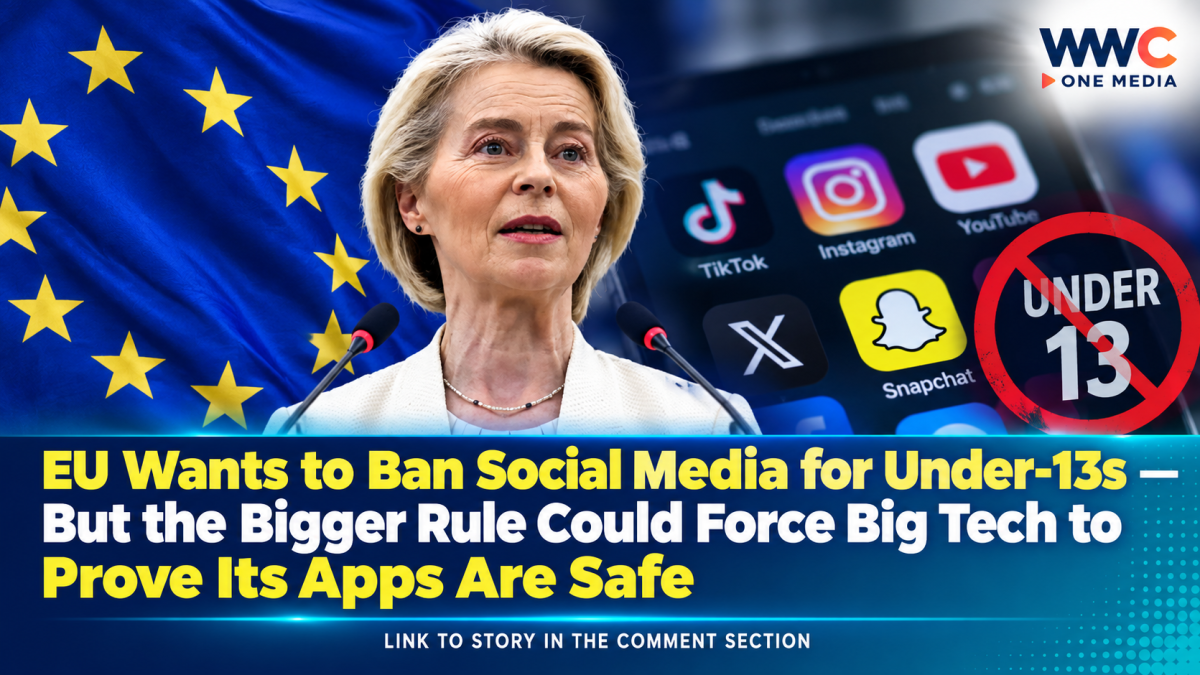
STRASBOURG — Europe is preparing to draw one of the clearest age lines yet between children and Big Tech.
The European Commission has adopted a proposed EU Kids Act that would ban children under 13 from social media, prevent those younger than 15 from having unrestricted personal accounts and force digital platforms to redesign services used by minors.
Under the age-tiered plan unveiled by European Commission President Ursula von der Leyen, children aged 13 and 14 would be able to use only limited “mini accounts” created and supervised by parents or guardians, with restricted features and a one-hour daily time limit. Users aged 15 to 17 could have personal accounts, but platforms would still face mandatory “safe design” requirements.
The Commission is also proposing obligations affecting social networks, video-sharing services, online games and AI chatbots serving users younger than 18, according to the Reuters report carried by CNA.
That means the legislation could eventually reach far beyond Instagram, Facebook and TikTok.
YouTube, gaming platforms and AI services aimed at or accessible to children could also face new restrictions.
But one point is essential:
This is a legislative proposal, not an EU-wide ban already in force.
The measure still has to survive negotiations with the European Parliament and the EU’s member governments before its main restrictions can become binding law. AP reported that the legislative process could take considerable time.
The proposed age ladder is much stricter than today’s system
The Commission’s model effectively creates three levels of social-media access.
| Age | Proposed EU treatment |
|---|---|
| Under 13 | No social media |
| 13-14 | Parent- or guardian-created mini accounts, restricted features and about one hour daily |
| 15-17 | Personal accounts allowed, but mandatory child-safe design applies |
The Commission describes the approach as “gradual and differentiated”, arguing that children at different developmental stages should not receive identical access to online services.
That makes the plan substantially more nuanced than a blanket under-16 ban.
But it also makes enforcement more technically complicated.
A platform would have to know not merely whether somebody is an adult or a child.
It would have to distinguish a 12-year-old from a 13-year-old, and a 14-year-old from a 15-year-old, because completely different account rules would apply.
The most consequential phrase may be: “prove you are safe”
Von der Leyen is proposing another major shift.
Rather than regulators carrying the entire burden of demonstrating that a platform harms children, the Commission says platforms should have to prove that they are safe for young users.
That could have far-reaching consequences for product design.
Social-media companies might have to demonstrate that recommendation algorithms, notifications, autoplay, direct messaging and other engagement mechanisms are not creating unacceptable risks for minors.
The Commission also plans a separate Digital Fairness Act later this autumn specifically targeting addictive digital design.
That matters because the policy debate is increasingly moving beyond what children see online.
It is also focusing on how platforms are designed to keep people using them.
Infinite scrolling and “rabbit holes” are already under EU scrutiny
Europe is not starting from zero.
Under the existing Digital Services Act, platforms accessible to minors are already expected to protect children’s privacy, safety and physical and mental well-being.
Commission guidelines issued in July 2025 specifically address addictive design, cyberbullying, harmful content and unwanted contact.
They recommend measures including private-by-default settings, greater control over recommendation systems and restrictions on features that encourage excessive engagement.
The Commission has separately been investigating whether Facebook and Instagram features and recommendation algorithms contribute to addictive behaviour or “rabbit-hole effects” among younger users.
The Kids Act would therefore build on an existing European regulatory framework rather than create child-safety obligations from scratch.
And Brussels already has a very large financial weapon
The Digital Services Act gives EU regulators the ability to impose fines of up to 6% of a company’s worldwide annual turnover for confirmed breaches of its requirements.
For the world’s largest technology companies, 6% of global revenue can translate into billions of dollars.
However, it would be premature to say automatically that every violation of the proposed Kids Act would result in a 6% fine.
The Kids Act’s exact enforcement relationship with the DSA will depend on the legislation ultimately approved.
What is already clear is that Europe has demonstrated a willingness to use substantial financial sanctions in digital regulation.
The irony: many social-media companies already say users must be 13
Facebook, Instagram and TikTok already generally require users to be at least 13 to create accounts.
Yet regulators say large numbers of younger children continue to access them. AP noted that enforcement of existing age rules has been a persistent problem.
That exposes the biggest weakness in any legal age ban.
Writing “13+” inside terms of service is easy.
Proving that the person entering a birthday really is 13 is much harder.
That is why Europe has been working on a technical age-verification system.
The EU has already built an age-verification prototype
In July 2025, the European Commission released an age-verification app prototype designed to allow someone to prove they meet an age threshold without giving a platform their exact age or identity.
The Commission has described the approach as privacy preserving.
Rather than handing TikTok, Instagram or another platform a passport or a full government identity profile every time, the system is meant to confirm only the necessary information — for example, whether someone is above a legally required age.
That addresses one of the central contradictions in online age verification:
Protecting children often requires platforms to know more about users.
Protecting privacy requires them to collect less.
The final Kids Act will have to find a way to do both.
France already discovered how quickly that problem becomes constitutional
France provides an important warning.
French lawmakers approved their own ban on social media for children under 15 this year.
But on August 14, France’s Constitutional Council struck the measure down.
The court found that the law disproportionately interfered with freedom of expression and communication and did not contain sufficient safeguards governing how people would prove their age.
The problem was not simply protecting children.
Because an age restriction potentially requires every user — including adults — to prove that they are old enough, the court concluded that privacy and constitutional freedoms were also implicated.
President Emmanuel Macron has asked the French government to rewrite the legislation.
That legal defeat helps explain why France has pushed hard for an EU-level framework.
Macron originally wanted an even higher threshold
Macron has urged Brussels to support an EU-wide social-media restriction for children under 15, rather than setting the absolute ban at 13.
Other European governments have also supported stronger action.
The Commission ultimately chose a tiered compromise:
complete social-media exclusion below 13;
parent-supervised access from 13 until 15;
and increasingly independent but safer access afterward.
That is less restrictive than the pure under-15 ban France had pursued.
But it would still establish a common age framework across all 27 EU countries if adopted.
Australia went further — and found enforcement difficult
Europe has repeatedly pointed to Australia, which became the first country to impose a nationwide social-media ban on children under 16.
Australia’s restrictions took effect on December 10, 2025 and targeted platforms including Facebook, Instagram, TikTok and YouTube.
The policy quickly became the most important real-world experiment for other governments considering similar laws.
And its early results show why Brussels cannot assume an age ban automatically removes teenagers from social media.
A study from Australia’s internet regulator found that more than eight in 10 children aged 10 to 15 were still using social media three months after the ban took effect.
Account ownership did decline, including statistically significant reductions on some platforms.
But actual use remained widespread.
That gap is crucial.
A teenager can lose an official account and still access social-media content through another account, a browser, a family member’s device or other workarounds.
Meta says it removed more than 750,000 Australian teen accounts
Platforms are not doing nothing.
Meta said that between December 2025 and June 2026 it removed around 756,000 Australian accounts believed to belong to under-16 users — approximately 462,000 Instagram accounts and 294,000 Facebook accounts.
Yet Australian data still showed substantial continued use among minors.
That highlights the difference between two questions:
Can a company identify and delete underage accounts?
And can it actually stop underage people from returning?
The second problem is much harder.
The EU appears to be trying to learn from Australia
Europe’s tiered proposal suggests Brussels does not want to rely exclusively on prohibition.
For 13- and 14-year-olds, it would allow some access — but through controlled accounts.
For older teenagers, the focus shifts away from banning the user and toward changing the platform itself.
That is where “safe design” enters.
Rather than simply saying teenagers cannot use a service, regulators could require companies to alter the way the service behaves when the user is a minor.
Potential areas include algorithmic recommendations, autoplay, endless scrolling, notifications, stranger contact and privacy defaults.
Existing DSA child-safety guidelines already point in this direction.
Some digital-rights advocates still think the EU is targeting the wrong problem
The proposal has not received universal support.
Digital-rights organisation European Digital Rights, or EDRi, argued that simply delaying access risks leaving the underlying commercial model untouched.
Policy adviser Simeon de Brouwer told AP that the proposal could merely postpone young users’ exposure to harmful practices rather than change the business incentives behind platforms designed to maximise engagement and advertising.
That is one side of the policy debate.
Age restrictions focus on when young people gain access.
Critics argue regulators should focus more heavily on what platforms are allowed to do once anybody gains access.
The Commission appears to be trying to address both issues through the Kids Act and the separate Digital Fairness Act.
Parental supervision creates another debate
The EU proposal gives parents and guardians substantial control over accounts belonging to 13- and 14-year-olds.
That can provide a safeguard.
But child-rights advocates have also raised concerns about whether parental access to a teenager’s online life could sometimes interfere with privacy or access to information.
This is particularly relevant in households where a parent may not always be the safest person to oversee a child’s communications.
The legislation will therefore have to define what “supervision” actually means.
Does a parent approve the account?
Can they read messages?
Do they choose who the child follows?
Do they control the algorithm?
Or do they only set time and safety restrictions?
Those details could determine whether mini accounts become workable or intrusive.
AI chatbots bring a completely different set of risks
CNA’s Reuters report says the Commission is also proposing obligations for AI chatbots offering services to people under 18.
That creates a challenge very different from Instagram or TikTok.
A social network mainly connects users to content and other users.
A chatbot directly converses with the child.
Regulators are increasingly concerned about AI systems designed to imitate friendship, companionship or emotionally intimate relationships.
The earlier Commission draft reviewed by Reuters included AI chatbots and companions alongside social media, video services and online gaming.
Exactly how the final law will distinguish general-purpose assistants from dedicated AI companions will be an important regulatory question.
Gaming platforms are in the proposal too
Online games introduce still another regulatory category.
Children may communicate with strangers while playing.
Games may include virtual currencies, loot-style rewards, streaks or other features encouraging repeated engagement.
Yet gaming is also interactive entertainment rather than simply social networking.
That makes blanket age rules harder to apply.
The Commission’s broader proposal therefore uses different obligations depending on both the type of service and the age of the child, according to the Reuters-reviewed framework.
That is one reason calling the Kids Act simply a “social-media ban” understates its potential reach.
The real enforcement question is how platforms will know who is a child
Everything ultimately comes back to age assurance.
TikTok announced earlier this year that it would strengthen age detection across Europe using profile information, posted content and behavioural signals to identify accounts that may belong to users under 13.
Flagged accounts would be reviewed by moderators rather than automatically deleted, while appeals could involve facial-age estimation, credit-card checks or government identification.
Meta and other platforms have experimented with similar systems.
Each method has drawbacks.
Self-declared birthdays are easy to fake.
IDs raise privacy concerns.
Facial estimation is imperfect.
Behavioural analysis can make mistakes.
And asking every adult to verify their age can create a much larger surveillance infrastructure than originally intended.
France’s constitutional ruling shows those concerns are not theoretical.
Big Tech already faces stronger European scrutiny
The Kids Act also arrives while relations between Brussels and major technology companies remain tense.
The EU has been using the Digital Services Act and other competition and technology rules to regulate major platforms more aggressively.
The Commission has said DSA violations by the largest services can carry penalties reaching 6% of worldwide annual turnover.
AP reported that the new child-safety legislation could create another point of conflict with U.S. technology companies and with the Trump administration, which has criticised European technology regulation.
That geopolitical dimension does not determine whether the Kids Act will pass.
But it makes the proposal more than a parenting debate.
It is also another test of how far the EU is prepared to dictate the design of globally used technology platforms.
Europe is trying to shift responsibility away from parents alone
For years, child-online-safety advice often focused on what parents should do:
set screen limits;
check accounts;
talk to children;
use parental controls.
Those measures remain part of the EU proposal.
But the Kids Act changes the emphasis.
The Commission is arguing that companies that design recommendation algorithms, engagement systems and digital products should carry greater responsibility for making those services safe for younger users.
That philosophy is captured in the proposal to reverse the burden of proof.
Instead of asking parents to demonstrate that an app is dangerous, Europe wants the company selling the experience to demonstrate that it is safe.
But Europe still has to prove regulation can work in the real world
That may become the defining question.
Australia created a ban.
Meta removed hundreds of thousands of accounts.
Yet more than 80% of children in the studied age group were still using social media in the early months of enforcement.
France passed a law.
Its constitutional court struck the core restriction down over freedom-of-expression and privacy concerns.
Europe is now attempting something more complex:
an absolute threshold for younger children;
restricted accounts for early teenagers;
safe-design obligations for older teens;
age verification;
platform accountability;
and separate regulation of addictive digital features.
That may address weaknesses exposed elsewhere.
It may also create new technical and legal challenges.
The biggest change may not be the number 13
The headline number will inevitably dominate attention.
Under 13: no social media.
But the more consequential long-term rule could be what happens after a child turns 13, 15 or even 18.
If Europe succeeds in establishing that technology companies must actively prove that products used by minors are safe, the principle could affect far more than account ages.
It could influence algorithms.
Notifications.
Autoplay.
Recommendation feeds.
AI companions.
Gaming mechanics.
Data collection.
And the entire business model built around maximising time spent on a screen.
The Commission has now formally put that idea into its 2026 legislative agenda.
The ban is the easy part to understand.
Making the internet behave differently because the person holding the phone is 12, 14 or 17 may be the much bigger experiment.




Leave a Reply