
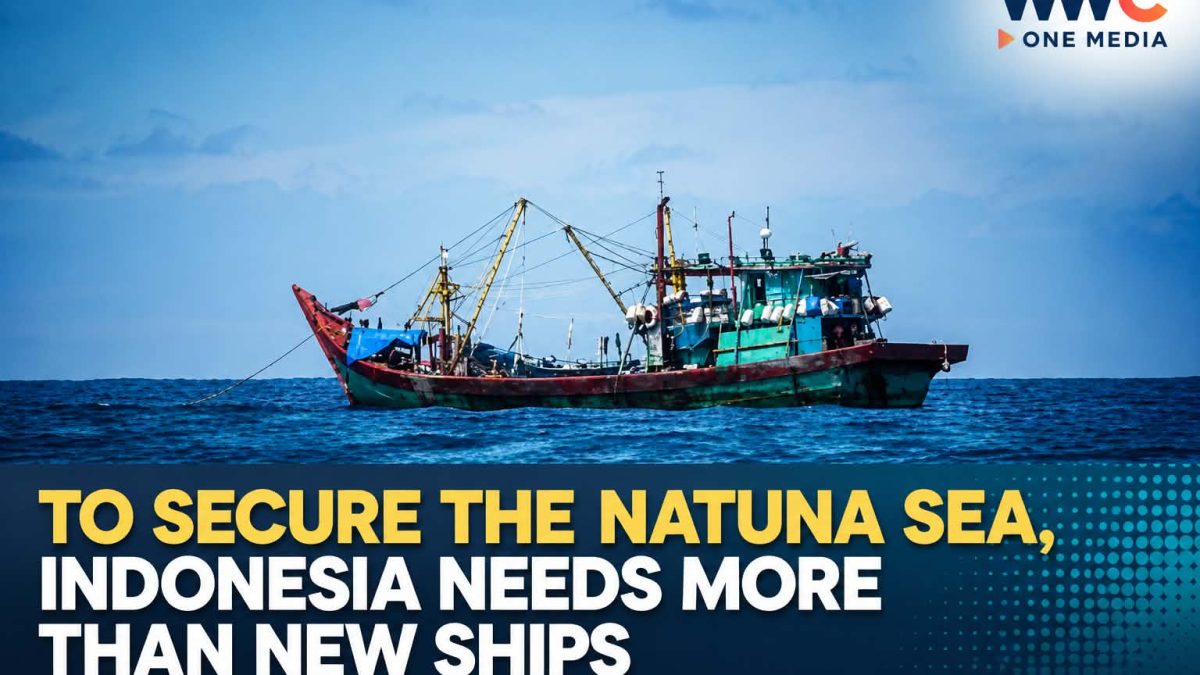
Indonesia is expanding its maritime fleet, but the battle for the North Natuna Sea will increasingly depend on something less visible than ships: real-time surveillance, intelligence, enforcement capacity and regional cooperation.
Indonesia is adding new patrol vessels to strengthen its presence in the North Natuna Sea, one of Southeast Asia’s most strategically sensitive maritime areas.
But there is a problem.
A bigger fleet does not automatically create better maritime security.
The latest assessment from The Diplomat argues that Indonesia needs to build an integrated maritime-security system around its ships—one capable of detecting suspicious vessels, sharing information quickly and putting the right enforcement asset in the right place before an incident disappears over the horizon.
That challenge is becoming more urgent as illegal, unreported and unregulated fishing continues to threaten Indonesia’s enormous maritime jurisdiction, while the North Natuna Sea sits close to overlapping claims and strategic competition in the South China Sea.
INDONESIA IS BUYING MORE PATROL POWER
Jakarta is not ignoring the problem.
In July, Indonesia’s Ministry of Marine Affairs and Fisheries announced plans to build 10 new Class I surveillance vessels and expand the PSDKP patrol base in Batam, which is being positioned as a principal operating base for the North Natuna Sea.
The expansion is aimed particularly at combating illegal, unreported and unregulated fishing (IUUF) in Fisheries Management Area WPPNRI 711, which includes the North Natuna Sea.
Indonesia’s existing KKP patrol fleet has 34 vessels, according to the ministry.
But simply putting more hulls into the water does not solve the entire problem.
The key question is:
Can Indonesia detect a vessel, identify it, track it, respond to it and enforce the law quickly enough?
THE NATUNA SEA IS TOO BIG FOR SHIPS ALONE
Indonesia is the world’s largest archipelagic state, with an enormous maritime area to monitor.
That creates a basic operational problem: distance.
A patrol vessel can only be in one place at a time.
The Diplomat reported that in 2025, only three of seven KKP patrol vessels assigned to the broader WPPNRI 711 area could reach the North Natuna Sea. It also highlighted a second bottleneck: even when authorities intercept suspected illegal fishing vessels, infrastructure for holding seized boats and their crews can be inadequate.
That means maritime security is not just about acquiring ships.
It is about building an entire chain:
Detect → Identify → Track → Intercept → Inspect → Prosecute.
If one link fails, the entire operation can fail.
THE REAL BATTLE MAY BE HAPPENING ON SCREENS
Indonesia’s maritime agencies are increasingly focusing on Maritime Domain Awareness (MDA)—the ability to build a real-time picture of what is happening across the country’s waters.
Bakamla, Indonesia’s maritime security agency, has been working with Japan and other partners to improve surveillance and information-sharing capabilities. In February, Bakamla hosted Japan Coast Guard personnel for training involving aviation reconnaissance sensors and maritime-domain awareness.
Bakamla has also studied the United Kingdom’s approach to integrating AIS, radar, satellite imagery and other intelligence sources into a common maritime picture.
The objective is straightforward:
See the vessel before the vessel becomes the problem.
That capability could be particularly important in the vast waters surrounding the Natuna Islands.
ONE MISSED CONTACT CAN CHANGE THE STORY
A recent example illustrates the problem.
According to The Diplomat, Indonesian fishermen reported foreign vessels suspected of illegal fishing in the North Natuna Sea in June. The Indonesian Navy subsequently deployed KRI John Lie-358 for an extended patrol.
But by the time the warship searched the reported area the following morning, the vessels were gone.
Indonesia’s Navy separately confirmed that KRI John Lie-358 conducted sector patrols in the North Natuna Sea in June, using visual observation and radar to monitor shipping and fishing activity.
The lesson is not that Indonesian patrols are ineffective.
It is that response time and information flow can be just as important as firepower or ship numbers.
INDONESIA IS ALREADY BUILDING A NETWORK
This is where Indonesia’s international partnerships become important.
Japan is supporting Indonesian maritime capacity, including a 9.053 billion-yen grant for an offshore patrol vessel for Bakamla, scheduled for delivery in 2028, according to The Diplomat. Japan has also supported training in maritime law enforcement and other coast-guard capabilities.
Australia is also expanding maritime cooperation with Indonesia.
A joint Australia-Indonesia statement issued in August said the two countries would strengthen maritime cooperation, including aerial drones and training for Bakamla to improve maritime-domain awareness.
And Indonesia is expanding cooperation within ASEAN.
Bakamla hosted maritime law-enforcement representatives from Indonesia, Malaysia, the Philippines, Vietnam and Thailand, alongside the UN Office on Drugs and Crime, for discussions on regional maritime security cooperation.
The direction is becoming clear:
Indonesia cannot monitor every corner of its maritime territory alone.
AND THEN THERE IS CHINA
The North Natuna Sea sits within Indonesia’s exclusive economic zone (EEZ), but the area overlaps with the broader maritime claims China makes in the South China Sea.
Indonesia does not formally describe itself as having a territorial dispute with China, but Chinese coast guard activity in waters Indonesia considers part of its EEZ has repeatedly created friction.
In 2024, for example, Indonesia said its patrol vessels twice drove away a Chinese coast guard ship that had interrupted an Indonesian seismic survey near the Natuna Islands. China maintained that the area fell within what it described as its jurisdiction.
That episode demonstrated why Natuna security is more complicated than combating illegal fishing.
It involves maritime law enforcement, economic resources, national sovereignty and strategic competition—all operating in the same body of water.
THE BIGGER LESSON FROM THE SOUTH CHINA SEA
Recent confrontations elsewhere in the South China Sea show how quickly maritime encounters can become diplomatic crises.
In July, the Philippines accused China’s coast guard of using water cannons against Philippine government fisheries vessels near Scarborough Shoal. China rejected Manila’s accusations and defended its actions as lawful enforcement.
The Natuna situation is not identical to the Philippines-China dispute.
But the broader lesson is relevant:
Coast guard encounters can carry geopolitical consequences even when they begin as fishing or maritime-law-enforcement incidents.
For Indonesia, maintaining a credible and professional presence in the North Natuna Sea therefore requires more than naval strength.
It requires persistent surveillance, clear rules of engagement, reliable communications and disciplined law enforcement.
THE NEXT FRONTIER: DRONES, SATELLITES AND FISHERMEN
One of the most interesting parts of Indonesia’s evolving strategy is the combination of technology and local knowledge.
A satellite can identify unusual vessel movements.
A drone can extend surveillance over large areas.
Radar can track contacts.
AIS can provide information about cooperating vessels.
But local fishermen can sometimes notice activity that sophisticated systems miss.
The challenge is connecting all those pieces into one functioning information network.
Bakamla’s own 2026 planning has emphasized stronger maritime-threat projections, patrol planning and national maritime security infrastructure. Its 2026 priorities include additional monitoring stations and development connected to the National Maritime Security System.
That could ultimately matter more than simply counting how many patrol ships Indonesia possesses.
NATUNA IS A TEST OF INDONESIA’S MARITIME FUTURE
Indonesia’s new patrol vessels are important.
They provide endurance, visibility and enforcement capability.
But ships are only the visible part of the system.
WWC ONE MEDIA G.A

Leave a Reply