
MANILA, Philippines — Three remarkable figures from Singapore, Bangladesh and Myanmar have been named the 2026 Ramon Magsaysay Awardees, receiving one of Asia’s most prestigious recognitions for service, leadership and work that has helped communities confront some of the region’s most difficult challenges.
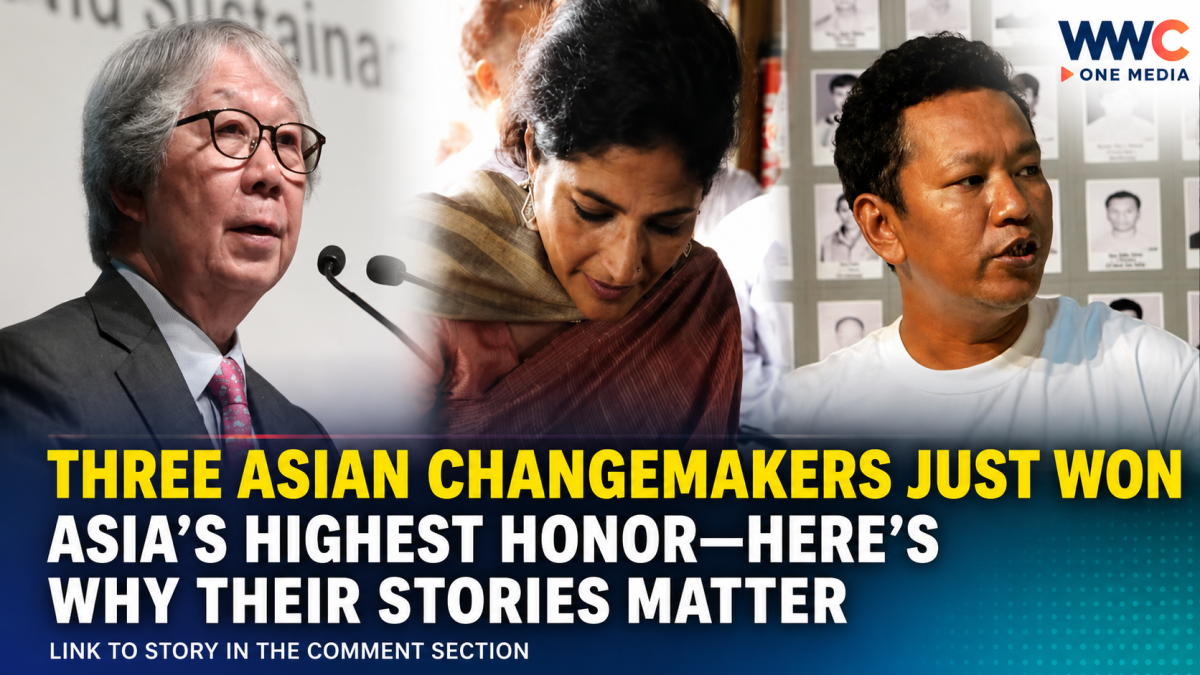
The Ramon Magsaysay Award Foundation announced the three recipients on Monday, August 31: Singaporean diplomat and scholar Tommy Koh, Bangladeshi social entrepreneur Runa Khan, and Myanmar human rights advocate Bo Kyi.
Their fields could hardly be more different. Koh built a career around diplomacy and international law; Khan has spent decades bringing healthcare, education and livelihood opportunities to communities living in some of Bangladesh’s most remote and climate-vulnerable areas; while Bo Kyi has dedicated his life to documenting abuses and supporting political prisoners in Myanmar.
Yet the foundation says their work is connected by a common principle: creating opportunities for people who might otherwise be left behind.
Tommy Koh: The Diplomat Who Helped Shape International Law
For Singapore’s Tommy Koh, the award recognizes more than five decades of diplomacy, legal scholarship and international leadership.
Koh represented Singapore at the United Nations and became one of the country’s most prominent diplomats. His international career included a pivotal role in negotiations surrounding the United Nations Convention on the Law of the Sea (UNCLOS), the landmark framework governing the world’s oceans.
He also chaired the 1992 Earth Summit in Rio de Janeiro, further cementing his role in international diplomacy and environmental negotiations.
Beyond diplomacy, Koh has had a significant influence on Singapore’s academic and cultural institutions, including the National University of Singapore, where he has held senior academic and leadership roles.
The award foundation’s recognition of Koh highlights the idea that international agreements are not simply products of negotiation—they can become tools for cooperation between countries with competing interests.
Runa Khan: Taking Healthcare to Communities the Roads Can’t Reach
In Bangladesh, Runa Khan took a very different route to social change.
Khan founded Friendship in 2002 after witnessing the extreme isolation faced by communities living on river islands, known locally as chars. These communities can be cut off from essential services by constantly shifting waterways, flooding, erosion and climate-related disasters.
Instead of expecting vulnerable communities to reach conventional hospitals and schools, Khan’s organization developed mobile and floating services capable of reaching them.
Friendship’s work has since expanded beyond healthcare to include education, disaster preparedness, climate adaptation, economic development, social inclusion and access to rights.
Her recognition is particularly significant as Bangladesh remains highly exposed to climate-related risks, including flooding, cyclones, river erosion and displacement.
Khan’s work demonstrates a central idea behind this year’s awards: geography should not determine who gets access to opportunity, healthcare or dignity.
Bo Kyi: Turning the Experience of Imprisonment Into a Fight for Justice
The third recipient, Bo Kyi of Myanmar, brings another deeply personal dimension to the 2026 awards.
A former political prisoner, Bo Kyi became involved in Myanmar’s pro-democracy movement and was imprisoned for his activism. After leaving Myanmar, he co-founded the Assistance Association for Political Prisoners (AAPP) in Thailand in 2000.
AAPP has worked to document political imprisonment, human rights abuses and other violations in Myanmar while supporting prisoners and their families.
Bo Kyi’s own experience of detention helped shape his determination to ensure that political prisoners were not forgotten.
His work has taken on renewed importance following Myanmar’s 2021 military coup, after which political arrests, detentions and human rights concerns have drawn international attention.
The Ramon Magsaysay recognition therefore places a spotlight not only on one activist’s life but also on the continuing struggle for human rights and accountability in Myanmar.
Why This Year’s Ramon Magsaysay Award Matters
The three awardees represent three very different approaches to public service.
Koh used diplomacy and international law to build bridges between nations.
Khan built practical systems for communities threatened by poverty, isolation and climate change.
Bo Kyi documented human rights abuses and stood with people facing political imprisonment.
What connects them is the belief that leadership is measured not simply by position or power, but by what that leadership makes possible for others.
The Ramon Magsaysay Award Foundation describes the prize as Asia’s premier prize and highest honor, recognizing “greatness of spirit” demonstrated through selfless service to the peoples of Asia. Since the award was first presented in 1958, it has recognized hundreds of individuals and organizations across the region.
The foundation has also moved away from the fixed award categories used during the award’s earlier decades. Since 2009, recipients have generally been recognized for the significance and impact of their work rather than being confined to traditional categories.
When Will the 2026 Awardees Receive Their Medals?
The announcement on August 31 marks the beginning of the 68th Ramon Magsaysay Awards Festival Season.
Koh, Khan and Bo Kyi will formally receive their awards during the 68th Ramon Magsaysay Awards Presentation Ceremonies on November 15, 2026, at the Metropolitan Theater in Manila. The presentation ceremonies are scheduled to be open to the public.
The timing of the announcement is also symbolic: the Ramon Magsaysay Award Foundation traditionally announces its recipients on August 31, the birth anniversary of former Philippine President Ramon Magsaysay, whose ideals inspired the creation of the award.
Three Stories, One Message
Tommy Koh’s decades of diplomacy, Runa Khan’s work among climate-vulnerable communities and Bo Kyi’s advocacy for political prisoners may appear to belong to entirely different worlds.
But together, their stories tell a larger Asian story—one about service, resilience and the determination to make space for people whose voices can easily be overlooked.
And that may be the most important part of the 2026 Ramon Magsaysay Award.
The medals will be presented in Manila in November. But the work that earned them began long before the ceremony—and continues every day in communities, institutions and countries across Asia.



Leave a Reply