
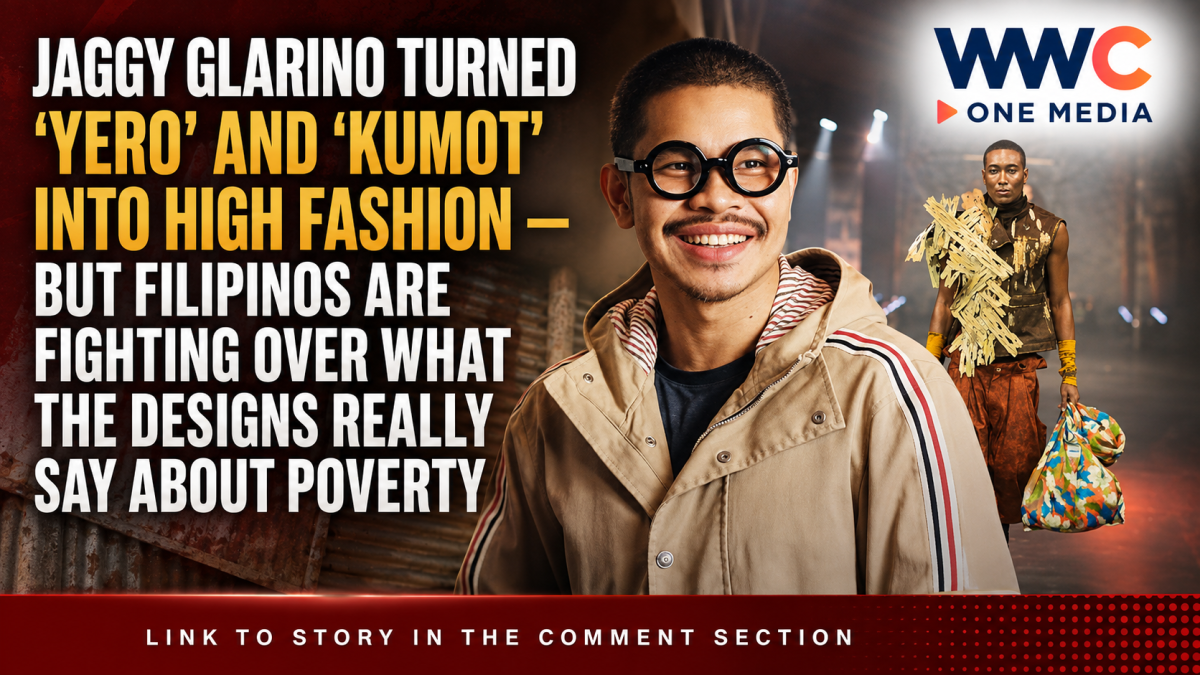
One of the pieces now attracting attention is Glarino’s Yero Top, part of his IGNO collection.
In an earlier interview with Vogue Philippines, Glarino explained that the design began when he encountered a corrugated, gold-toned material that immediately reminded him of the roofs he had seen along the Manila Skyway.
Rather than leave the material pristine, he distressed and altered it to resemble sheets of galvanized iron weathered by years of sun and rain.
For Glarino, those rooftops were tied directly to his memory of entering Metro Manila from the province and confronting a city that looked simultaneously harsh, unfamiliar and full of possibility. He described the Yero Top as a “memory piece,” rather than an attempt to simply reproduce poverty as an aesthetic.
That distinction is important.
The IGNO collection itself grew out of Glarino’s experience of arriving in Manila as a probinsyano—a newcomer without the fashion-school pedigree or connections often associated with the industry.
Tatler reported that Glarino deliberately reclaimed the word “igno,” derived from ignorante, after experiencing it as a dismissive label. His collection used materials and treatments resembling weathered denim, tarpaulin and coated canvas to depict people moving through the city and trying to establish themselves.
MEGA similarly described IGNO as a collection concerned with survival, migration, sacrifice and the Filipino everyman. Glarino explicitly told the publication that survival is neither completely beautiful nor completely ugly—and that the tension between those realities was intentional.
And then there were the basureros, kargadors and homeless
This is where the debate becomes harder.
The Philippine Star’s PhilSTAR Life described IGNO as drawing from people including kargadors, basureros, homeless Filipinos living in Manila’s backstreets and provincial migrants searching for opportunity in the capital.
Its runway references included material resembling corrugated roofing, giant garbage bags, Divisoria bags, makeshift rain protection and other features of working-class urban life.
The Diarist likewise documented a collection filled with unmistakable Manila imagery: garments manipulated to resemble shanty roofing, oversized black “trash-bag” trousers, antennas, electric posts, woven street-vendor references and even the familiar “bawal umihi dito” warning painted across urban walls.
Seen without that context, the imagery can easily produce discomfort.
A corrugated roof is fashionable abstraction to one viewer.
To someone who has actually worried about a leaking roof during a typhoon, it can represent something considerably less romantic.
And that is essentially why the “poverty porn” criticism has traction even if that was never Glarino’s stated intention.
But the ‘kumot’ story goes much further back
The current conversation also risks treating Glarino’s fascination with everyday Filipino objects as something invented for shock value.
It wasn’t.
Years before IGNO, he had already built collections around his childhood in General Santos City.
His Spring/Summer 2023 work referenced his family’s carinderia, the kitchen where he grew up, thermoses, plastic mantel, bags, household patterns and the kumot he remembered from childhood.
Vogue Philippines reported that Glarino even recalled dressing himself in blankets as a child, only to discover later that other Filipinos recognized exactly the same experience. What began as an intensely personal memory became a surprisingly shared cultural reference.
PeopleAsia reported that his family’s livelihood came from a humble carinderia in General Santos City and that Glarino had previously neither hidden nor fully celebrated that background. Fashion eventually became a way for him to publicly embrace it.
Vogue later described his kumot-print garments as among his recognizable creations, connecting the motif to his broader attempt to reconsider ideas of Filipino identity, masculinity and the embarrassment people can sometimes feel toward backgrounds dismissed as bakya or unsophisticated.
So reducing the kumot to “poor aesthetics” misses a substantial part of its origin.
Poverty porn or cultural reclamation?
There may not be a clean answer—and that may be exactly why Glarino’s clothes are generating discussion.
The strongest argument against this kind of fashion is straightforward: once objects associated with economic hardship are transformed into expensive editorial images or runway pieces, real deprivation can become aesthetically desirable to audiences who never have to experience it.
A leaking sheet of galvanized iron looks different when viewed from a front-row seat.
The strongest argument in Glarino’s defense is equally important: artists from working-class or provincial backgrounds should not be told that the visual language of their own lives is somehow off limits simply because those memories contain poverty.
Glarino did not discover the kumot or yero from a mood board.
His interviews across several years consistently connect the objects to his upbringing, migration to Manila and earlier discomfort about being perceived as provincial or bakya.
That makes this less a question of whether fashion is “allowed” to use yero and more a question of how hardship is represented, whose story is being told and whether the people represented retain dignity and agency.
The timing of the controversy couldn’t be more interesting
The debate also arrives just as Glarino’s international visibility is growing.
Rakuten Fashion Week Tokyo’s official schedule lists Glarino alongside Filipino designers Joey Samson and Rhett Eala for the “BENCH/ Presents Threads of Dreams” partnership presentation on September 1, 2026.
The three designers had earlier participated in the Philippine-Japanese Threads of Dreams project, created around 70 years of diplomatic relations between the two countries.
In other words, an argument that looks at first like another short-lived Filipino social-media fight is unfolding just as a very particular vision of Philippine fashion is being presented to a much wider audience.
And that may be the bigger story.
Glarino is effectively asking international fashion to look at things Filipinos have traditionally been encouraged to hide: the carinderia, the provincial childhood, the plastic tablecloth, the blanket, the chaotic city street and the weather-beaten roof.
Whether that transformation feels empowering or exploitative will depend heavily on who is looking.
But perhaps the most uncomfortable question is also the most useful one:
When a Filipino designer turns the things society calls cheap, poor or “bakya” into objects worthy of a runway, is he glamorizing poverty—or exposing why Filipinos were taught to be ashamed of those things in the first place?
That debate is unlikely to end with the yero.
And with Glarino heading onto another international runway, the rest of the fashion world may soon be joining it.



Leave a Reply