
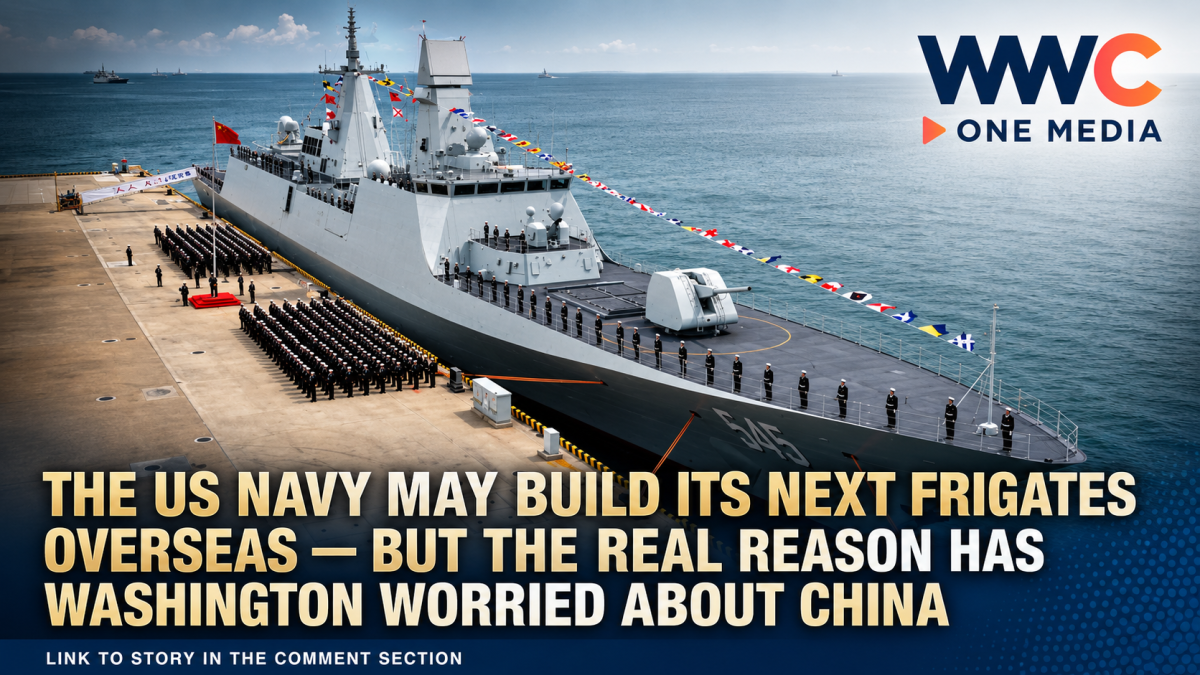
WASHINGTON — The U.S. Navy is considering something that would have been almost unthinkable for much of the past century: putting foreign-built combat ships into American service.
Japanese, South Korean and Turkish frigate designs are being evaluated as Washington searches for a faster way to add warships while its own shipbuilding industry struggles with delays, workforce shortages and rising costs — all while China continues to expand the world’s largest navy and dominates global commercial ship construction.
But there is an important distinction behind the eye-catching headlines: the United States has not yet selected or ordered one of these foreign frigates. The ships are under consideration as part of an acquisition review that could eventually lead to an international competition. According to USNI News, an assessment ordered by Acting Secretary of the Navy Hung Cao is due November 12, 2026.
That review could become one of the most consequential tests yet of whether America can use allied industrial power to buy time while rebuilding its own shipyards.
The three frigates reportedly in the running
USNI News reported that officials are examining the export version of Japan’s Mitsubishi Heavy Industries Mogami-class frigate, South Korea’s Chungnam-class guided-missile frigate, and Turkey’s Istanbul-class frigate.
The attraction is relatively straightforward: all three countries possess active naval shipbuilding industries and existing frigate designs, potentially allowing Washington to avoid starting another warship program almost entirely from scratch.
The White House opened the door to such an arrangement on August 13, when President Donald Trump issued a memorandum directing the Pentagon to develop a new acquisition strategy for surface combatants capable of anti-submarine warfare, surface warfare and convoy escort missions.
The order invokes what the administration calls the “Finland Model.”
Under that approach, a qualified foreign company could build as many as the first two ships overseas. To participate, however, the foreign supplier would also have to invest in or establish a U.S. shipyard, train American workers, transfer shipbuilding technology and eventually construct subsequent ships in the United States using an American supply chain.
In other words, Washington’s stated goal is not simply to outsource Navy construction indefinitely.
It is to use foreign production as a bridge to rebuild American capacity.
America’s frigate problem did not start with China
The immediate pressure comes partly from the troubled Constellation-class frigate program.
The Navy originally planned to acquire at least 20 Constellation-class ships, which were derived from the Italian-French FREMM design. But the program fell years behind schedule as the U.S. version underwent substantial redesign and struggled to stabilize its configuration.
The Congressional Research Service said design delays helped push the lead ship about three years behind its original schedule. In late 2025, the Navy moved to truncate the program and pursue a new frigate effort known as FF(X), based on the Coast Guard’s National Security Cutter design. The Navy has discussed eventually acquiring roughly 50 to 65 FF(X) ships, although those numbers remain planning figures rather than a completed procurement program.
The Navy wants the first FF(X) launched around late 2028, with Naval News reporting a planned delivery around 2030 if the aggressive schedule holds.
That still leaves Washington facing a more immediate problem: it needs additional ships while domestic yards are already under enormous pressure from submarine, destroyer, amphibious ship and other construction programs.
Congressional researchers have described the central dilemma clearly. U.S. shipbuilding capacity is constrained just as China’s naval construction pace is increasing, leading supporters of foreign participation to argue that allied shipyards may be one of the few ways to expand production quickly.
China’s real advantage may be the shipyards, not just the ships
The competition is about more than comparing the number of warships flying U.S. and Chinese flags.
It is about how rapidly each country can build, repair and replace them.
The Pentagon previously projected that the People’s Liberation Army Navy would grow to around 395 ships by 2025 and 435 by 2030, reinforcing China’s status as the world’s largest navy by numerical fleet size.
China’s industrial advantage is even more dramatic in commercial shipbuilding.
CSIS estimates that China accounted for more than 53% of global shipbuilding output, while America’s share has fallen to roughly one-tenth of one percent in recent years and effectively zero in 2025 by one measurement. CSIS also notes that China State Shipbuilding Corporation alone has produced extraordinary levels of commercial tonnage compared with the entire modern U.S. industry.
Commercial and naval shipyards are not interchangeable, but they rely on overlapping ecosystems of skilled welders, engineers, suppliers, dry docks, heavy manufacturing and maritime technology.
That broader industrial base is precisely where Washington increasingly fears it has fallen behind.
Japan and South Korea could offer something America urgently needs: speed
South Korea in particular has emerged as a major focus of U.S. shipbuilding discussions.
South Korean yards routinely build sophisticated naval and commercial vessels, while major companies have been investing in the American maritime sector. Hanwha, for example, acquired Philadelphia’s Philly Shipyard and has pledged billions of dollars toward expanding U.S. operations.
Japan brings another highly developed maritime industrial base and the Mogami frigate, a modern design notable for extensive automation and a relatively small crew.
Turkey, meanwhile, adds another potentially competitive option through its Istanbul-class program, illustrating how broadly Washington may be willing to look for a proven escort design. USNI News says Turkish participation entered discussions following contacts between Turkish leadership and Trump around the July NATO summit.
The strategic logic is tempting: instead of spending many years developing another customized American warship, choose a mature allied design, build the first ships where production expertise already exists, then transfer construction to America.
But Washington has tried the “proven foreign design” approach before.
The Constellation itself began with a mature European FREMM parent design. American modifications eventually became extensive enough that the program experienced substantial design instability and delays.
That history explains one particularly important sentence in Trump’s August memorandum: the Navy is instructed not to impose iterative design changes on the original mature parent designs without high-level approval.
The message is unmistakable: don’t repeat Constellation.
Congress could still derail the plan
The biggest obstacle may not be engineering.
It could be Capitol Hill.
Federal law generally prohibits construction of U.S. Armed Forces vessels in foreign shipyards, although it contains a national-security waiver mechanism. Trump’s memorandum invokes that authority and delegates parts of the process to the Secretary of War.
However, lawmakers are already moving in the opposite direction.
USNI News reports that draft versions of the FY2027 defense legislation include provisions that would restrict or eliminate funding avenues for foreign-built American warships. The House and Senate have not yet completed the final legislation, meaning the outcome remains unsettled.
American shipbuilding advocates have also warned that moving Navy orders overseas could weaken the very industrial base Washington says it wants to rebuild. Reuters reported that the Shipbuilders Council of America has raised concerns that foreign construction could undermine domestic capacity.
That creates the paradox at the center of the entire proposal.
America may need foreign shipyards because its domestic industry cannot currently produce ships quickly enough.
But if too much work moves overseas, domestic yards could have an even harder time recovering.
The bigger battle is not Japan vs. Korea vs. Turkey
Much of the coming debate will naturally focus on which frigate is better.
Mogami?
Chungnam?
Istanbul?
Yet that may not be the most important question.
The larger challenge is whether the United States can create a system capable of producing large numbers of affordable warships repeatedly and on schedule.
China already possesses something Washington is trying to recreate: industrial scale.
Buying two frigates overseas will not erase that advantage. Nor will choosing the most heavily armed ship automatically solve America’s maritime problem.
The foreign-frigate plan therefore represents something much bigger than a shopping trip for warships.
It is an experiment in whether America can turn the industrial strength of its allies into a temporary accelerator — and then use that breathing room to rebuild shipbuilding capacity at home.
If that transition works, Japan, South Korea or Turkey could help the U.S. Navy recover precious time.
If it fails, Washington could emerge with several new frigates while the fundamental gap with China keeps getting wider.
WWC ONE MEDIA MJE




Leave a Reply