
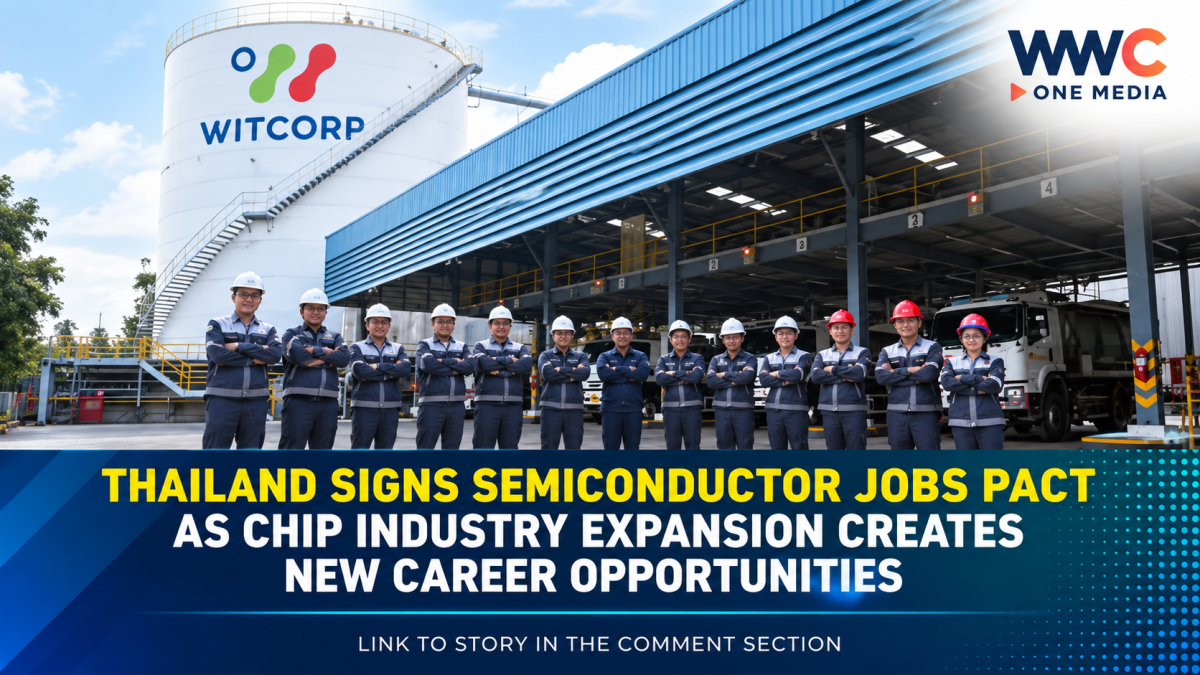
Thailand is moving to strengthen its semiconductor workforce after the government signed a new memorandum of understanding aimed at creating more employment opportunities in the country’s fast-growing chip industry.
The agreement brings together government agencies, educational institutions and industry players to improve recruitment, training and career pathways for workers seeking jobs in semiconductor-related fields.
The initiative comes as Thailand attempts to position itself as a more important player in the global semiconductor supply chain.
Semiconductors are increasingly viewed as a strategic industry because chips are essential to everything from smartphones and computers to electric vehicles, artificial intelligence systems, industrial machinery and advanced medical equipment.
Thailand already has an established electronics and electrical manufacturing sector, but authorities want to move further up the value chain by attracting investment in higher-skilled semiconductor activities.
That expansion is creating demand for engineers, technicians, production specialists, researchers and workers with expertise in electronics, automation and advanced manufacturing.
The new agreement is intended to help close the gap between what companies need and the skills available in the labour market.
Training programmes are expected to focus on areas relevant to semiconductor manufacturing and related industries, giving students and existing workers a clearer route into the sector.
The government sees workforce development as essential because attracting semiconductor investment requires more than factories and infrastructure.
Companies deciding where to establish production facilities also look closely at whether a country has enough skilled workers to operate sophisticated manufacturing equipment and maintain high-quality production standards.
Thailand is competing with other Asian economies for this investment.
Countries across Southeast Asia are seeking to benefit from companies diversifying their semiconductor supply chains amid growing geopolitical tensions and efforts to reduce excessive dependence on any single manufacturing base.
Thailand’s existing industrial infrastructure and experience in electronics manufacturing give it an advantage, but a shortage of highly specialised workers could limit the country’s ability to capture more advanced investment.
The new workforce initiative is therefore designed to support both current employment and future industrial expansion.
For students, the semiconductor sector could offer opportunities in engineering, research, equipment maintenance, quality control, automation and other specialised fields.
For existing workers, additional training could allow them to transition from traditional electronics manufacturing into higher-value semiconductor positions.
The agreement also reflects a broader shift in Thailand’s economic strategy.
The country is seeking to attract investment in advanced industries rather than relying primarily on traditional manufacturing and lower-cost production.
Semiconductors fit into that strategy because the industry can generate high-skilled jobs, encourage technology transfers and strengthen connections between universities, research institutions and multinational companies.
The global chip industry is undergoing major changes as demand grows for processors used in artificial intelligence, electric vehicles and data centres.
That has encouraged governments to provide incentives for semiconductor companies to establish or expand operations in their countries.
Thailand wants to ensure it is prepared to take advantage of that investment wave.
However, building a semiconductor workforce will take time.
Advanced chip manufacturing requires specialised knowledge and practical experience, meaning training programmes must keep pace with rapidly changing technologies.
Companies and educational institutions will therefore need to work closely together to ensure courses reflect actual industry requirements rather than relying solely on traditional academic programmes.
The new partnership could help address that problem by creating stronger links between employers and training providers.
It could also make semiconductor careers more visible to young Thais who may not previously have considered the industry.
For the government, the goal is ultimately to create a sustainable talent pipeline capable of supporting Thailand’s semiconductor ambitions for years to come.
The country is not expected to compete directly with the world’s most advanced chipmaking centres in every part of the semiconductor supply chain.
Instead, Thailand can build on its strengths in electronics, automotive manufacturing, hard-disk production, testing, packaging and related industrial activities while gradually moving into more sophisticated areas.
The workforce agreement is an important part of that transition.
If training and recruitment efforts succeed, Thailand could see a growing number of high-skilled jobs emerge alongside new semiconductor investment.
The semiconductor race is no longer only about who can build the biggest factory.
It is increasingly about who has the engineers, technicians and skilled workers capable of keeping those factories running.
Thailand’s latest initiative is an attempt to make sure the country has the people needed to turn its semiconductor ambitions into real jobs, investment and long-term economic growth.




Leave a Reply