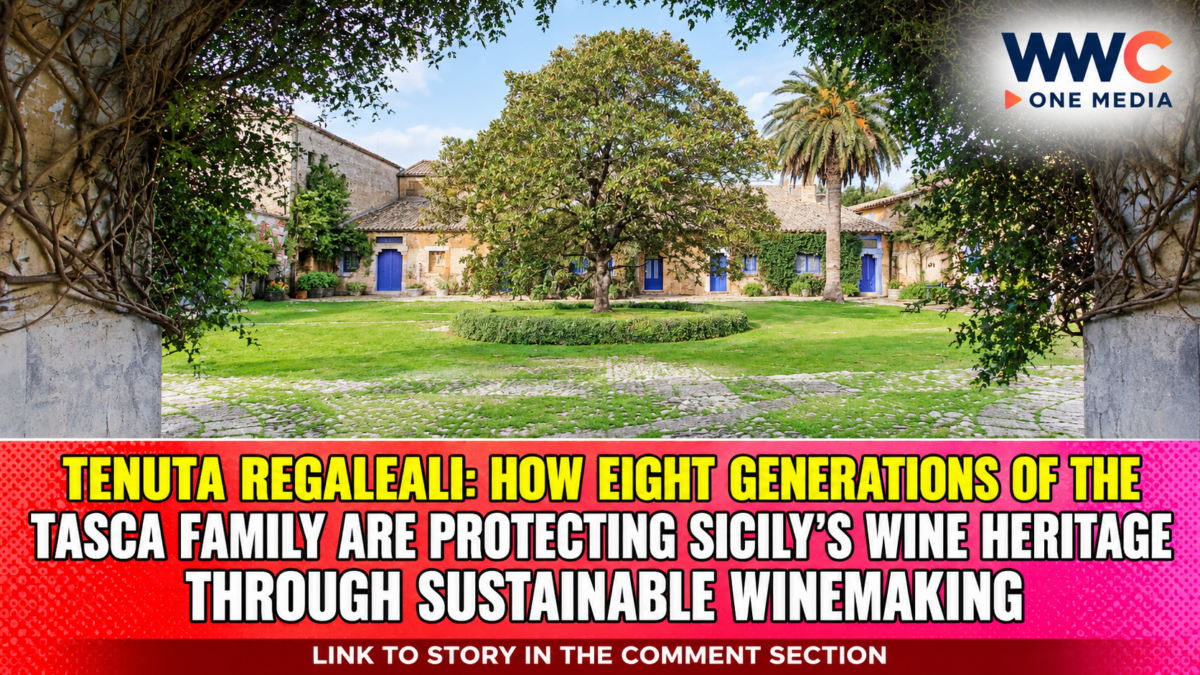
In the heart of Sicily, where rolling hills, vineyards and olive groves shape the landscape, one historic wine estate is demonstrating how tradition and sustainability can work together to create wines with a strong sense of place.
Tenuta Regaleali, the flagship estate of the Tasca d’Almerita family, is more than a vineyard. It is a 550-hectare agricultural landscape that reflects nearly two centuries of winemaking, experimentation and environmental stewardship.
Owned by the Tasca family since 1830, the estate has become an important part of Sicily’s wine identity. Its approach is built around a long-term philosophy: producing distinctive wines while protecting the land and natural resources that make them possible.
The story is particularly relevant as wine producers worldwide face growing pressure to respond to climate change, protect biodiversity and reduce the environmental impact of agriculture.
A Sicilian Estate Shaped by 12 Soil Types and Six Hills
One of Tenuta Regaleali’s defining characteristics is the diversity of its landscape.
The estate covers approximately 550 hectares and contains 12 different soil types across six hills situated between 450 and 850 metres above sea level.
These variations in elevation, soil composition and exposure create different growing conditions across relatively short distances. As a result, individual vineyard areas can produce grapes with distinct characteristics, giving the winemaking team a wide range of options when developing its wines.
The location also challenges common assumptions about Sicilian wine.
Although Sicily is often associated with hot Mediterranean conditions, Regaleali’s inland position and higher elevations create a more varied environment. These conditions help explain why the estate can produce wines that balance ripeness with freshness.
For Alberto Tasca, who leads the family business, understanding the land requires patience, observation and continuous experimentation rather than relying on a fixed formula.
Nearly 200 Years of Family Winemaking
The Tasca family’s connection to Regaleali began in 1830, when the Tasca brothers acquired the estate in central Sicily.
Over eight generations, the family developed its agricultural operations and helped establish the property as a significant wine-producing destination.
Its history includes the cultivation of traditional Sicilian grape varieties such as Nero d’Avola, Catarratto, Perricone, Nerello Mascalese and Grillo, alongside international varieties including Cabernet Sauvignon and Chardonnay.
Today, approximately 25 grape varieties are cultivated at Tenuta Regaleali.
One of the estate’s historically important wines is Rosso del Conte, which originated from an experimental vineyard planted in 1959 by Count Giuseppe Tasca d’Almerita. The wine, first released from the 1970 vintage, became an important expression of the estate’s ambition to demonstrate the potential of Sicilian vineyards.
The family’s philosophy has also expanded beyond Regaleali. Tasca d’Almerita now manages five estates across different parts of Sicily, each representing a distinct agricultural environment and winemaking identity.
Sustainability Is Built Into the Vineyard
Environmental responsibility is central to the estate’s agricultural practices.
Tasca d’Almerita participates in SOStain Sicilia, a sustainability programme designed to encourage measurable environmental and social responsibility throughout the Sicilian wine industry.
The initiative looks beyond the grapes themselves. Its framework considers vineyard management, biodiversity, energy use, water consumption, packaging, worker welfare and the wider impact of wine production.
At Regaleali, one important measure is the decision not to use chemical herbicides for weed control.
Instead, the estate relies on mechanical methods, including cultivation equipment that removes unwanted vegetation without chemical weed-killing agents.
The estate also preserves substantial areas outside its vineyards. These include forests, pastures, olive groves, lakes, streams, agricultural fields and uncultivated land that can provide habitats for local wildlife.
Bees are also kept on the properties. Beyond producing honey, they serve as important indicators of ecosystem health and contribute to pollination.
These practices reflect a broader understanding of sustainability: a vineyard is part of a living landscape, not an isolated agricultural production site.
Lighter Bottles and Measurable Environmental Targets
Sustainability also extends to the materials used after the grapes have been harvested.
Tasca d’Almerita reports that its average 750-millilitre non-sparkling wine bottle weighs approximately 507 grams, below the SOStain programme’s 550-gram threshold.
Reducing bottle weight matters because glass production and transportation require energy. Lighter bottles can reduce the amount of raw material needed and lower the emissions associated with shipping wine.
The winery also monitors energy consumption and environmental indicators through programmes including VIVA, which assesses areas such as carbon footprint, water footprint, vineyard management and territorial impact.
According to the company’s published sustainability information, its electricity consumption per litre of processed wine has remained below the SOStain benchmark of 0.7 kilowatt-hours.
These figures are part of the estate’s wider effort to measure its environmental performance rather than relying on sustainability claims alone.
Tasca d’Almerita has also achieved B Corp certification, joining a global movement of businesses assessed on their environmental and social performance, governance, employees and community impact.
The certification does not mean that wine production has no environmental footprint. Instead, it reflects an independently assessed commitment to broader standards of responsible business operations.
Two Regaleali Wines Bring the Estate’s Identity to Manila
The estate’s philosophy is also expressed through the wines being introduced to guests in Manila.
At the Tatler Ball 2026, two labels from the Regaleali range are being presented: Regaleali Bianco 2025 and Regaleali Nero d’Avola 2023.
The Regaleali Bianco has a history stretching across 66 harvests. Its blend combines native Sicilian grape varieties Catarratto, Inzolia and Grecanico with a smaller proportion of Chardonnay.
The intention is to preserve freshness, aromatic character and drinkability while maintaining the identity of the estate.
The Regaleali Nero d’Avola 2023 represents another longstanding expression of the property, with a history spanning 68 harvests.
Nero d’Avola is one of Sicily’s best-known red grape varieties, valued for its capacity to produce wines with ripe fruit character and structure.
For this vintage, the estate carefully monitors grape ripening before ageing the wine for ten months. The process is divided between stainless-steel tanks and large Slavonian oak casks, allowing the wine to develop complexity without allowing oak flavours to dominate the fruit.
Together, the two wines offer different expressions of the same agricultural landscape: one built around freshness and native white varieties, the other around the depth and character of a celebrated Sicilian red grape.
Why Sicily’s Wine Industry Is Looking Beyond the Bottle
The work at Tenuta Regaleali reflects a wider shift in the global wine industry.
Producers are increasingly being judged not only by the quality of their wines but also by how they manage land, water, energy, packaging and biodiversity.
Climate conditions can influence harvest timing, grape ripening and the balance between acidity and sugar. For vineyards, understanding local soil and elevation differences can therefore become an important part of adapting to changing conditions.
This makes Regaleali’s detailed approach to its individual vineyard plots particularly significant.
The estate’s 12 soil types and varied elevations provide different growing environments within one property. Studying those differences allows the winemaking team to make more informed decisions about grape varieties, vineyard management and the character of each wine.
The issue also connects with broader pressures facing established wine regions. France’s projected 2026 wine harvest decline, for example, has highlighted how weather extremes can affect production even in countries with centuries of winemaking history.
Read more about the pressures facing the European wine industry:
https://wwconemedia.com/frances-wine-harvest-is-heading-for-a-70-year-low-and-the-damage-goes-far-beyond-one-brutal-summer/
From Sicilian Wine Heritage to a More Responsible Future
Tenuta Regaleali’s story is ultimately about continuity.
The Tasca family has managed the estate since 1830, but its approach is not simply about preserving historical methods. It combines traditional grape varieties and generations of agricultural knowledge with environmental monitoring, modern vineyard management and ongoing experimentation.
That balance is increasingly important for wine producers seeking to protect the character of their regions while responding to new environmental and commercial challenges.
The estate’s wines also connect naturally with the wider dining experience, where food, ingredients and beverages are increasingly considered part of a larger cultural story.
Explore how wine is used to shape flavour in the kitchen:
https://wwconemedia.com/the-science-behind-cooking-with-alcohol/
For readers interested in how premium beverages are becoming part of luxury hospitality, Singapore’s emerging Moutai House offers another example of how drinks can be connected with dining, culture and collectible experiences:
https://wwconemedia.com/singapores-new-moutai-house-is-bringing-million-dollar-bottles-fine-dining-and-cocktails-to-the-riverfront/
The changing expectations surrounding fine dining also provide useful context for the role of wine in contemporary hospitality:
https://wwconemedia.com/fine-dining-is-chasing-worlds-best-rankings-while-diners-chase-value-but-the-prestige-race-may-be-breaking-the-restaurant-model/
For Tasca d’Almerita, however, the central idea remains rooted in the land.
A bottle of Regaleali represents more than a particular grape variety or vintage. It carries the influence of Sicily’s hills, soils, agricultural traditions and the decisions made by generations of people responsible for protecting the estate.
As the family looks toward future generations, its challenge is not simply to produce another successful harvest. It is to ensure that the landscape capable of producing these wines remains healthy and productive long into the future.