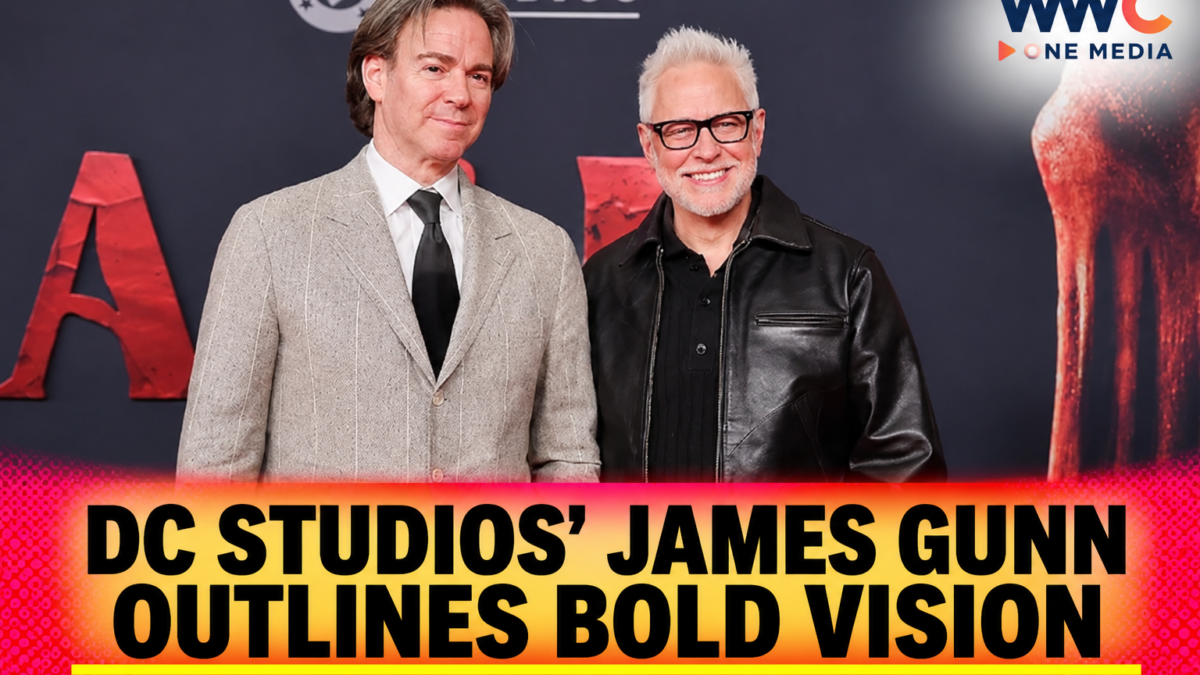
James Gunn and Peter Safran OUT at DC Studios as Marvel Veteran Takes Over — Could Superman’s New Era Be in Trouble?
LOS ANGELES, California — Hollywood’s superhero landscape is facing another major shake-up as James Gunn and Peter Safran prepare to leave their leadership positions at DC Studios, ending a four-year run that was supposed to rebuild one of the entertainment industry’s most recognizable comic-book franchises.
Their replacement? A familiar name from Marvel’s successful cinematic universe.
Skydance Motion Picture Group has appointed Jeremy Latcham, a former Marvel Studios executive who helped develop blockbuster productions including Iron Man, The Avengers and Guardians of the Galaxy, as the new president and chief creative officer of DC Studios.
The leadership change takes effect December 1, 2026.
The announcement, made November 9, comes shortly after Skydance completed its acquisition of Warner Bros. Discovery and finalized its merger with Paramount Pictures.
Although Gunn and Safran will return to full-time creative work, their departure from the studio’s top leadership positions raises significant questions about the future direction of Superman, Batman and the wider DC Universe.
The timing is particularly important.
Gunn’s Superman generated approximately $618.7 million worldwide, giving DC a significant theatrical success. However, the studio also experienced disappointing results with Supergirl, while its other productions delivered mixed commercial performances.
Now, with a Marvel veteran taking control, DC faces another opportunity to redefine its superhero strategy.
But will Latcham continue the creative vision established by Gunn and Safran, or will Skydance introduce another major transformation?
DC Studios Confirms Major Leadership Change Under Skydance
Skydance announced that Gunn and Safran would step away from their leadership responsibilities after four years overseeing DC Studios.
The company praised the pair for rebuilding the studio’s creative foundation and establishing a new slate of television and film productions.
Skydance chairman and CEO David Ellison and co-CEO Ynon Kreiz expressed appreciation for their contributions, describing their leadership as an important period of transformation for DC.
Under the new arrangement, Latcham will oversee the studio’s creative development, production, talent and strategy across movies, television and animation.
He will report to Dana Goldberg and Josh Greenstein, co-chairs of Skydance Motion Picture Group.
Importantly, Gunn and Safran are not being removed from every DC production.
They are expected to continue working on existing projects, including the upcoming Superman sequel, Man of Tomorrow.
The company has described the move as a leadership transition, not a complete separation from the DC franchise.
That distinction matters because several productions developed under their direction are already moving forward.
Who Is Jeremy Latcham? The Marvel Executive Now Leading DC
Latcham is not a newcomer to superhero filmmaking.
He joined Marvel Studios in 2004 and became part of the executive team that helped establish the Marvel Cinematic Universe.
His experience includes several major productions:
- Iron Man
- Iron Man 2
- The Avengers
- Guardians of the Galaxy
- Avengers: Age of Ultron
- Spider-Man: Homecoming
He worked closely with Marvel president Kevin Feige during the development of the studio’s early cinematic universe.
His responsibilities included helping coordinate major productions that eventually became part of Marvel’s interconnected storytelling strategy.
Latcham left Marvel in 2017 to establish his own production company, Latcham Pictures.
He later produced projects including Bad Times at the El Royale and Dungeons & Dragons: Honor Among Thieves.
His appointment gives DC an executive who understands both individual superhero productions and the complicated process of managing a large entertainment franchise.
However, his Marvel background does not automatically guarantee success.
DC has its own established characters, audience expectations and storytelling traditions.
The challenge will be creating a sustainable identity rather than simply copying Marvel’s formula.
James Gunn Speaks Out About His DC Studios Departure
Following the announcement, Gunn addressed his departure through a personal statement.
He expressed gratitude toward the DC Studios team, actors, filmmakers and fans who supported the new direction.
However, he also acknowledged that managing the studio had been difficult.
Gunn described the corporate responsibilities of the job as challenging, explaining that balancing his filmmaking interests with executive duties had taken a considerable amount of time and energy.
He said he was excited to return to filmmaking.
His statement also made clear that his relationship with DC is not necessarily ending.
Gunn indicated that he and Safran would continue working on Man of Tomorrow and another DC project that he is writing.
He did not disclose the details of that additional project.
The comments suggest that the filmmaker is looking forward to concentrating more heavily on storytelling rather than managing the daily responsibilities of a major studio.
For fans, that could be significant.
Gunn is widely associated with DC’s current creative direction, and his continued involvement could help preserve some consistency during the transition.
Superman Became Gunn and Safran’s Biggest DC Success
The 2025 release of Superman was one of the defining moments of Gunn and Safran’s leadership.
Starring David Corenswet as Clark Kent, the film introduced a new interpretation of the iconic superhero after years of changes to DC’s cinematic direction.
The movie generated approximately $618.7 million worldwide, according to figures reported by the Associated Press.
Its approach combined superhero action, humor, emotional storytelling and a wider collection of DC characters.
The performance provided encouragement that audiences were still interested in DC’s theatrical universe.
However, box-office success is not measured by worldwide ticket sales alone.
Production budgets, marketing costs, theatrical revenue shares and downstream distribution income all influence a film’s financial performance.
Although Superman was the strongest commercial result of the Gunn-Safran era, it did not guarantee that every subsequent project would attract the same audience.
The next major challenge will be maintaining interest in the franchise after the leadership transition.
Supergirl’s Box Office Performance Raised New Questions
Not every DC release delivered the results the studio wanted.
Supergirl, released in July 2026, generated approximately $126.5 million worldwide against a reported production budget of around $170 million, according to industry reporting by Variety and other entertainment publications.
The result was a major commercial disappointment.
It also intensified questions about DC’s strategy of introducing characters and stories outside its most established superhero properties.
The challenge for the studio is finding the right balance between recognizable characters and new creative ideas.
Audiences may be familiar with Superman and Batman, but lesser-known characters often require stronger marketing and storytelling to attract mainstream viewers.
Industry observers have also questioned whether superhero films can continue supporting increasingly expensive production budgets.
The genre remains commercially important, but its performance is becoming less predictable.
For Latcham, the lesson may be that strong intellectual property alone is not enough.
The studio must produce films that connect with audiences while maintaining financial discipline.
Clayface Shows Why DC Cannot Rely on One Superhero Formula
Another important production from the Gunn-Safran era is Clayface.
Unlike a traditional superhero blockbuster, the film explores a darker, body-horror approach to one of Batman’s enemies.
According to the Associated Press, the movie had generated approximately $109 million worldwide by the time of its November 9 report.
Variety reported a production budget of approximately $44 million.
Although its commercial performance has been more modest than Superman’s, the film demonstrates DC’s willingness to experiment with different genres.
That approach could become an important part of the franchise’s identity.
Not every DC production needs to resemble a traditional superhero action movie.
Some characters may work better in horror, mystery, crime or psychological drama.
The question is whether Latcham will preserve this creative flexibility or move toward a more conventional blockbuster strategy.
What Happens to Superman: Man of Tomorrow?
One of the biggest concerns among DC fans involves the future of Man of Tomorrow.
The film is scheduled for theatrical release on July 9, 2027.
Gunn is writing and directing the project, with Gunn and Safran serving as producers.
The upcoming installment will continue the story of Clark Kent and Lex Luthor.
Because the project is already in post-production, the leadership change does not automatically mean its creative direction will be altered.
Skydance has publicly identified the movie as part of the upcoming DC Studios slate.
For fans, this is important because it means Gunn’s Superman storyline will continue beyond his executive departure.
However, the longer-term future of the franchise will depend on decisions made under Latcham’s leadership.
Will the studio continue developing the interconnected DC universe established by Gunn and Safran?
Or will future projects introduce a different creative structure?
Those questions remain unanswered.
The Batman Part II Is Also Moving Forward
Another major project is The Batman Part II, starring Robert Pattinson.
The film is moving forward under the existing production plan, with Gunn and Safran attached as producers.
The project is particularly interesting because Batman’s separate cinematic world has historically operated differently from the main DC Universe.
That distinction allows the studio to develop different interpretations of its most popular characters without necessarily placing every film within one continuous storyline.
Maintaining this flexibility could become important for the new management team.
DC has an opportunity to serve different audiences through distinct storytelling approaches.
The challenge is making those projects work together commercially without confusing viewers about how the different universes connect.
DC Television and Animation Also Face a New Creative Era
Latcham’s responsibilities will extend beyond theatrical movies.
During their leadership, Gunn and Safran oversaw several television and animation productions, including Peacemaker and Creature Commandos.
They also served as executive producers on Lanterns.
Another upcoming production is The People v. Gorilla Grodd, an eight-episode HBO Max series featuring Skyler Gisondo as Jimmy Olsen and Jimmy Tatro as Gorilla Grodd.
According to Skydance, the series has completed filming and is expected in 2027.
These projects demonstrate the scale of the DC entertainment operation.
The studio must coordinate movies, television productions and animation while maintaining consistency across its characters and stories.
Latcham’s ability to manage this pipeline could become one of the most important tests of his leadership.
Skydance’s Warner Bros. Acquisition Changes the Corporate Equation
The DC leadership shake-up is happening within a much larger corporate transformation.
Skydance completed its acquisition of Warner Bros. Discovery on October 6, 2026, bringing major entertainment brands under a new corporate structure.
The combined company includes:
- Warner Bros. Pictures
- Paramount Pictures
- HBO
- HBO Max
- Paramount+
- CBS
- CNN
- Nickelodeon
The transaction created a major entertainment group with extensive film, television, streaming and media operations.
However, integrating two major companies also creates financial and organizational challenges.
Skydance has outlined a plan targeting at least $6 billion in annual recurring cost savings over three years.
The restructuring includes corporate consolidation, technology integration, marketing efficiencies and vendor cost reductions.
This does not establish that cost-cutting directly caused Gunn and Safran’s departure.
Neither Skydance nor the outgoing executives publicly identified a specific financial dispute as the reason for the leadership transition.
Nevertheless, the timing raises questions about how the new corporate structure will influence DC’s creative independence and production priorities.
Why Marvel’s Former Executive Could Be DC’s Biggest Advantage
Latcham’s appointment creates an interesting situation for Hollywood.
A former executive who helped build Marvel’s cinematic universe will now oversee one of its biggest competitors.
Marvel demonstrated that superhero films could become part of a larger interconnected entertainment strategy.
The Avengers became a major example of how individual superhero stories could eventually converge into large-scale theatrical events.
DC has attempted similar strategies, but its cinematic history has involved multiple leadership changes and creative reorganizations.
Latcham could bring valuable experience in coordinating large productions and managing franchise continuity.
However, DC does not necessarily need another version of Marvel.
Superman, Batman, Wonder Woman and the Justice League already have distinct identities and decades of storytelling history.
The opportunity is to build a recognizable DC approach that audiences can trust.
That may require stronger planning, controlled production budgets and a clearer long-term vision.
What the Leadership Change Means for DC Fans
For audiences, the immediate impact may be limited because several major projects are already underway.
Man of Tomorrow remains scheduled for July 2027.
The Batman Part II is moving forward.
The People v. Gorilla Grodd is also expected in 2027.
However, the future of projects that have not yet entered production could become more uncertain.
Latcham will have to evaluate the existing slate and determine which stories deserve continued investment.
This could influence future superhero appearances, television spin-offs and the direction of the larger DC Universe.
Fans will also be watching whether Gunn continues to have significant creative influence despite leaving the executive position.
His relationship with Safran and Latcham could help make the transition smoother.
But the final decisions will belong to the new studio leadership.
The Bigger Picture: Hollywood’s Superhero Business Is Changing
The DC leadership transition comes during a period when superhero movies are facing greater commercial pressure.
For years, studios relied on established comic-book characters to generate massive theatrical audiences.
The Marvel Cinematic Universe helped popularize the interconnected franchise model, while DC continued developing its own collection of superhero properties.
But audience expectations have changed.
Moviegoers now have more entertainment choices, including streaming services, video games and social media.
Production budgets and marketing expenses also make blockbuster filmmaking increasingly risky.
Studios must therefore become more selective about the projects they finance.
The future may favor films with stronger storytelling, more controlled budgets and clearer audience appeal rather than simply producing more superhero releases.
For DC, this makes Latcham’s appointment especially important.
His experience could help the studio improve its production strategy, but he will still need to prove that he understands what audiences want from DC’s characters.
Final Verdict: A New DC Boss, but the Superman Story Is Not Over
James Gunn and Peter Safran’s departure from DC Studios marks the end of an important leadership chapter.
Their four-year tenure brought a new Superman, expanded television and animation projects, and a more varied approach to comic-book storytelling.
The results were mixed, with Superman providing a major theatrical success while Supergirl demonstrated the financial risks of expensive superhero productions.
Now Jeremy Latcham takes over with the responsibility of building DC’s next generation of entertainment projects.
His experience at Marvel gives him a strong background in blockbuster production and interconnected franchises.
But DC’s future will depend on more than his previous credits.
He must maintain audience confidence, manage production costs and establish a creative direction that makes Superman, Batman and the wider DC Universe commercially sustainable.
Gunn and Safran may be stepping away from executive leadership, but their creative influence will remain visible in upcoming productions.
The real test begins when Latcham starts making decisions about what comes after them.
DC has changed leadership once again, Marvel has sent one of its experienced executives to take control, and the future of Superman and Batman is entering another uncertain chapter. Could Jeremy Latcham finally give DC the stability it needs—or will fans witness yet another superhero universe reset?