
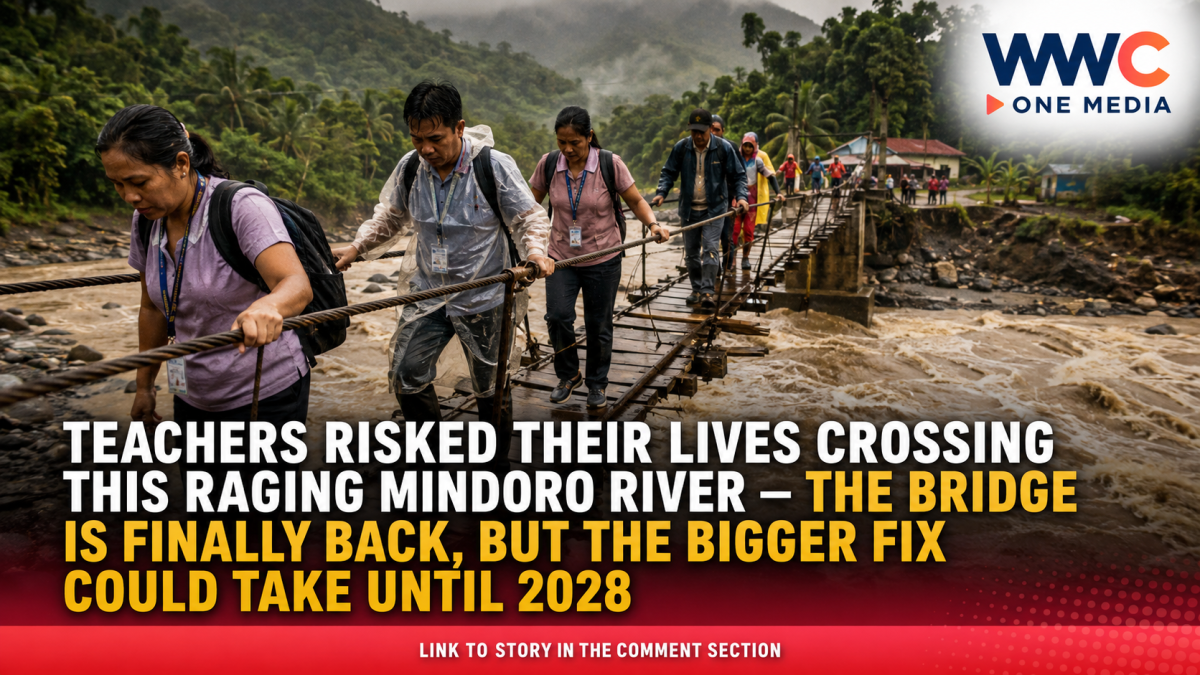
BONGABONG, Oriental Mindoro — A vital bridge used by teachers, students and members of the Bangon Mangyan community in a remote part of Bongabong has been restored after days of dangerous crossings over a swollen river exposed the severe transportation challenges facing residents of Sitio Naswak.
The crossing connects communities around Barangay Hagan with Sitio Naswak in Barangay Lisap and provides access to Naswak Hatubuan Bangon Elementary School, where teachers have continued reporting for duty despite difficult and at times life-threatening travel conditions.
ABS-CBN News reported on Sunday, August 30, that the bridge had been restored after images and reports showed teachers and Indigenous residents carefully making their way across the damaged structure while powerful river currents rushed underneath.
Teachers stranded as river suddenly rose
The latest development comes more than a week after a major emergency in the same community.
On August 20, rapidly rising water caused the bamboo access bridge in Sitio Naswak to collapse, leaving teachers stranded after they could no longer safely cross the river.
The Philippine Information Agency and Inquirer, citing police and disaster-response authorities, reported that 12 teachers were safely evacuated following the incident. Responders from the Oriental Mindoro police, Special Action Force, Bureau of Fire Protection and Bongabong Municipal Disaster Risk Reduction and Management Office participated in the rescue.
No injuries were reported.
The exact number of teachers has varied in some media accounts, with certain television reports referring to 15 teachers. The official PIA report based on information from Oriental Mindoro police listed 12 teachers, so that figure is used here for accuracy.
Teachers, students forced onto damaged bridge
GMA News separately documented how teachers, students and residents continued relying on the damaged hanging bridge because it was effectively their main route to the school and surrounding settlements.
Footage showed people gripping cables and carefully navigating the structure above the strong current.
One teacher reportedly had to spend the night at the school after worsening weather made the return trip too dangerous.
The Department of Education responded by stressing that teachers should not have to put their lives at risk simply to reach their classrooms. DepEd also said teachers assigned to difficult areas may receive a Special Hardship Allowance equivalent to 25 percent of their monthly salary, subject to the applicable hardship classification.
Bridge is more than a route to school
For the Bangon Mangyan communities living in the area, the crossing is not only about education.
It is also an economic lifeline.
The bridge allows Indigenous residents to bring agricultural products from upland communities toward town and provides access to markets, government services and other necessities.
The struggle is not new.
An Inquirer report published roughly a decade ago documented Mangyan residents in the same general area resorting to improvised flotation devices to cross rivers and transport produce when bamboo bridges became unusable. The report described how communities in Naswak and neighboring sitios depended heavily on river crossings for everyday life and livelihoods.
The latest bridge failure therefore highlights a long-running infrastructure problem rather than an isolated weather emergency.
Permanent 216-meter bridge planned
While the repaired crossing provides immediate relief, authorities are also pursuing a much larger permanent solution.
GMA News reported that the Department of Public Works and Highways has a project to replace the vulnerable crossing with a steel bridge.
According to DPWH officials interviewed by GMA, the entire planned bridge is approximately 216 meters long and will be completed in phases.
Phase 1 reportedly carries funding of around ₱18 million. Contractor MG Dragon Construction Services said fabrication of steel components had already begun, with about 35 percent of the required steel components obtained at the time of the report.
The 2026 General Appropriations Act separately lists ₱19.244 million for the “Construction of Bridge, Sitio Naswak” in Barangay Lisap, Bongabong, Oriental Mindoro, covering stations 0+000 to 0+216 — consistent with the reported 216-meter length of the project.
DPWH Southern Mindoro District Engineer Annielyn Padullo told GMA that another phase was being proposed for 2027. Based on the agency’s timeline cited in the report, the full structure could potentially be finished by the end of 2027 or during the first half of 2028, depending on implementation and funding.
That means the newly restored community crossing should not be confused with the planned permanent bridge, which remains a longer-term infrastructure project.
A recurring challenge for remote Mangyan schools
The situation in Naswak reflects a broader challenge across geographically isolated communities in Oriental Mindoro.
The provincial government renewed contracts in July for 87 teachers serving remote Indigenous communities under its Programang Pang-edukasyon sa Kalibliban and announced plans to deploy 10 additional teachers.
Another government report described teachers traveling across as many as five rivers and mountain trails just to reach Ambang Mangyan Integrated School in Puerto Galera.
These stories underline a larger issue: access to education in remote Indigenous communities depends not only on classrooms and teachers, but also on safe bridges, roads, communications and reliable transportation.
For the teachers and Bangon Mangyan families of Sitio Naswak, restoring the damaged crossing removes an immediate danger.
But the real milestone will come when residents no longer have to gamble with a raging river at all.




Leave a Reply