
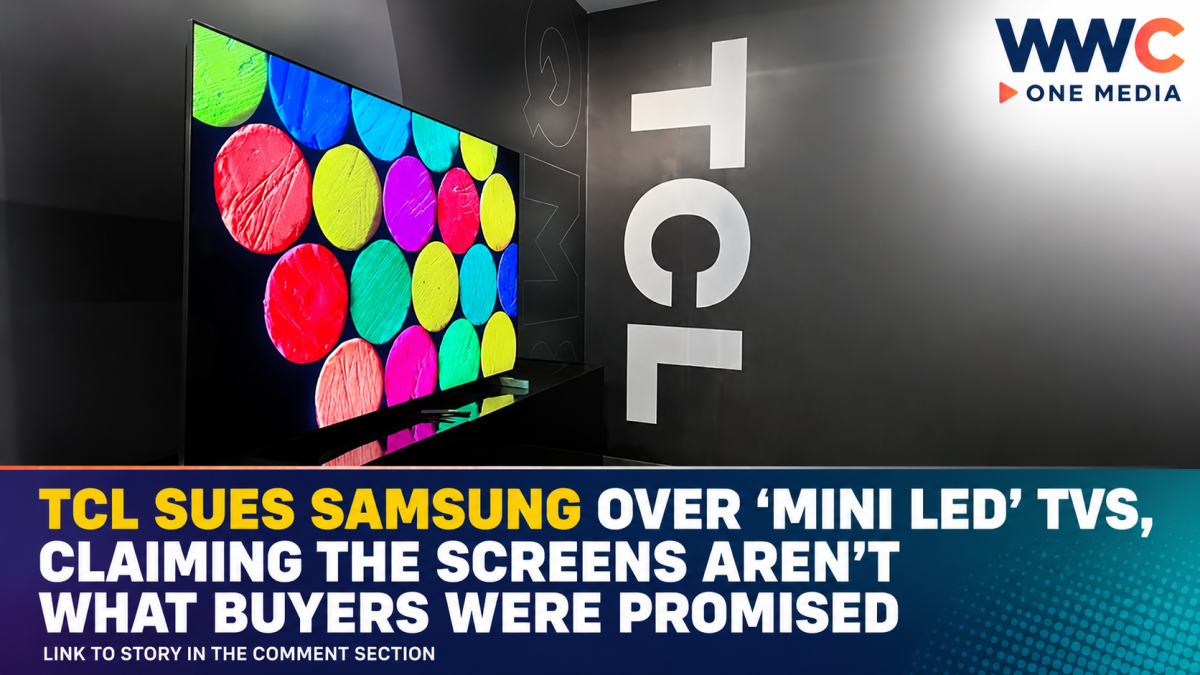
LOS ANGELES — A major battle over one of the television industry’s fastest-growing technologies has moved into the courtroom.
TCL North America has sued Samsung Electronics America in a U.S. federal court, accusing the South Korean electronics giant of falsely advertising certain televisions as Mini LED models even though, according to TCL’s lawsuit, the sets do not contain the technology’s key components.
The lawsuit, filed Aug. 31 in federal court in California, targets Samsung’s M Model televisions. TCL alleges that Samsung repackaged or rebranded a conventional LED television and marketed it to consumers as a Mini LED product at a lower price than competing TCL models.
Samsung had not responded to Reuters’ request for comment when the report was published. The allegations therefore remain claims made by TCL and have not been established by a court.
What TCL is accusing Samsung of doing
According to the complaint, Samsung’s M Model televisions were marketed as incorporating Mini LED technology despite allegedly lacking the technological components associated with genuine Mini LED backlighting.
TCL claims the M Model is closely related to Samsung’s standard Crystal UHD televisions and alleges that Samsung effectively repackaged an existing conventional LED product as a Mini LED model.
The lawsuit further alleges that Samsung launched the M Model in March at prices below TCL’s least expensive Mini LED televisions. TCL argues that the pricing and labeling gave Samsung a way to compete more aggressively in a segment where TCL had gained significant ground.
TCL is seeking an injunction that would prevent Samsung from marketing or selling the disputed televisions as Mini LED products, along with compensatory damages. The amount of damages sought has not been specified.
Why the Mini LED label matters
Mini LED is not simply a marketing term for a brighter conventional LCD television.
The technology uses a much larger number of smaller LED light sources behind an LCD panel. Those LEDs can be divided into numerous local-dimming zones, allowing the television to control brightness more precisely across different parts of the image.
That can improve contrast, highlight detail and the separation between bright and dark areas while helping reduce some of the limitations traditionally associated with LCD televisions.
The technology has become an increasingly important battleground between major television manufacturers as companies attempt to deliver OLED-like contrast and premium picture performance at lower prices.
Omdia reported in August that Mini LED televisions accounted for 13% of global TV shipments in the second quarter of 2026, highlighting how quickly the technology has moved beyond a niche premium category.
TCL and Samsung are fighting for a rapidly changing market
The lawsuit comes as the balance of power in the Mini LED television market is shifting.
Omdia said TCL held a 30.2% share of global Mini LED TV shipments in the first quarter of 2026. By the second quarter, however, Samsung had moved into first place with a 28.2% share, while TCL’s position fell behind it.
That makes the timing of the lawsuit particularly significant.
Omdia has described Samsung’s strategy as expanding Mini LED into more mainstream price points, while TCL has been pushing its own Mini LED technology across both premium and more affordable segments.
In other words, this is not simply a dispute over a product name. It is unfolding in the middle of a rapidly intensifying fight over who controls the next major segment of the premium LCD television market.
TCL says consumers were misled
TCL’s central argument is that consumers shopping for a Mini LED television would reasonably expect the benefits associated with the technology.
The company says Samsung’s alleged labeling could therefore influence purchasing decisions by making a conventional LED television appear to offer the more advanced performance associated with Mini LED.
TCL attorney R.C. Harlan said the alleged advertising misled consumers seeking the picture-quality benefits associated with Mini LED technology and damaged TCL’s sales, reputation and technology position.
The complaint also alleges that Samsung’s M Model sales increased sharply after the launch, with TCL claiming that sales of Samsung’s Mini LED televisions nearly quadrupled in less than three months. That figure is an allegation contained in TCL’s case, rather than an independently established market result.
The bigger fight is bigger than one TV model
The legal dispute arrives at a pivotal moment for the global television industry.
Samsung dominated the Mini LED market in earlier years, but TCL and Hisense have aggressively expanded through lower-cost products.
Omdia says TCL and Hisense gradually overtook Samsung in Mini LED market share by 2024. Samsung has since pushed back by expanding its Mini LED portfolio into lower-priced segments.
The competition is also moving beyond conventional Mini LED.
Manufacturers are developing technologies such as RGB Mini LED and other advanced backlighting systems designed to increase brightness, color performance and contrast while keeping costs under control.
Omdia’s latest research shows just how intense that competition has become: Samsung, TCL and Hisense are among the three leading Mini LED TV makers, collectively accounting for roughly three-quarters of the market.
There is another twist in the Mini LED labeling debate
The TCL-Samsung dispute also comes as the broader industry faces increased scrutiny over how manufacturers describe advanced display technologies.
In a separate August report, South Korea’s ChosunBiz raised questions about TCL’s own promotional claims surrounding some of its Mini LED products, including how certain picture-quality measurements were presented in relation to Omdia.
Omdia told ChosunBiz that the measurements in question had been conducted by TCL rather than directly by Omdia, according to the report.
That does not establish that TCL’s current lawsuit against Samsung is unfounded, nor does it determine the merits of Samsung’s case. But it illustrates a broader problem confronting consumers: television manufacturers are increasingly using sophisticated technical terminology to differentiate products in a highly competitive market.
What happens next?
The case, TTE Technology Inc. dba TCL North America v. Samsung Electronics America Inc., is now entering the U.S. federal court process. The complaint asserts claims under the federal Lanham Act as well as California false-advertising and unfair-competition laws.
For now, TCL has made its case.
Samsung’s response—and ultimately the evidence presented in court—will determine whether the allegations survive legal scrutiny.
And that is what makes this dispute particularly important for television buyers.
If the court finds TCL’s allegations have merit, the case could force changes in how Samsung markets the disputed televisions and potentially influence how the industry defines and communicates “Mini LED” technology to consumers.
If Samsung successfully challenges the claims, however, the lawsuit could become another chapter in an increasingly aggressive battle among the world’s biggest TV manufacturers over technology, pricing and branding.
For consumers, the question is deceptively simple: when a television says “Mini LED” on the box, what exactly is behind the screen?
That question may now be answered in court.

Leave a Reply