
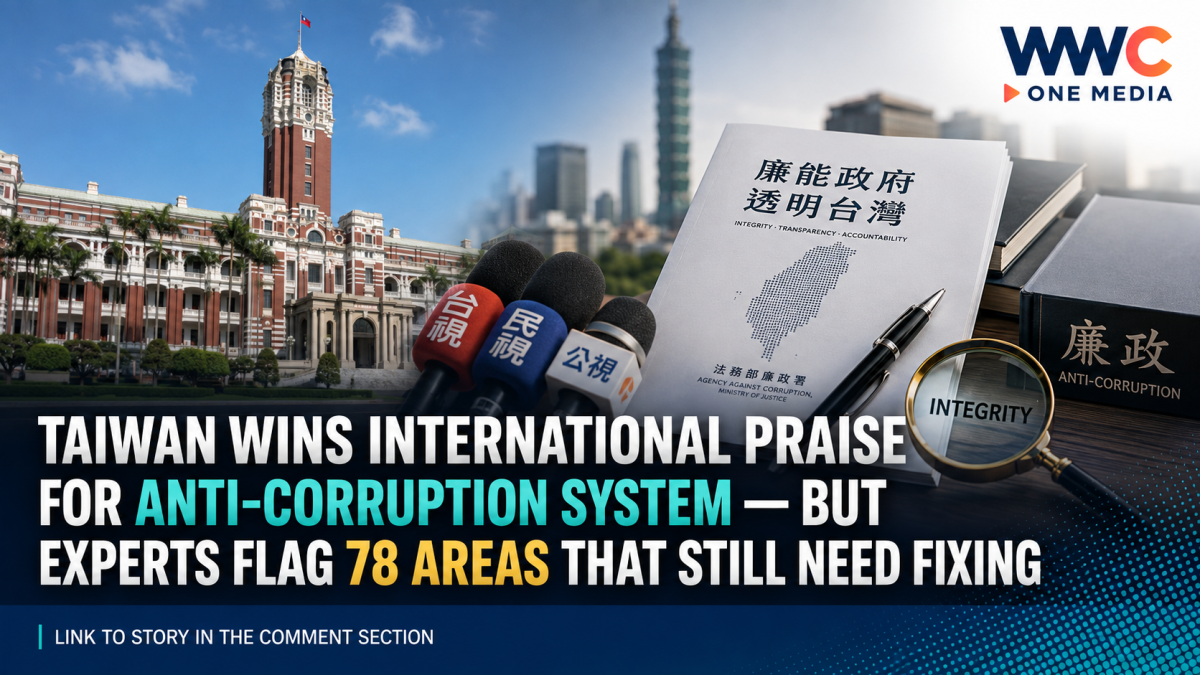
TAIPEI, Taiwan — Taiwan has won strong international praise for building what experts described as a mature and innovative anti-corruption system, but the assessment came with a significant warning: the island still faces serious transparency and accountability gaps involving political donations, lobbying, government procurement, corporate records and even national defense.
A five-member international review committee examining Taiwan’s third national report under the United Nations Convention against Corruption, or UNCAC, concluded its two-day review on August 28.
The experts recognized 41 measures as best practices, while identifying 78 implementation challenges and recommendations for improvement — making the review as much a roadmap for Taiwan’s unfinished reforms as an endorsement of the progress it has already made.
Committee chairman José Ugaz, a former chairman of Transparency International, said Taiwan had reached a mature stage in anti-corruption governance. But the panel stressed that the next challenge is proving that those systems actually work through results that can be measured and independently verified.
That distinction could become increasingly important for Taiwan: having anti-corruption rules on the books is one thing; demonstrating that they consistently prevent misconduct is another.
Political Donations and Lobbying Put Under the Spotlight
Among the most politically sensitive recommendations were calls for greater and faster transparency surrounding political donations, political lobbying and lobbying registration.
Committee member Julie Haggie praised Taiwan’s enforcement of conflict-of-interest regulations but said disclosure involving political contributions and lobbying could be made more immediate and transparent.
United Daily News separately highlighted political-finance transparency as one of the central issues raised by the international panel, reporting that reviewers want Taiwan to improve the timeliness of political donation disclosures and provide greater visibility into lobbying activities.
These recommendations matter because election financing and access to government decision-makers are among the areas where transparency rules can directly affect public confidence in democratic institutions.
Taiwan’s Procurement System Praised — With a Major Caveat
The review panel gave particularly strong marks to Taiwan’s Government Procurement Integrity Platform and Government e-Procurement System.
Committee member Gillian Dell said the mechanisms could serve as models for other countries.
But that praise was paired with calls for further improvement.
Dell said Taiwan needs stronger and more stable anti-corruption safeguards in government procurement, while also identifying national defense transparency and the maintenance of adequate judicial capacity as areas requiring continued attention.
That creates one of the central tensions in Taiwan’s next phase of reform: how to increase transparency and accountability in sensitive government spending without compromising legitimate security requirements.
Companies Could Face Greater Scrutiny
The review also moved beyond government agencies and examined corruption risks in Taiwan’s private sector.
Committee member Duncan Hames praised initiatives such as Taiwan’s Enterprise Service Integrity Platform and efforts to include state-owned enterprises in integrity evaluations.
But he recommended improving the transparency and reliability of information contained in company registration databases.
More significantly, Hames said Taiwan should establish a system of criminal liability for legal entities, potentially strengthening the ability of authorities to hold corporations — rather than only individuals — responsible for certain wrongdoing.
The recommendation could prove significant as governments worldwide increasingly focus on corporate responsibility, beneficial ownership, money laundering and cross-border financial crime.
Anti-Money Laundering and Asset Recovery Earn Strong Marks
Not all of the review centered on weaknesses.
Committee member Peter Ritchie highlighted Taiwan’s strengths in prosecution, anti-money laundering systems, corruption-risk assessments, management of virtual assets and mechanisms for recovering illicit proceeds.
He encouraged Taiwan to share more real-world case studies and enforcement experience with businesses and international partners, potentially allowing other jurisdictions to learn from Taiwan’s approach.
The experts also praised Taiwan’s efforts to promote integrity within the private sector and prevent conflicts of interest.
Why Taiwan Is Being Reviewed Under a UN Convention
There is an important technical distinction behind the process.
Taiwan is not a member of the United Nations and is not an official state party to UNCAC. Instead, Taiwan voluntarily enacted the Act to Implement the United Nations Convention against Corruption in 2015, giving the convention’s standards domestic legal effect.
It subsequently established its own reporting and international-review process, inviting overseas anti-corruption specialists to evaluate how closely Taiwan’s laws and enforcement practices meet UNCAC standards.
That means describing the five reviewers simply as “UN experts” would be misleading. They are international experts reviewing Taiwan’s voluntary implementation of UNCAC principles rather than conducting Taiwan’s review through the UN’s formal treaty mechanism.
Taiwan Already Has Its Best-Ever Corruption Ranking
The latest review also comes after Taiwan posted its strongest result to date in Transparency International’s global Corruption Perceptions Index.
In the 2025 CPI, released in February 2026, Taiwan scored 68 out of 100 and ranked 24th among 182 countries and territories, improving from 25th place and 67 points a year earlier.
It was Taiwan’s highest ranking and score under the current index and placed it ahead of roughly 86 percent of the jurisdictions evaluated.
However, a high CPI ranking does not mean corruption has been eliminated. The index measures perceptions of public-sector corruption, while the latest UNCAC-style review examines specific laws, institutions and enforcement mechanisms in considerably greater detail.
That helps explain how Taiwan can simultaneously record its best international corruption ranking while still receiving 78 recommendations for reform.
What Happens Next Could Matter More Than the Praise
Minister without Portfolio Lin Ming-hsin, who received the panel’s conclusions on behalf of the government, said the recommendations would be used as references for future anti-corruption policies, legislation and institutional reforms.
Taiwan is expected to report on its response and progress during its next national review cycle.
And that may ultimately be the most important part of this week’s assessment.
The headline result is encouraging: international experts believe Taiwan has built one of the more mature and innovative anti-corruption governance systems.
But the 78 recommendations reveal where the next battle will be fought — particularly over political money, lobbying transparency, defense procurement, corporate accountability and whether government anti-corruption programs can demonstrate measurable results rather than simply impressive rules.
For Taiwan, the next test is no longer whether it has an anti-corruption architecture.
It is whether that architecture can expose risks, withstand political pressure and prove that it works when transparency matters most.



Leave a Reply