
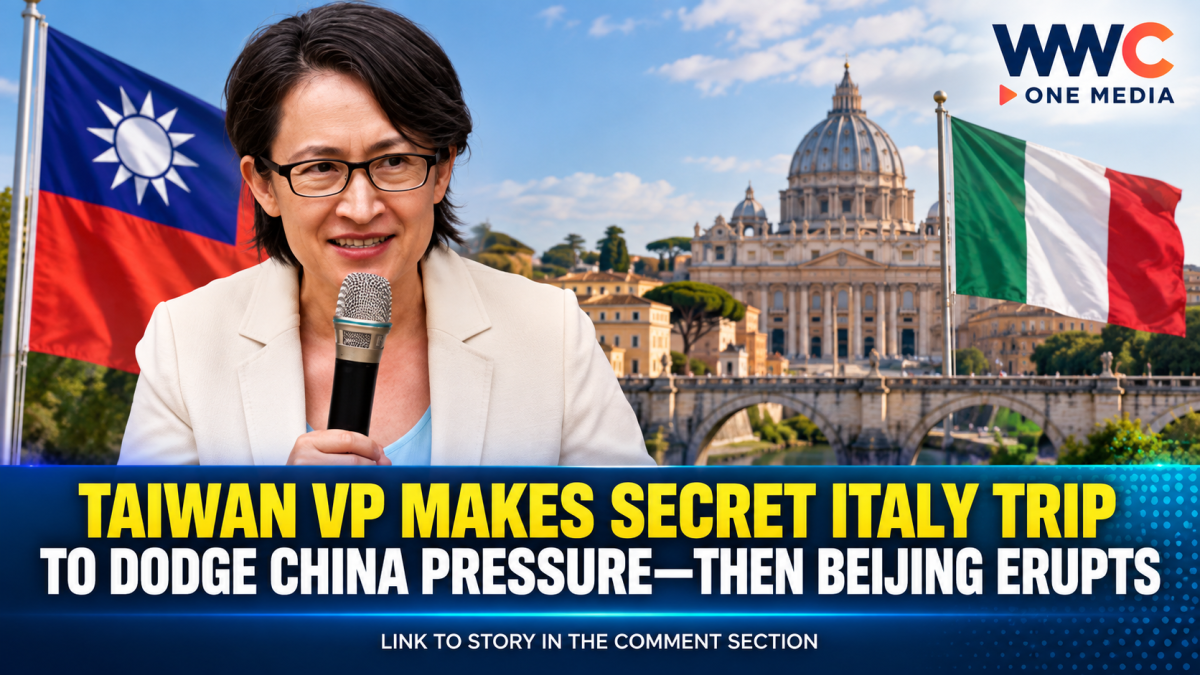
Taiwan Vice President Hsiao Bi-khim made a rare and deliberately low-profile trip to Italy this month, with Taipei keeping the visit under wraps until she had arrived—a move officials said was designed to minimize interference and ensure her safe participation in a major European democracy conference.
Hsiao traveled to the Italian island of Ventotene to attend the Second European Conference of Ventotene for Freedom and Democracy, held from September 10 to 12. She was accompanied by Taiwan Foreign Minister Lin Chia-lung.
The trip was confirmed only after European Parliament Vice President Pina Picierno publicly revealed Hsiao’s presence at the conference. Picierno said the Taiwanese vice president’s participation had been kept confidential until her arrival specifically to safeguard the visit.
The secrecy immediately drew attention because Taiwan’s vice president rarely visits Europe, particularly countries such as Italy that maintain formal diplomatic relations with Beijing rather than Taipei.
Why was the visit kept secret?
Taiwan’s Presidential Office later confirmed that the decision not to announce the trip before departure was intended to “minimize unnecessary interference” and help ensure that Hsiao and her delegation could reach Ventotene safely.
In remarks after returning to Taiwan on September 14, Hsiao said the journey from Taiwan to Ventotene involved a combination of plane, car and ferry travel and took about 27 hours, with the delegation also encountering bad weather and rough seas.
Taipei’s Foreign Ministry was more direct in its response to Beijing, saying China had no right to dictate whether Hsiao could participate in an event to which she had been invited by European officials.
Beijing protests the visit
China reacted angrily after Hsiao’s presence became public.
Chinese Foreign Ministry spokesperson Mao Ning said Beijing had lodged formal representations with both Italy and the European Union. China reiterated its opposition to what it described as official interactions between Taiwan and countries that maintain diplomatic relations with Beijing.
Beijing regards Taiwan as part of China and has long opposed high-level international engagement by Taiwanese officials, particularly in countries that recognize the People’s Republic of China.
Reuters reported that Beijing described Hsiao’s visit as “despicable” and that Italy did not arrange official meetings between the Taiwanese delegation and Italian Prime Minister Giorgia Meloni or Foreign Minister Antonio Tajani.
A rare appearance in Europe
Hsiao’s trip is significant because she is one of Taiwan’s highest-ranking officials and because official-level visits to Europe remain politically sensitive.
According to Focus Taiwan and Taipei Times, this was Hsiao’s second visit to Europe since becoming vice president in May 2024. Her previous European appearance came in November 2025, when she attended an Inter-Parliamentary Alliance on China meeting in Brussels.
Taiwan has increasingly sought stronger relationships with European governments and lawmakers, particularly as concerns over security, supply chains, authoritarianism and China’s growing influence have intensified.
Italy, however, does not have formal diplomatic relations with Taiwan.
Hsiao: Taiwan has the right to make friends
Speaking at the Ventotene conference, Hsiao defended Taiwan’s right to engage with international partners.
She said Taiwan believes it has the same right as other societies to make friends, communicate with partners and participate in international discussions.
She also argued that Taiwan wants to work with like-minded countries on shared challenges while maintaining peace and preserving its democratic way of life.
The setting was particularly symbolic.
The Ventotene Manifesto, written during World War II by Italian anti-fascist figures, is widely associated with the vision of a united and democratic Europe. The conference uses that historical legacy to promote democracy and resistance to authoritarianism.
European Parliament Vice President Picierno strongly defended Hsiao’s participation, arguing that Beijing should not determine who can be welcomed at a European democratic forum.
Taiwan’s message reaches Europe
During the conference, Hsiao also drew parallels between the security challenges facing Taiwan and lessons emerging from Russia’s invasion of Ukraine.
She said Taiwan must strengthen its defenses, protect its position in global technology supply chains and deepen partnerships with other democracies.
Taipei has increasingly emphasized that Taiwan’s security is not merely a regional issue because the island plays a crucial role in global technology manufacturing, particularly the semiconductor industry.
Hsiao has previously been sanctioned by Beijing over her political positions, making her international appearances especially sensitive.
Italian politicians push back against Beijing
The controversy also sparked criticism of China’s response inside Italy.
Several Italian lawmakers defended Hsiao’s right to participate in the conference. Italian Senate Vice President Gian Marco Centinaio called it an honor to host Taiwanese officials and described China’s protest as unacceptable.
Other Italian lawmakers similarly argued that neither Italy nor the European Union should allow Beijing to determine which democratic leaders or representatives can participate in European political discussions.
European Parliament officials also indicated that closer exchanges with Taiwan have become increasingly important in recent years.
Why this matters
Hsiao’s quiet arrival in Italy highlights the increasingly complicated diplomatic space surrounding Taiwan.
Taipei does not maintain formal diplomatic relations with most European governments, yet it has been steadily expanding unofficial ties with European lawmakers, political groups and civil-society organizations.
For Beijing, those relationships risk giving Taiwan greater international visibility.
For Taiwan and its supporters, however, the episode sends the opposite message: China’s objections do not necessarily prevent Taiwan from building relationships with democratic partners.
The fact that Hsiao was able to reach Ventotene, address an international democracy conference and return to Taiwan despite the controversy demonstrates how Taipei is navigating a narrow diplomatic path—expanding its international presence while attempting to avoid unnecessary confrontation with Beijing.
And that may be the bigger story behind the secretive trip: Taiwan did not need a formal diplomatic breakthrough to make its presence felt in Europe. It simply needed to get there.

Leave a Reply