
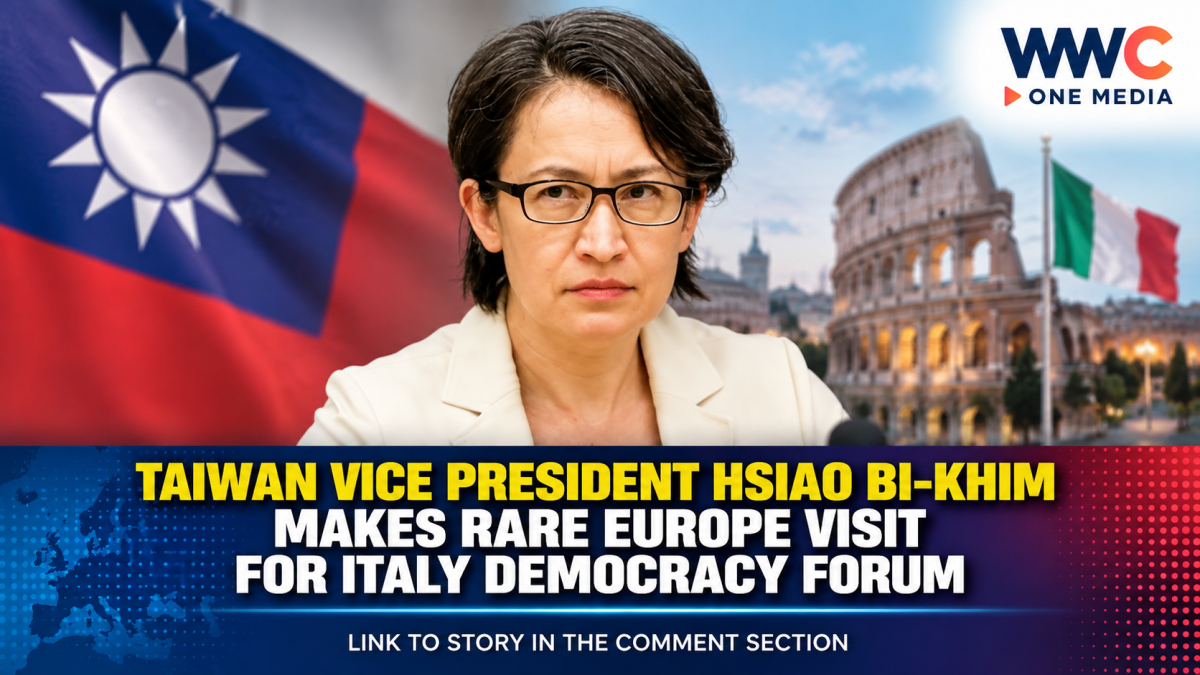
ROME, Italy — Taiwan Vice President Hsiao Bi-khim has made a rare high-level visit to Europe, travelling to Italy to attend a major forum on freedom and democracy in a trip closely watched for its potential impact on already tense relations between Taiwan, China and Europe.
Hsiao is attending the Ventotene Conference for Freedom and Democracy alongside Taiwan’s Foreign Minister Lin Chia-lung, Taiwan’s presidential office said.
The visit is particularly significant because it is unusual for a Taiwanese official as senior as the vice president to travel to a European country that does not maintain formal diplomatic relations with Taipei.
And with Beijing highly sensitive to official exchanges involving Taiwan, Hsiao’s European trip could carry diplomatic consequences far beyond the conference itself.
Rare Visit by a Taiwanese Vice President
Taiwanese foreign ministers and other senior officials have made visits to Europe in the past.
But a trip by a sitting Taiwanese vice president is far less common.
Hsiao’s visit was reportedly kept confidential until her arrival, underscoring the sensitivity surrounding her participation.
The secrecy reflects the complicated diplomatic position Taiwan faces internationally.
China considers Taiwan part of its territory and strongly opposes official exchanges between Taiwanese leaders and foreign governments.
Taiwan’s government rejects Beijing’s sovereignty claims and says the island’s future can only be decided by its people.
That makes every high-level international appearance by Taiwan’s leaders politically significant.
Italy Hosts Democracy Forum
Hsiao has been invited to participate in the Ventotene Conference for Freedom and Democracy, an event taking place in Italy this week.
The forum brings together political figures and other participants to discuss issues surrounding democracy, freedom and Europe’s future.
Taiwan’s participation places the democratically governed island at an international event focused on values that have become increasingly important in its diplomatic outreach.
Taipei has sought to build stronger relationships with democratic partners, particularly in Europe.
The effort has gained momentum as concerns grow over global security, economic competition and tensions involving China.
Why the Visit Matters
Italy, like most countries around the world, does not maintain formal diplomatic relations with Taiwan.
However, both Taiwan and Italy maintain representative offices that handle unofficial relations and exchanges.
That arrangement allows cooperation in areas such as:
- Trade
- Investment
- Culture
- Education
- Technology
- Economic cooperation
But visits involving Taiwan’s highest-ranking officials remain sensitive.
China has repeatedly urged countries to avoid official contact with Taiwanese leaders.
A high-profile appearance by Hsiao in Italy could therefore draw close attention from Beijing.
The trip is not just about attending a conference — it is also a test of how far Taiwan can expand its international engagement despite diplomatic pressure from China.
Hsiao Joined by Taiwan’s Foreign Minister
Foreign Minister Lin Chia-lung is accompanying Hsiao during the trip.
Taiwan’s presidential office has indicated that further details about the visit will be provided after Hsiao returns home.
The limited information released about the trip highlights its sensitive nature.
Italy’s Foreign Minister Antonio Tajani was not scheduled to meet with the Taiwanese delegation.
That distinction could help Italy maintain its existing diplomatic position while still allowing Hsiao to attend the democracy forum.
Taiwan Expands Its European Outreach
Taiwan has increasingly sought closer ties with Europe in recent years.
The island has worked to expand cooperation in areas including:
- Democracy
- Technology
- Semiconductors
- Trade
- Security
- Supply chains
- Economic resilience
Europe’s relationship with China has also become more complicated.
European governments have raised concerns about trade imbalances and Beijing’s relationship with Russia.
At the same time, Taiwan has positioned itself as a partner to democratic governments and an important player in the global semiconductor industry.
For Taipei, Europe represents not only a diplomatic opportunity but also a strategically important network of economic and political partners.
Hsiao Is No Stranger to International Diplomacy
Hsiao Bi-khim is one of Taiwan’s most internationally experienced political figures.
Before becoming vice president, she served as Taiwan’s representative to the United States and played a major role in strengthening ties between Taipei and Washington.
She is known for her international outreach and fluent English-language communication.
China has previously sanctioned Hsiao over what it describes as her support for Taiwanese independence.
Hsiao and Taiwan’s government reject Beijing’s accusations and maintain that Taiwan is already a self-governed democracy.
Her latest trip demonstrates Taipei’s continued effort to maintain an international presence despite the diplomatic restrictions it faces.
China Expected to Watch Closely
Beijing did not immediately comment publicly on Hsiao’s visit.
But China has consistently opposed high-level exchanges between Taiwan and foreign governments.
Beijing’s position is based on its claim that Taiwan is part of China.
Taiwan rejects that position.
The diplomatic disagreement remains one of the most dangerous geopolitical disputes in Asia.
China has increased military, political and diplomatic pressure on Taiwan in recent years, while Taiwan has strengthened its ties with countries that support maintaining peace and stability across the Taiwan Strait.
That means even a conference appearance in Europe can quickly become part of a much larger geopolitical contest.
Democracy Takes Centre Stage
The choice of the Ventotene Conference is also symbolically important.
Taiwan has increasingly presented itself internationally as a democracy facing pressure from an authoritarian neighbour.
Taipei has used that message to build stronger relationships with governments and political groups concerned about:
- Democratic resilience
- Foreign interference
- Regional security
- Cyber threats
- Economic coercion
- Global supply chains
Hsiao’s appearance allows Taiwan to bring those concerns directly to a European audience.
It also gives Taipei another opportunity to argue that developments involving Taiwan have consequences beyond Asia.
The Bottom Line
Taiwan Vice President Hsiao Bi-khim has made a rare visit to Europe to attend a major democracy forum in Italy, marking another significant step in Taipei’s international outreach.
Hsiao is travelling with Foreign Minister Lin Chia-lung, while details of the sensitive trip have been tightly controlled.
The visit highlights Taiwan’s growing effort to strengthen ties with European partners despite the lack of formal diplomatic relations and continued pressure from Beijing.
But as Hsiao steps onto the European stage, the biggest question may be what happens next: Will Taiwan’s rare high-level visit open more doors across Europe — or trigger a fresh diplomatic confrontation with China?

Leave a Reply