
TAIPEI — Taiwan’s legislature has approved a massive six-year push to expand the island’s drone capabilities, but the political battle over how to pay for those weapons could prove just as important as the headline NT$240 billion price tag.
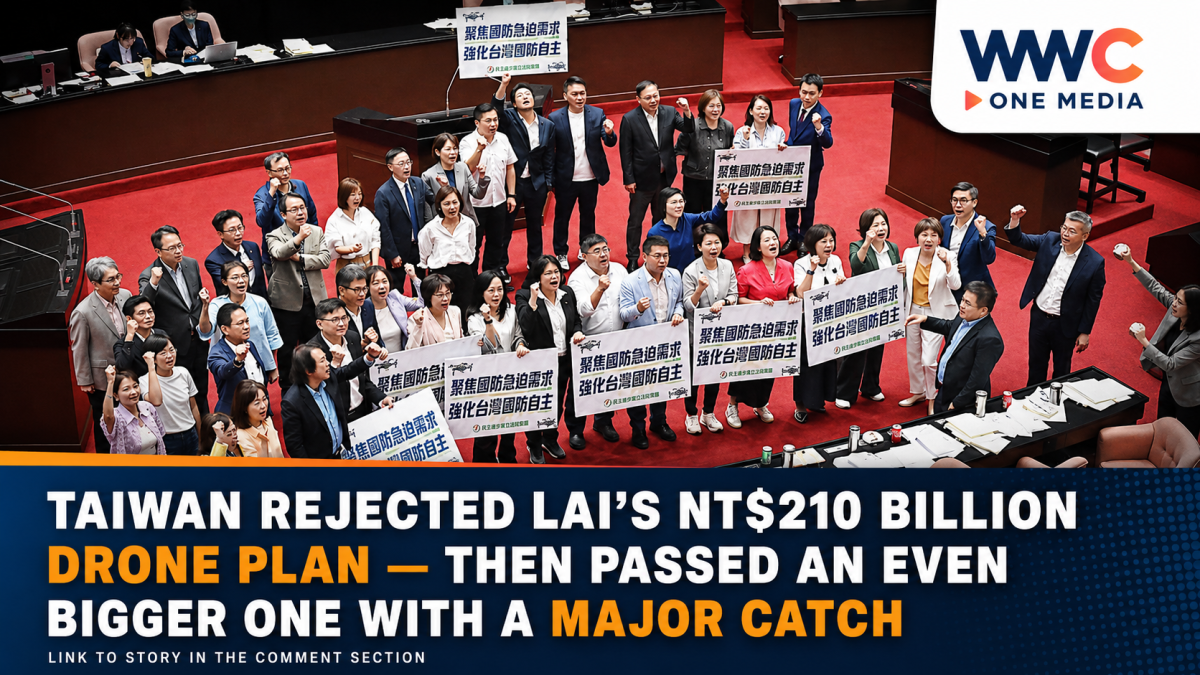
On August 27, the opposition-controlled Legislative Yuan rejected the Executive Yuan’s proposed NT$210 billion, or roughly US$6.6 billion, special budget for military drones and instead passed an opposition-backed law that calls for roughly NT$240 billion over six years through Taiwan’s regular annual budget process.
The legislation passed 60-50 in the 113-seat legislature, according to Focus Taiwan. It calls for NT$40 billion to be earmarked each year in principle, although lawmakers can approve additional funding when necessary.
That distinction has turned what looks on paper like a larger defense package into a much more complicated political and military question.
The Bigger Number Comes With a Catch
President Lai Ching-te’s administration had backed a special-budget approach aimed at purchasing roughly 210,000 military drones through 2031, arguing that lessons from modern wars have demonstrated how rapidly unmanned aircraft and other autonomous weapons are reshaping the battlefield.
The newly approved opposition plan actually carries a higher six-year headline amount—NT$240 billion compared with the Cabinet proposal’s NT$210 billion.
But it does not guarantee that the entire amount can be deployed with the same timing or flexibility.
Instead, the money is expected to move through Taiwan’s regular annual budget process, starting from an allocation of about NT$40 billion per year in principle. Any additional spending would still require legislative approval.
That is the “catch” at the center of the controversy.
Defense Minister Wellington Koo has warned that the NT$40 billion annual figure could constrain the military’s plans because the Ministry of National Defense already expects drone-related spending of about NT$42.1 billion in 2027 alone.
The law does allow additional appropriations, meaning NT$40 billion is not an absolute ceiling. But those extra funds could depend on future negotiations in a legislature that has experienced intense budget battles between the ruling Democratic Progressive Party and the opposition Kuomintang and Taiwan People’s Party.
KMT Says Annual Oversight Prevents a ‘Blank Check’
The opposition argues that precisely this annual review is a strength rather than a weakness.
KMT lawmakers have said drone technology evolves so rapidly that committing large amounts through a special multiyear budget risks purchasing systems that could become technologically outdated before the entire procurement cycle is completed.
KMT Legislator Hsu Chiao-hsin also argued that lawmakers have a responsibility to maintain oversight over how defense money is spent rather than simply granting the administration what critics characterize as an insufficiently supervised multiyear funding mechanism.
The KMT has therefore portrayed its legislation as a combination of stronger military investment and tighter legislative accountability.
Taiwan News reported that KMT representatives also stressed that the final legislation covers coastal surveillance drones, coastal attack drones and small one-way attack unmanned surface vessels—categories sought by the Defense Ministry—and permits additional funding when needed.
The Law Is Much Broader Than Just Flying Drones
Another major difference is scope.
The new legislation does not deal solely with aerial military drones. Its definition of unmanned vehicles extends to remotely operated or autonomous systems operating in the air, on land, on the sea surface and underwater.
Potential missions include reconnaissance, attacks, logistics, communications, electronic warfare, decoys, mine-clearing and mine-laying.
The law also has an industrial-policy component designed to strengthen Taiwan’s domestic unmanned-systems ecosystem.
The Ministry of Economic Affairs is expected to establish standards for locally produced systems and trusted supply chains, accredit qualified manufacturers and establish at least three testing sites where military and commercial drone makers can assess flight-control systems, anti-jamming capability and combat readiness.
Military procurement itself remains under the Ministry of National Defense.
That broader framework reflects another Taiwanese objective: building a domestic drone manufacturing base that is less dependent on components from China and better able to supply Taiwan during a crisis.
A New Committee Is Already Causing Political Friction
The legislation also calls for a Cabinet-level National Unmanned Vehicle Industry Development Strategy Special Committee.
The Cabinet would choose members from nominees recommended by legislative caucuses.
That provision has drawn some of the strongest criticism from DPP lawmakers.
Critics argue that involving political parties in nominating members to a body dealing with strategically sensitive drone development could politicize decisions that should primarily be driven by military and technical requirements.
Some DPP lawmakers have gone further, warning about potential information-security risks if sensitive procurement information is exposed through an expanded political oversight structure.
Those remain political and security concerns raised by government lawmakers—not established evidence that the committee has actually been compromised.
Analysts Warn the Real Battle Could Be Over Time
The biggest practical concern may not ultimately be whether Taiwan spends NT$210 billion or NT$240 billion.
It could be whether the military can obtain the systems quickly enough.
Analysts interviewed by CNA after the vote warned that requiring repeated annual budget negotiations could interrupt contracting, production and delivery schedules.
Policy analyst Cathy Fang noted that drone technology can evolve extraordinarily quickly and argued that phased procurement makes sense—but that phased procurement is not necessarily the same thing as making each phase dependent on another annual political budget cycle.
International Crisis Group analyst William Yang similarly warned that Taiwan’s continuing political confrontation could allow future drone appropriations to become leverage in broader battles between the executive branch and opposition-controlled legislature.
The Institute for the Study of War likewise assessed that the annual-budget model could make funding less stable than the Cabinet’s proposed special budget, although it also noted that the legislation still provides substantial resources for asymmetric defense systems and Taiwan’s domestic defense industry.
Why Taiwan Wants So Many Drones
The underlying military strategy has been shaped heavily by lessons from recent conflicts.
Small reconnaissance drones, loitering munitions, unmanned boats and other comparatively inexpensive systems can force an adversary to expend much more expensive weapons, provide persistent battlefield surveillance and strike targets without risking pilots or crews.
For Taiwan, those characteristics fit into a broader asymmetric-defense strategy intended to make any attempt to seize the island significantly more difficult and costly.
Reuters reported that the United States has strongly supported Taiwan’s efforts to develop military drone capabilities.
The disagreement inside Taipei therefore is less about whether drones matter than about who controls the money, how fast it can be spent and how much flexibility military planners should have.
What Happens Next Could Matter More Than the NT$240 Billion Headline
Premier Cho Jung-tai said after the vote that the government would review whether the legislation meets Taiwan’s national-security requirements, defense self-reliance objectives and ambitions to develop a domestic unmanned-vehicle industry.
The Defense Ministry, meanwhile, expressed regret that the Cabinet proposal was rejected, saying its original plan had been developed after extensive internal assessments and coordination with unnamed allied countries.
Taiwan has therefore emerged from the legislative battle with something unusual:
A larger drone program on paper—but potentially less certainty over when every dollar will become an actual weapon.
And with the Defense Ministry already expecting its 2027 drone requirements to exceed the law’s NT$40 billion annual baseline, the first major test of that system could arrive much sooner than the six-year timeline suggests.




Leave a Reply