
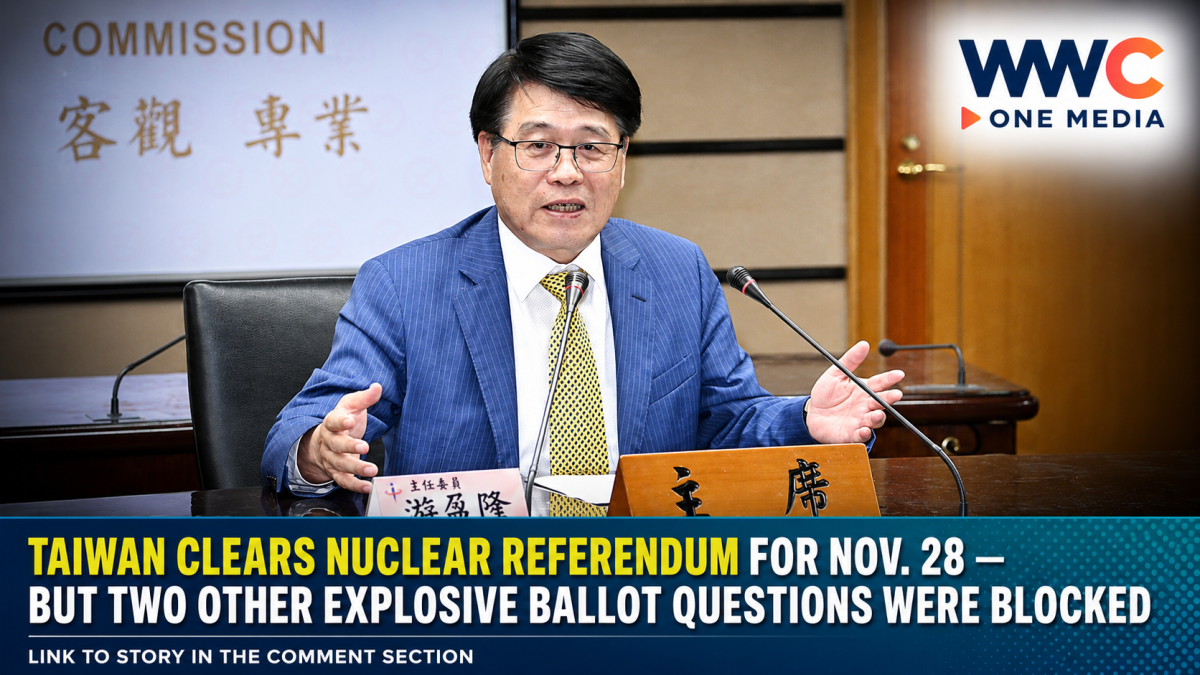
TAIPEI — Taiwan’s voters are heading back to the polls for another high-stakes decision on nuclear power, after election authorities approved a nationwide referendum that could challenge one of the island’s most consequential energy policies.
But two other controversial proposals — one calling for judicial caning and another seeking to redirect traffic-fine revenue — will not make it onto the ballot.
Taiwan’s Central Election Commission (CEC) announced that the referendum seeking to abolish the government’s “Nuclear-Free Homeland” policy had cleared its legal review and would be held on November 28, 2026, the same day as Taiwan’s nine-in-one local elections.
The decision leaves nuclear energy as the sole survivor of three referendum proposals approved by the opposition-controlled Legislative Yuan on August 14.
And it sets up another major showdown over Taiwan’s energy future only a little more than a year after voters considered whether the island’s last nuclear power plant should return to service.
What Taiwan Will Vote On
The approved referendum asks voters whether Taiwan should abolish its “Nuclear-Free Homeland” energy policy.
Supporters of the proposal argue that changing the policy could help secure stable electricity supplies, control energy costs, strengthen Taiwan’s national-defense resilience and provide the enormous amounts of electricity required by rapidly expanding industries such as artificial intelligence.
The policy itself dates back more than two decades. Taiwan incorporated the nuclear-free objective into its Basic Environment Act in 2002, while the Democratic Progressive Party accelerated the nuclear phaseout after returning to power in 2016.
Taiwan completed that phaseout in May 2025, when the final reactor at the Maanshan Nuclear Power Plant stopped operating.
But the shutdown did not end the political fight over nuclear energy.
Instead, the debate has intensified around questions of electricity reliability, Taiwan’s heavy dependence on imported energy, climate policy, electricity prices and the growing power requirements of its semiconductor and AI sectors.
This Will Be Taiwan’s Fourth Nuclear Referendum Since 2018
The November vote will mark Taiwan’s fourth nuclear-related national referendum since 2018, highlighting just how difficult the energy issue has been to settle politically.
In 2018, voters supported removing a statutory requirement that nuclear power generation end by 2025.
Three years later, voters rejected a proposal to resume construction of Taiwan’s long-mothballed Fourth Nuclear Power Plant.
Then came another referendum in August 2025 over the Maanshan Nuclear Power Plant.
That vote produced one of the most important pieces of context for the upcoming referendum.
Around 4.34 million people voted in favor of allowing Maanshan to continue operating if regulators determined it could do so safely, while approximately 1.51 million voted against.
Yet the referendum still failed.
Why?
Taiwanese law requires more than simply winning a majority of the votes cast.
For a national referendum to pass, the number of valid “yes” votes must exceed the number of “no” votes and must equal at least 25 percent of all eligible voters. The 2025 referendum needed just over five million affirmative votes but fell roughly 659,000 votes short.
That same turnout hurdle could become one of the defining factors in November.
Why the Caning Referendum Was Rejected
The most controversial of the rejected proposals sought to introduce judicial caning for people convicted of crimes including sexual assault, child abuse, high-value fraud and aggravated fraud.
The KMT-backed measure narrowly passed the legislature on August 14 by 52 votes to 51.
But it ran into a major legal obstacle at the CEC.
Chairman Michael You said the commission concluded that the proposal did not qualify as the type of major public policy that the Legislative Yuan is permitted to submit directly to a national referendum.
That distinction matters.
Taiwan’s Referendum Act allows national referendums on matters including the repeal of laws, the creation of legislative principles and major public policies. However, Article 15 specifically allows the Legislative Yuan to directly submit referendum proposals concerning the major-policy category contained in Article 2.
The CEC concluded that introducing an entirely new form of criminal punishment amounted to establishing a new legislative framework rather than putting an existing major policy before voters.
Seven commissioners rejected the proposal, while You chaired the meeting without voting.
Human-rights concerns had already surrounded the proposal before the CEC decision.
Taiwan’s National Human Rights Commission warned earlier this month that judicial caning could conflict with international human-rights standards incorporated into Taiwan’s domestic legal framework, particularly protections against cruel, inhuman or degrading punishment.
Traffic-Fine Referendum Falls by a Single Vote
The second rejected measure came from the Taiwan People’s Party.
It proposed requiring revenue from traffic violations to be used for road-safety improvements and public-transportation subsidies rather than continuing to expand automated traffic-enforcement equipment.
Unlike the caning proposal, the CEC was sharply divided.
Commissioners reportedly voted on the issue three times — and each time the result remained 4-3 against allowing the referendum to proceed.
The narrow rejection immediately intensified criticism from the opposition.
The KMT accused the election commission of denying voters the opportunity to decide questions that had already been approved by elected lawmakers.
The TPP also attacked the decision, arguing that the commission had interpreted its authority too broadly and restricted citizens’ referendum rights.
Those allegations remain political arguments from the opposition rather than established findings of wrongdoing.
The Bigger Battle May Be About More Than Nuclear Power
The November referendum now carries significance well beyond Taiwan’s electricity mix.
The KMT and TPP control a majority in the Legislative Yuan, while President Lai Ching-te and the executive branch are led by the DPP.
That divided-government environment has repeatedly produced confrontations over budgets, legislation, national security and the boundaries of institutional authority.
The referendum dispute is becoming another front in that struggle.
Opposition parties can point to the 2025 Maanshan result and argue that far more Taiwanese voters supported restarting nuclear generation than opposed it.
But nuclear skeptics can point to the same result and note that supporters still failed to persuade enough of Taiwan’s total electorate to cross the legally required threshold.
President Lai also did not completely close the door on nuclear power after the 2025 referendum. He said the government could consider nuclear technology if stringent safety requirements were satisfied and issues such as nuclear-waste disposal were properly addressed.
That means November’s question is unlikely to be a simple choice between “nuclear” and “non-nuclear.”
It could become a broader referendum on how Taiwan balances energy security, electricity prices, climate commitments, technological growth, nuclear safety and national resilience.
November 28 Could Change Taiwan’s Energy Debate Again
Nearly 20 million eligible voters are expected to participate in Taiwan’s wider electoral process this year, with thousands of local offices being contested across the island.
Now one nationwide question will share the spotlight with those local races.
Under Article 29 of Taiwan’s Referendum Act, supporters must achieve two things: win more valid votes than opponents and secure “yes” votes from at least one-quarter of the entire eligible electorate.
That requirement proved decisive in 2025.
Whether November produces a different result could determine not only the political future of Taiwan’s “Nuclear-Free Homeland” policy — but whether the island’s long-running nuclear debate is finally entering an entirely new phase.
Leave a Reply