
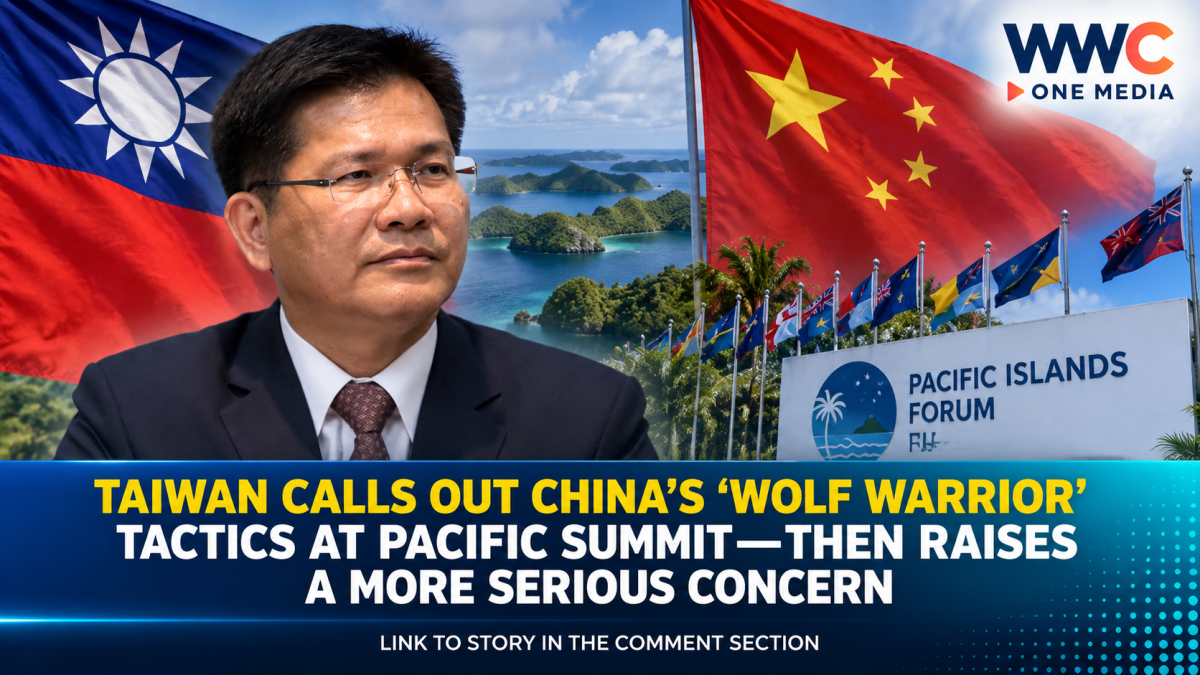
TAIPEI — Taiwan has accused China of using increasingly aggressive diplomatic tactics to pressure Pacific nations during this week’s Pacific Islands Forum in Palau, saying Beijing’s approach risks undermining regional unity.
Taiwanese Foreign Minister Lin Chia-lung made the accusation after China objected to Taiwan’s participation in activities surrounding the 55th Pacific Islands Forum Leaders’ Meeting, held in Palau from August 30 to September 4.
Lin described Beijing’s approach as “wolf warrior” diplomacy—a term commonly used to describe a more confrontational and forceful style of Chinese diplomacy—and said China’s actions were unwelcome in a regional forum built around cooperation among Pacific nations.
China warned of ‘consequences’ over Taiwan’s participation
The dispute intensified after Chinese officials objected to Taiwan’s presence at the gathering.
According to reports, China’s special envoy for Pacific island affairs, Qian Bo, warned that Taiwan’s participation would have “consequences.” Beijing maintains that Taiwan is part of China and opposes its participation in international organizations in any capacity that implies separate statehood.
Taiwan rejects Beijing’s sovereignty claims and has participated in Pacific Islands Forum activities as a development partner since 1993.
This year’s meeting was particularly significant because it was hosted by Palau, one of only three Pacific island countries that maintain formal diplomatic relations with Taiwan, alongside the Marshall Islands and Tuvalu.
Lin argued that decisions concerning the participation of partners should ultimately be handled through the Pacific Islands Forum rather than dictated by an outside power.
Taiwan raises concerns over alleged Chinese surveillance
Lin also made a more serious allegation, saying Taiwanese officials observed Chinese personnel at multiple venues and events during the summit.
He alleged that plainclothes and security personnel linked to China were present around the gathering and characterized their activities as a form of espionage. Lin thanked Palau for strengthening security measures.
These claims are allegations by Taiwan and have not been independently established in the available reporting. China, meanwhile, rejected Lin’s broader accusations and accused him of fabricating narratives for political purposes.
The dispute illustrates how Taiwan-China tensions are increasingly intersecting with the Pacific Islands’ own efforts to maintain control over their regional agenda.
Palau pushes back as China-Pacific tensions grow
Palau President Surangel Whipps Jr. has also been outspoken about Beijing’s activities in the region.
The summit was held against the backdrop of China’s July ballistic-missile test in the Pacific. Pacific leaders expressed concern about the launch and the need for greater transparency and advance notification of such tests, although the final regional position stopped short of a unanimous condemnation naming China.
Nauru dissented from the stronger criticism, while Kiribati did not participate in the relevant leaders’ retreat, highlighting the divisions facing the region.
China has defended the missile test, saying its defense policy is defensive and that it does not engage in military expansion. Chinese Foreign Ministry spokesperson Guo Jiakun also accused Palau of attempting to influence other Pacific Forum members over the issue.
Beijing also issued a travel warning for Palau
The diplomatic dispute went beyond the summit itself.
China previously designated Palau as an “unsafe travel destination,” a move Lin described as part of Beijing’s pressure campaign. He argued that such warnings and threats were particularly inappropriate in a Pacific regional gathering focused on cooperation.
China has not accepted Taiwan’s participation in the forum on terms that contradict Beijing’s “one-China” position. Its Foreign Ministry has repeatedly said Taiwan-related participation in international organizations must follow what Beijing calls the one-China principle.
Taiwan highlights its development role in the Pacific
Taipei, meanwhile, is seeking to frame its Pacific engagement around development rather than geopolitical confrontation.
Taiwan’s Foreign Ministry said Lin’s delegation promoted cooperation in areas including renewable energy, smart agriculture, healthcare, digital resilience, infrastructure and workforce development during its Palau visit and participation in the forum-related activities.
Taiwan has also emphasized its contribution to Pacific resilience and development. Its Foreign Ministry said the United States and more than 40 other countries had expressed concern over the recent Pacific missile test and supported greater transparency and advance notification of missile launches.
Washington has separately backed Taiwan’s continued participation in the Pacific Islands Forum, describing Taiwan as a reliable partner contributing to regional development, according to Taiwan’s Foreign Ministry.
Why the Pacific matters to both China and Taiwan
The dispute reflects a much larger contest for influence across the Pacific.
For Pacific island governments, the region’s priorities include climate change, economic development, disaster resilience, infrastructure, healthcare, fisheries and maritime security. But competition among China, Taiwan, the United States, Australia and New Zealand increasingly intersects with those priorities.
The Pacific Islands Forum itself has stressed regional unity and collective leadership. Its 2026 security outlook describes the region as facing an increasingly complicated security environment, with climate change remaining a central security and development concern while geopolitical tensions add pressure to regional institutions.
China has emphasized its own development and economic partnership with Pacific island countries. At the Palau forum, Chinese special envoy Qian Bo promoted cooperation in areas including energy transition, trade, investment and a “blue partnership,” while reaffirming Beijing’s position on the one-China principle.
Taiwan says pressure could backfire
Despite the confrontation, Lin said Taiwan remains confident it can continue working with Pacific partners.
His argument is that increasingly forceful Chinese pressure could ultimately encourage Pacific governments to defend their own ability to determine who participates in regional cooperation.
Taiwan’s participation remains politically sensitive, however, and its future presence at upcoming meetings will continue to test the balance between Pacific regional autonomy and Beijing’s insistence that Taiwan cannot participate in international affairs as a separate state.
The next Pacific Islands Forum leaders’ meeting is expected to take place in New Zealand in 2027, setting the stage for another potentially contentious debate over Taiwan’s role in the regional organization.
For now, the Palau summit has demonstrated that the rivalry between Beijing and Taipei is no longer confined to the Taiwan Strait. It is increasingly playing out across the Pacific—where small island nations are being asked to navigate a growing struggle for influence while insisting that their own regional priorities come first.
WWC ONE MEDIA J.M.S



Leave a Reply