
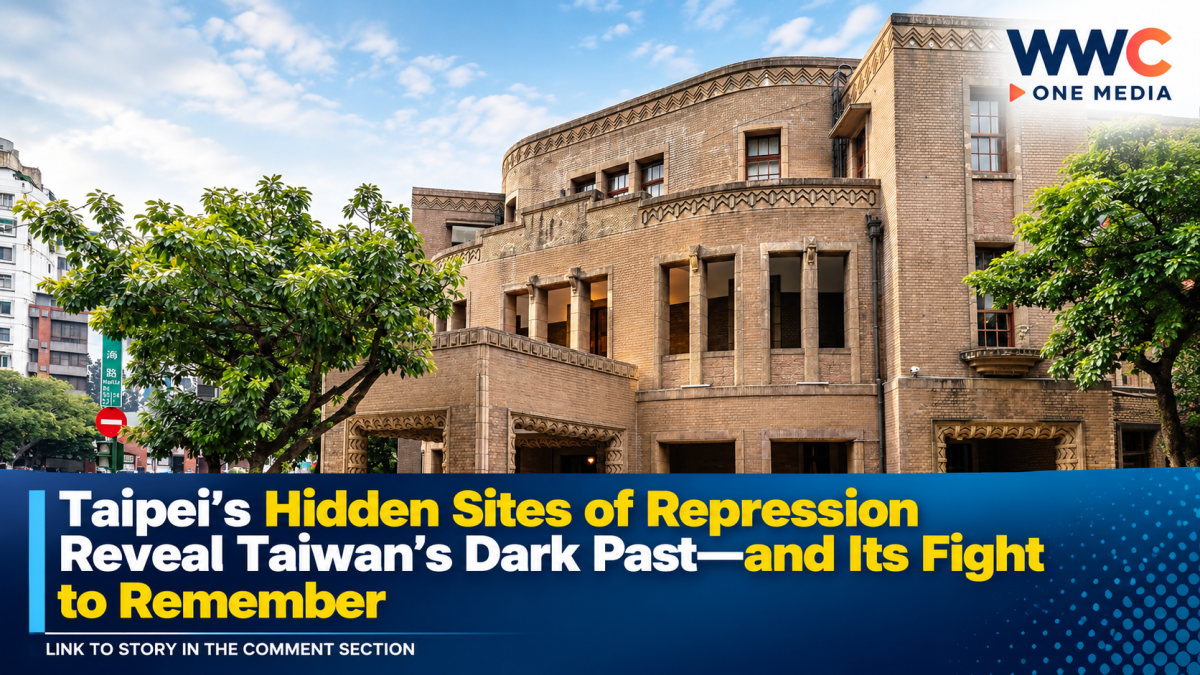
TAIPEI, Taiwan — Beneath Taipei’s modern skyline, busy shopping districts and familiar tourist attractions lies another layer of history—one marked by political imprisonment, interrogation, executions and decades of authoritarian rule.
Taiwan is increasingly confronting that past through transitional justice, preserving or identifying locations where people were persecuted during the island’s authoritarian era and turning them into places of remembrance and public education.
The effort is giving rise to a form of dark tourism in Taiwan—but historians and human-rights advocates say these sites should not be viewed simply as unusual tourist attractions. They are places where visitors can confront the consequences of political repression and understand how Taiwan eventually transitioned to democracy.
A city with a hidden history
The latest discussion was highlighted by Taiwan Panorama and Taiwan News, which explored several locations in Taipei connected to the island’s authoritarian past.
According to architectural heritage specialist Ling Tzung-kuei, sites connected to transitional justice generally fall into two broad categories: places deliberately constructed as symbols of authoritarian power and “sites of injustice” where people were arrested, interrogated, tortured or executed.
Some of those locations remain standing.
Others have disappeared beneath modern buildings and developments, leaving only historical records and memorial efforts to remind people what happened there.
One striking example is Machangding Memorial Park, which occupies a former execution ground where political prisoners were executed during the early years of Taiwan’s White Terror.
Another is the site where the Sheraton Grand Taipei Hotel now stands. The location was formerly associated with a detention facility operated by the Taiwan Garrison Command’s Military Law Division, according to the Taiwan Panorama report.
The history becomes even more difficult to imagine in Ximending, one of Taipei’s busiest entertainment districts.
The site now occupied by the Lions’ Plaza Commercial Building was once home to a detention center where people suffered persecution during the authoritarian period.
For today’s visitors, these places can appear completely ordinary.
Their histories are anything but.
What was Taiwan’s White Terror?
Taiwan’s White Terror refers to decades of political repression associated with authoritarian rule and martial law.
The period followed the violent suppression of the 228 Incident in 1947 and intensified after the Kuomintang government relocated to Taiwan in 1949.
Political opponents, suspected dissidents and other civilians were subjected to arrests, imprisonment, surveillance and, in some cases, execution.
The martial-law era formally ended in 1987, while the broader period of authoritarian political repression extended into the early 1990s. Taipei Times reported that the White Terror period lasted from 1949 to 1992 and involved tens of thousands of people being imprisoned, executed or otherwise persecuted for alleged political dissent.
That history remains central to Taiwan’s ongoing transitional-justice efforts.
Turning former prisons into places of remembrance
One of the clearest examples is the Jing-Mei White Terror Memorial Park in New Taipei City.
The National Human Rights Museum says the site once housed detention facilities and military courts. Political prisoners were detained, prosecuted, tried and imprisoned there, while the First Court hosted major political trials, including the Formosa Magazine Incident trial in 1980.
Today, visitors can enter former detention buildings and exhibitions designed to explain the experiences of political prisoners and the broader history of the White Terror.
The National Human Rights Museum describes the site as a place where visitors can examine the memories of those imprisoned and understand the objectives of transitional justice.
Taiwan also preserves the Green Island White Terror Memorial Park, located on an island that once served as a major prison site for political detainees.
The National Human Rights Museum says the island’s former prison facilities provide visitors with an opportunity to confront Taiwan’s difficult path toward democracy.
Survivors are still telling their stories
The history is not confined to museum displays.
In May 2026, more than 100 White Terror survivors and relatives returned to Green Island to commemorate political prisoners and share memories with younger generations.
The National Human Rights Museum organized the gathering around the anniversary of the arrival of the first large group of political prisoners at the island’s New Life Correction Center in 1951. Participants visited former prison sites, laid flowers at a cemetery and listened to survivors recount their experiences.
The event underscored why preserving physical sites matters.
For survivors and their families, these are not simply historical landmarks. They are locations connected to real people, families and traumatic experiences.
Taiwan is putting more history online and into classrooms
The country’s effort to confront its authoritarian past is also moving beyond physical memorials.
In March 2026, Taiwan’s Ministry of Education launched an online platform designed to introduce students and the public to lesser-known chapters of the island’s authoritarian history.
The project began with material on the 228 Massacre, using videos and guided readings to make transitional-justice education more accessible.
The approach reflects a broader question facing Taiwan: how can a democratic society remember political repression without allowing painful history to disappear from public consciousness?
That question has also reached the film industry and universities.
A 2026 initiative promoting films about the White Terror on university campuses argued that cinema can help create dialogue about Taiwan’s authoritarian past and encourage younger generations to engage with transitional justice.
Why some historic sites are disappearing
Not every location connected to political repression can be preserved.
Taipei Times reported that researchers have spent years identifying places across Taiwan where people were detained, tortured or executed under authoritarian rule.
The former Transitional Justice Commission identified 42 sites with strong evidence of human-rights violations and another 64 potential sites of injustice. Since the commission’s dissolution, the National Human Rights Museum has taken on a major role in preserving and marking these locations.
But preservation can be complicated.
Some former sites have been demolished or redeveloped. Others are privately owned or occupied by businesses and modern buildings.
There can also be disagreement within communities about how prominently painful histories should be displayed.
By the end of 2026, the National Human Rights Museum planned to have bilingual information panels at more than two dozen sites of injustice, according to Taipei Times.
The goal is not simply to identify where something terrible happened.
It is to create what the museum describes as historical warnings—places where people can reflect on past violations and consider how to prevent similar abuses in the future.
From “dark tourism” to democratic memory
That distinction matters.
Dark tourism is often associated with places connected to death, disaster and tragedy. But Taiwan’s former detention centers, execution grounds and other sites of injustice carry another purpose: education and remembrance.
The challenge is to ensure that visitors do not consume these places merely as attractions.
Instead, the sites can help answer a much larger question:
How did a society that experienced decades of political repression become the democracy it is today?
Taiwan’s approach suggests that remembering the past is not necessarily about remaining trapped in it.
It can also be about recognizing what was lost, acknowledging those who suffered and understanding why democratic freedoms matter.
The streets of Taipei may look completely different today.
But beneath the modern city are places that still carry stories of fear, resistance and survival.
And as Taiwan continues its transitional-justice work, the question is no longer simply whether these stories should be remembered.
It is whether future generations will know where to look when they want to understand how easily freedom can be lost—and how hard it can be won back.




Leave a Reply