
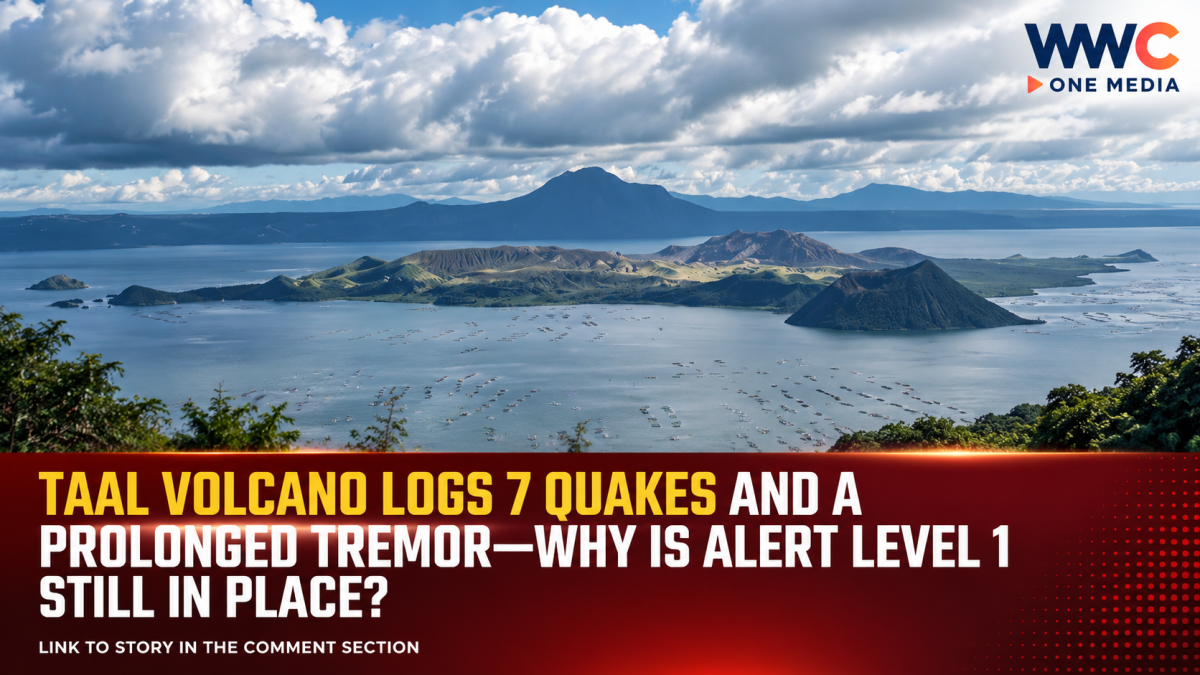
BATANGAS, Philippines — Taal Volcano has again shown signs of continued unrest after state volcanologists recorded seven volcanic earthquakes and a prolonged volcanic tremor over a 24-hour monitoring period.
Despite the renewed seismic activity, the Philippine Institute of Volcanology and Seismology (PHIVOLCS) kept Taal Volcano under Alert Level 1, meaning the volcano remains in a state of low-level unrest and is not currently showing signs that would justify raising the alert status.
The latest activity serves as another reminder that while Taal is not under an imminent major eruption warning, the volcano remains active and capable of sudden hazardous events.
What Does Alert Level 1 Mean?
PHIVOLCS continues to classify Taal Volcano under Alert Level 1, indicating abnormal volcanic activity but no immediate indication of a major eruption.
However, authorities have repeatedly warned the public that dangerous events can still occur with little warning.
PHIVOLCS continues to prohibit entry into Taal Volcano Island, particularly the Main Crater and Daang Kastila fissures. Occupancy and boating on Taal Lake are also restricted, while aircraft are advised against flying close to the volcano.
Possible hazards include:
- Steam-driven or phreatic explosions
- Gas-driven eruptions
- Volcanic earthquakes
- Minor ashfall
- Dangerous volcanic gas accumulation
Recent PHIVOLCS monitoring has also shown weak emissions and signs of short-term inflation at Taal Volcano Island, indicators that scientists continue to closely monitor.
A Volcano That Has Been Showing Continued Activity
The latest seven volcanic earthquakes are part of a pattern of continued activity observed at Taal in recent months.
Earlier this month, PHIVOLCS recorded three volcanic earthquakes during another 24-hour observation period. Monitoring data also showed sulfur dioxide emissions of hundreds of tonnes per day and short-term inflation at Taal Volcano Island.
Other reports have documented fluctuations in Taal’s activity, including six volcanic earthquakes and a prolonged tremor last week, as well as a significant increase in sulfur dioxide emissions.
Taal has also experienced minor phreatomagmatic eruptions earlier in 2026, including events reported in January, April and June. Despite those episodes, PHIVOLCS maintained Alert Level 1 while continuing intensive monitoring of the volcano’s seismic activity, gas emissions and ground deformation.
Why Scientists Are Still Watching Closely
Taal is one of the Philippines’ most active and closely monitored volcanoes, and its activity can change rapidly.
Volcanic earthquakes may indicate movement beneath the volcano, while tremors can signal continuous underground activity. On their own, however, these events do not automatically mean that a major eruption is imminent.
PHIVOLCS evaluates several factors before changing an alert level, including seismic activity, sulfur dioxide emissions, volcanic plumes, ground deformation and other monitoring data.
This means the seven earthquakes and prolonged tremor are significant enough to document and monitor—but based on the current assessment, PHIVOLCS has not found sufficient evidence to raise Taal’s alert status.
What Residents and Tourists Should Do
Authorities are urging the public not to become complacent simply because Taal remains under Alert Level 1.
Residents around Taal Lake and tourists visiting Batangas should continue monitoring official PHIVOLCS advisories and follow restrictions around the Permanent Danger Zone.
Entry into Taal Volcano Island remains prohibited, particularly around the Main Crater, while unnecessary activities on Taal Lake should also be avoided.
For now, Taal Volcano remains under Alert Level 1.
But with seven volcanic earthquakes and a prolonged tremor recorded in just 24 hours, one question remains: Will the activity stay at low-level unrest—or could the volcano’s next shift give PHIVOLCS reason to sound a higher alert?




Leave a Reply