
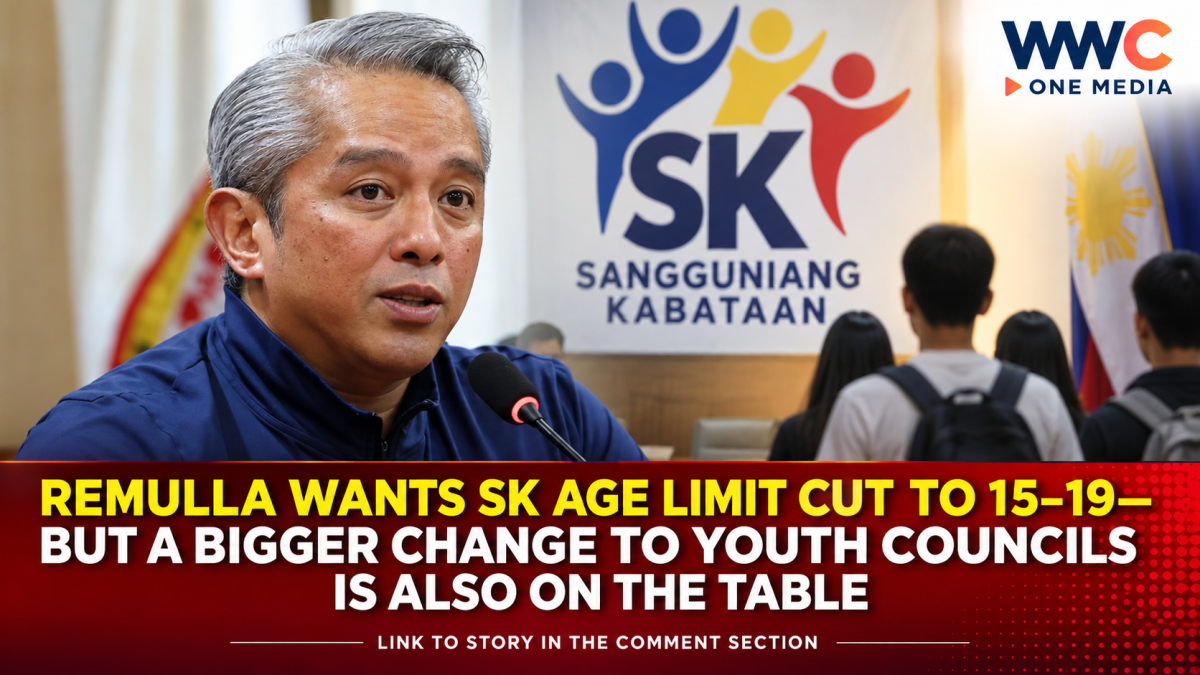
MANILA, Philippines — A major overhaul of the Sangguniang Kabataan (SK) system could be on the horizon after Department of the Interior and Local Government (DILG) Secretary Jonvic Remulla proposed bringing back a much younger age range for youth officials—while also questioning whether SK councils should continue to enjoy independent control over public funds.
Speaking during Senate deliberations on the DILG’s proposed 2027 budget, Remulla recommended restoring the SK eligibility age to 15 to 19 years old, arguing that youth representatives should remain closely connected to the young people they are elected to serve.
“My recommendation is to bring it back to 15 to 19 years old,” Remulla said during the Senate Committee on Finance hearing.
He argued that allowing officials to remain in the youth council into their late 20s could weaken the connection between SK leaders and their intended constituency, noting that people in that age group may already be working, married or raising families.
What is the current SK age requirement?
Despite Remulla’s proposal, the current legal requirement has not changed.
Under Republic Act No. 10742, or the Sangguniang Kabataan Reform Act of 2015, an elected or appointed SK official must generally be at least 18 but not more than 24 years old on election day. The law also allows an elected SK official who turns 25 during the term to finish the remaining portion of that term.
Republic Act No. 11768 subsequently amended portions of the SK law, including provisions concerning SK treasurers and secretaries, but retained the 18-to-24 eligibility requirement for elected SK officials.
That means Remulla’s suggested 15-to-19 age range would require changes to existing legislation before it could become the new eligibility rule.
Remulla also wants SK financial autonomy reviewed
The DILG secretary’s proposal goes beyond age limits.
Remulla also called for a review of the SK’s fiscal autonomy, saying he was concerned about whether young officials have sufficient experience and safeguards to independently manage government funds.
“I think that the fiscal responsibility of the SK is not fully formed yet,” Remulla said, warning that youth officials could be vulnerable to various forms of influence or manipulation.
Under the existing SK framework, the youth council receives a share of barangay funds and has financial independence in its operations, with the SK chairperson and treasurer serving as official signatories for its funds.
The issue has gained additional attention following disciplinary cases involving SK officials in Makati. Remulla cited cases involving allegations of a 20-percent kickback demand and irregularities involving documents and signatures. The cases have been used by the DILG as examples in its argument for stronger safeguards and accountability.
The timing makes the proposal even more significant
Remulla’s proposal comes as Congress is simultaneously considering a major change to the schedule and terms of barangay and SK officials.
The House of Representatives has approved House Bill No. 10971 on third and final reading. The measure would establish a fixed five-year term for barangay and SK officials and move the next Barangay and Sangguniang Kabataan Elections (BSKE) from November 2026 to November 2028.
The Senate has likewise advanced a similar proposal. Senate Bill No. 2387 seeks to set the terms of barangay and SK officials at five years and move the elections to 2028. The measure had passed second reading in the Senate as of the latest reports.
But the election postponement is not yet final.
The Commission on Elections has said it must continue preparing for the November 2, 2026 BSKE unless Congress passes, and the President signs, a law changing the schedule.
Why the proposed age change matters
The debate is ultimately about what “youth representation” should mean in local government.
The existing law recognizes Filipino youth broadly as those aged 15 to 30, while the SK’s elected officials occupy a narrower age bracket.
Remulla’s proposed 15-to-19 range would make SK officials considerably younger and could potentially shift the emphasis toward students, younger community leaders and first-time participants in local governance.
But it would also raise practical questions: Would teenagers be prepared to manage public funds? Should younger officials have the same financial authority currently granted to SK councils? And how would the system balance youth representation with accountability and administrative competence?
Those questions are likely to become more important if Congress proceeds with the proposed five-year term for barangay and SK officials.
Reform—or a reset for the SK?
Other reports have highlighted the same tension.
Philstar reported that Remulla wants the SK age range restored to 15–19 and also wants lawmakers to reconsider the council’s fiscal autonomy. Daily Tribune similarly reported that the DILG chief believes the SK should more directly reflect the youth sector it represents.
At the same time, Senate discussions on extending barangay and SK terms have exposed disagreement among lawmakers over whether the 2026 elections should proceed or be postponed. Some senators have supported a five-year term but questioned delaying the elections themselves.
For now, nothing has changed the existing SK eligibility rules. Remulla’s 15-to-19 proposal remains a recommendation, while Congress continues to debate separate legislation affecting the length and timing of barangay and SK terms.
But if both reforms move forward, the country’s youth councils could look dramatically different in the next election cycle—from who can run, to how long they can serve, to how they manage public money.




Leave a Reply