
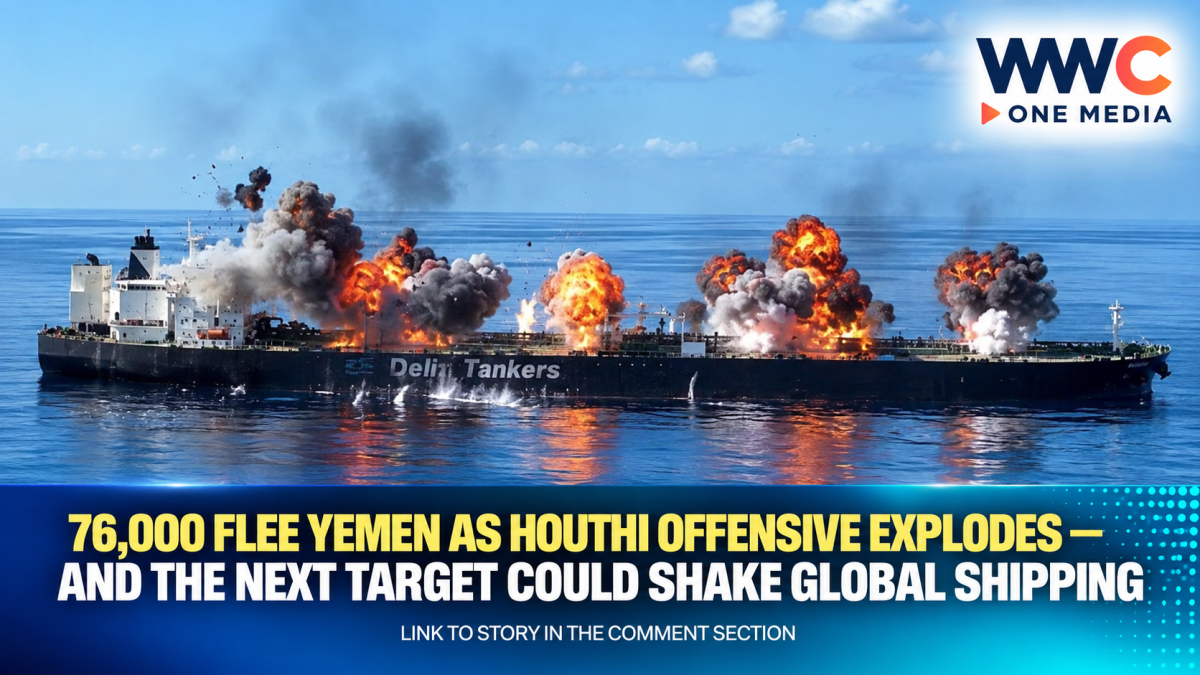
YEMEN — Yemen’s humanitarian crisis is rapidly worsening as at least 76,000 people have fled their homes since July, with the United Nations warning that displacement is accelerating as Iran-backed Houthi forces intensify their offensive along the country’s Red Sea coast.
The International Organization for Migration said Saturday that the number of displaced people had quadrupled in just one week, with more than 70,000 people forced from their homes since the beginning of September alone.
The latest figure represents a dramatic jump from the 46,000 displacements reported only days earlier.
IOM warned that the crisis is unfolding “by the hour,” with entire families fleeing at night and many having nowhere safe to go.
Thousands are fleeing as fighting spreads
The heaviest displacement has been reported in western Yemen and Taiz, where intensified fighting has forced communities to abandon their homes.
IOM said approximately 8,300 households — nearly 50,000 people — have been displaced in Taiz province alone. Another nearly 17,000 people have fled areas of Lahj, while more than 8,100 people have been displaced from coastal districts of Al Hodeidah.
Many of those escaping the fighting are not experiencing displacement for the first time.
IOM said numerous families have already been uprooted multiple times during Yemen’s more than decade-long conflict. Many are now fleeing again with little more than the clothes they are wearing.
Humanitarian workers face growing difficulties reaching them as fighting blocks roads and disrupts communications.
“Needs are far outpacing what we can deliver,” IOM warned.
Houthis push toward the Bab el-Mandeb
The humanitarian crisis is unfolding alongside a major military development.
Houthi forces have rapidly expanded their control along Yemen’s western coastline, including the strategic port city of Mocha, while advancing toward the Bab el-Mandeb Strait — the narrow maritime gateway connecting the Red Sea with the Gulf of Aden.
Reuters reported that Houthi forces also moved onto Perim Island, located in the middle of the strait, placing the group in a stronger position to threaten one of the world’s most important shipping corridors.
Other reporting indicates that the Houthis have seized additional strategically located Red Sea islands.
The development is particularly significant because the Bab el-Mandeb is a critical route for international commerce and energy shipments.
Why the Red Sea chokepoint matters
The Bab el-Mandeb is one of the world’s most important maritime chokepoints.
Any sustained disruption could force commercial vessels to take longer routes around Africa, increasing shipping times, fuel costs and insurance expenses.
Reuters reported that control or disruption of the strait could affect roughly 12% of global trade and about 7% of global petroleum supplies, making the latest Houthi advance a potential problem far beyond Yemen.
The strategic importance has increased even further because the wider Middle East conflict has already disrupted traffic through the Strait of Hormuz, another critical energy corridor.
That raises the prospect of pressure being placed simultaneously on two major maritime chokepoints.
Saudi Arabia strikes back
Saudi Arabia-backed Yemeni government forces have launched a counteroffensive as the Houthis consolidate their gains.
The escalation has already produced a significant battlefield toll.
AFP previously reported that more than 300 combatants had been killed during an earlier phase of the fighting, based on military and medical sources from both sides.
More recent reporting indicates that Saudi Arabia has carried out airstrikes against Houthi positions as government forces attempt to prevent the rebels from consolidating control around the Bab el-Mandeb.
The fighting marks one of the most serious escalations since a period of relative calm followed the 2022 ceasefire.
A humanitarian catastrophe could return
The United Nations has repeatedly warned that Yemen’s fragile stability could collapse if the latest fighting continues.
The country has endured more than a decade of conflict, leaving millions dependent on humanitarian assistance.
The Associated Press reported that civilians arriving in Aden described chaotic escapes as Houthi forces moved south along the Red Sea coast. Families have arrived carrying only limited belongings, while some have opened their homes to newly displaced relatives and strangers.
The UN’s Yemen envoy, Hans Grundberg, has warned that the renewed fighting could lead to a devastating reversal after years of relative calm.
For families already displaced once or twice, another flight means losing what little security they had managed to rebuild.
Aid groups are running out of room to respond
The biggest immediate concern is that humanitarian needs are growing faster than aid agencies can respond.
IOM Director-General Amy Pope said families were being displaced for a second or third time and that many had almost nothing left.
The agency is distributing emergency shelter materials, hygiene kits and other supplies, but access is becoming increasingly difficult because of fighting, damaged infrastructure and blocked roads.
Communications disruptions are also making it harder for humanitarian organizations to determine where civilians are trapped and what assistance they urgently require.
The stakes extend far beyond Yemen
The latest offensive is no longer only a local Yemeni battlefield story.
The Houthi advance toward Bab el-Mandeb could create a new pressure point for the global economy at a time when energy markets are already facing extraordinary geopolitical risks.
Reuters reported that the Houthi advance has created a major strategic dilemma for Washington, particularly because the United States is already dealing with the wider conflict involving Iran and faces difficult choices over whether to become directly involved against the Houthis.
For Washington, Riyadh and other regional powers, the question is no longer simply how to contain the Yemeni conflict.
It is increasingly about whether the Houthis can establish lasting control over a maritime chokepoint through which a significant portion of global commerce passes.
Yemen’s next chapter could affect the world
The latest figures paint a stark picture: at least 76,000 people displaced, tens of thousands fleeing in only days, and fighting spreading toward one of the world’s most strategically important waterways.
The international community is now facing two simultaneous risks — a rapidly deepening humanitarian disaster inside Yemen and a potential disruption to global shipping and energy markets.
And with Houthi forces continuing their advance, the question is becoming increasingly urgent:
Will the fighting remain a devastating Yemeni conflict — or become the next major threat to the world’s already fragile trade and energy routes?



Leave a Reply