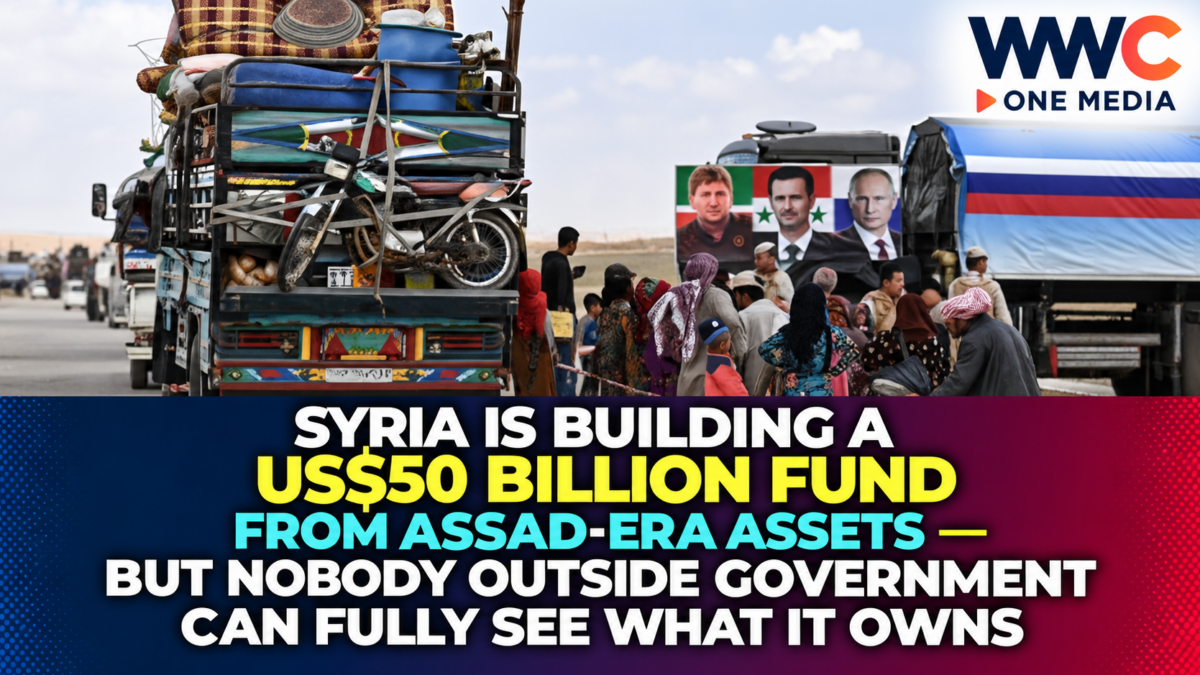
DAMASCUS — Syria’s post-Assad government is quietly building one of the most powerful financial institutions in the Middle East’s reconstruction story — a sovereign fund that the Financial Times reports now controls assets worth about US$50 billion.
The Syrian Sovereign Fund is becoming a central vehicle for President Ahmed al-Sharaa’s effort to revive an economy devastated by more than a decade of conflict, restructure assets accumulated under the former government and attract billions of dollars from Gulf and international investors.
But there is an extraordinary contradiction at its centre.
The fund is being positioned as a gateway for foreign capital into the new Syria.
Yet basic questions that investors would ordinarily expect a sovereign wealth fund to answer — exactly what it owns, how its assets have been valued, how profits are distributed, who exercises day-to-day control and how decisions are audited — remain unusually difficult to answer publicly.
That makes the fund both one of Syria’s most important reconstruction tools and one of the biggest tests of whether the new government can replace Assad-era economic patronage with something genuinely more transparent.
The US$50 billion figure is enormous — especially for Syria
The scale immediately stands out.
The World Bank estimated in 2025 that rebuilding Syria’s damaged physical infrastructure and buildings would cost about US$216 billion, with a plausible range of US$140 billion to US$345 billion.
Direct physical damage alone was estimated at US$108 billion.
The bank also estimated Syria’s nominal economy at just US$21.4 billion in 2024.
That means a sovereign fund carrying a reported valuation of around US$50 billion would theoretically represent assets worth well over twice the size of the country’s recent annual economic output.
But that comparison comes with an important warning.
The FT’s US$50 billion figure should not be presented as US$50 billion of cash sitting in an investment account.
The portfolio includes companies, property, state assets and other holdings whose valuations may be difficult to verify independently. Publicly available audited accounts detailing the fund’s entire balance sheet have not been released.
So “US$50 billion fund” is best understood as a reported valuation of the assets under its control — not a US$50 billion reconstruction war chest available for immediate spending.
The fund was formally created in July 2025
The institution itself is real and has a legal basis.
President al-Sharaa created the Syrian Sovereign Fund through Presidential Decree No. 113 of 2025, announced on July 9 of that year.
The decree established an economically oriented institution headquartered in Damascus, with its own legal personality and financial and administrative independence, but affiliated directly with the Syrian presidency.
Its official mission includes:
developing production and investment projects;
putting unused government assets to work;
mobilising capital and expertise;
and helping revitalise Syria’s economy.
Those goals are conventional for a sovereign investment vehicle.
What is unconventional is where much of its asset base appears to have come from.
The post-Assad government went after the old regime’s business empire
After Bashar al-Assad’s government collapsed in December 2024, Syria’s new leadership began targeting businessmen who had built fortunes through relationships with the former regime.
A major Reuters investigation published in July 2025 found that a previously unannounced economic committee was negotiating settlements with powerful Assad-era business figures.
Rather than pursuing every businessman through lengthy criminal trials, officials sought transfers of cash, company stakes and other assets in return for settlements or protection from prosecution in some cases, Reuters reported.
Reuters documented more than US$1.6 billion of assets that had come under the committee’s control at that stage.
Those holdings included interests connected with industries such as telecommunications, steel, fuel and aviation.
That US$1.6 billion should not be confused with the FT’s newer US$50 billion estimate.
The Reuters figure represented assets the investigation was able to document in 2025.
The FT’s figure describes the much broader portfolio now reported to sit under the sovereign fund.
The problem is that asset recovery and asset confiscation are not the same thing
For Syria, reclaiming property accumulated through corruption can have strong public appeal.
Assad’s political economy was widely characterised by extensive crony capitalism, with politically connected families and businessmen controlling valuable licences, monopolies, land and government contracts.
But transferring those assets into a new sovereign vehicle creates a difficult legal question:
Who actually owns them?
A company may have been politically connected without every underlying asset being illegally acquired.
Minority shareholders may exist.
Creditors may have claims.
Properties may have been seized from other owners years earlier.
Foreign companies may have contractual rights.
And disputed ownership can follow an asset long after the government that confiscated it is gone.
That means a sovereign fund built partly through settlements with former regime-linked businessmen could ultimately inherit legal disputes along with factories and real estate.
The FT says questions about ownership rights and the fund’s opacity are already among the concerns raised by critics.
Yet foreign investors are clearly willing to work with it
The most striking evidence is a massive agreement with UAE developer Arada.
On August 31, the Syrian Sovereign Fund and Arada signed an agreement for the New Damascus development west of the capital.
The planned project covers 4 million square metres and carries an estimated gross development value of about US$7 billion.
Arada says it will contain approximately 11,000 homes, along with hotels, offices, retail space, schools, healthcare facilities, parks and recreational infrastructure.
That makes the agreement equivalent to roughly one-third of Syria’s estimated 2024 GDP.
But another accuracy distinction matters:
US$7 billion is the project’s estimated development value, not evidence that Arada has already transferred US$7 billion in cash to Syria.
Megaproject values are generally realised over years through land, construction, financing and sales.
“New Damascus” reveals how the fund intends to operate
The project is structured as a joint venture rather than simply a government contract.
That model can be powerful.
Instead of Syria financing an entire development with scarce public money, the sovereign fund can contribute land or other assets while an outside developer provides capital, construction capability and international commercial expertise.
Arada describes the fund as its Syrian partner and says the development will be built in cooperation with relevant government authorities.
For foreign investors, the sovereign fund can therefore function as a single doorway into a bureaucratically complicated country.
For the government, that concentrates enormous negotiating power in one institution.
And that is precisely why transparency matters.
The fund is already reaching beyond real estate
The sovereign fund’s activities are not confined to luxury developments.
In August, SARH Holding, described by Syria’s state news agency as an affiliate of the Sovereign Fund, signed an agreement with InterHealth Canada covering the rehabilitation and modernisation of 14 public hospitals.
The programme includes hospital buildings, equipment and operating systems.
The fund has also signed agreements involving food production.
In July, Chairman Mazen al-Salhani signed a memorandum with Saudi Arabia’s Al Muhaidib Group to examine investment in cattle farming, dairy production and food-industry infrastructure.
That gives a clearer picture of what Syria is constructing.
This is not intended to be a passive investment fund holding foreign stocks and government bonds.
It is increasingly acting as a national development conglomerate.
More than 40,000 jobs are reportedly tied to its portfolio
The FT says businesses under the fund’s control collectively employ more than 40,000 people.
That creates a practical reason for the new government to avoid simply dismantling companies once connected with Assad-era businessmen.
If the government closed every inherited company, thousands of workers could lose their jobs.
Maintaining operations while changing ownership allows the state to preserve production and employment.
But it also creates another governance risk.
The fund could become one of the most powerful employers, property owners and commercial decision-makers in the country.
A sovereign fund with opaque finances is one thing.
A sovereign fund with opaque finances that also controls large parts of the domestic economy is much more consequential.
Its chairman is public — but the director question is much murkier
The government openly identifies Tourism Minister Mazen al-Salhani as chairman of the Syrian Sovereign Fund.
SANA has repeatedly described him in that role in reports about investment agreements.
The fund’s day-to-day executive leadership is less straightforward.
Reporting has identified Abraham — also known as Ibrahim — Succarieh, a Lebanese-Australian also known as Abu Mariam al-Australi, as the fund’s director-general.
But no presidential decree appointing him to that position has appeared in the public record reviewed by independent researchers, even though the fund’s founding rules require the director-general to be appointed by decree.
That alone would be unusual.
His sanctions status makes it far more significant.
Australia renewed counter-terrorism sanctions on Succarieh just days ago
Australia’s Department of Foreign Affairs and Trade relisted Abraham Succarieh on October 3, 2026, under its counter-terrorism targeted financial sanctions regime.
Australia first listed him in 2018.
DFAT said at the time that Succarieh was alleged to be a member of Jabhat al-Nusra, the former al-Qaeda-linked organisation active in Syria.
The current listing means Australian persons and companies can face legal restrictions when dealing with assets connected to him unless appropriate authorisation exists.
This does not mean Australia has sanctioned the Syrian Sovereign Fund itself.
Nor does a sanctions listing by itself prove criminal guilt.
But if a sanctioned individual is genuinely exercising a senior executive role inside the fund, international banks and counterparties may face elevated compliance and due-diligence questions.
That matters enormously for an institution whose main objective includes attracting foreign investment.
Syria itself is becoming much easier to invest in
The timing is important because the wider sanctions environment has moved dramatically in Syria’s favour.
The United States ended its broad Syria sanctions programme effective in July 2025, while retaining targeted sanctions on Bashar al-Assad and other designated actors.
Congress later repealed the Caesar Syria Civilian Protection Act in December 2025.
Then, on August 24, 2026, Washington removed Syria from its list of State Sponsors of Terrorism.
The U.S. also removed Hay’at Tahrir al-Sham from additional terrorism-related restrictions, although sanctions remain against specifically designated individuals and groups.
Those changes have removed some of the largest obstacles preventing international banks and companies from doing business in Syria.
They do not remove every compliance risk.
Visa and Mastercard have already returned
The impact is starting to become visible.
Visa and Mastercard carried out international card transactions in Syria after the August U.S. delisting, with QNB and Fransabank involved in the early rollout.
International hotel companies are also examining opportunities.
Reuters reported this week that major regional and global hospitality groups are looking at projects in Damascus, Latakia and other areas as Syria attempts to revive tourism.
Foreign investors therefore are not waiting until reconstruction is complete.
They are positioning themselves while much of the country is still being rebuilt.
That gives the sovereign fund significant leverage.
Syria says it has attracted tens of billions in investment commitments
President al-Sharaa said in late 2025 that Syria had attracted approximately US$28 billion in investment commitments during the first 10 months of that year.
Those announcements included large infrastructure, property and energy proposals.
Again, investment agreements should not automatically be treated as money already spent.
Projects can be delayed.
Financing can change.
Contracts can be renegotiated.
And some announced developments never reach completion.
But the volume of agreements demonstrates how quickly Syria has moved from economic isolation toward courting Gulf capital.
The Gulf may be the fund’s most important source of external credibility
Saudi Arabia, the UAE, Kuwait and other Gulf states have strong incentives to participate in Syria’s rebuilding.
There are commercial opportunities in property, food, logistics, hospitality, energy and infrastructure.
There are also strategic reasons to deepen relationships with the post-Assad government.
For Syria, Gulf capital offers an alternative to the dependence on Russia and Iran that characterised much of Assad’s later rule.
For Gulf investors, early entry provides access to land and assets that could become substantially more valuable if Syria stabilises.
The sovereign fund is emerging as the institution connecting those two ambitions.
But rebuilding Syria will require far more than US$50 billion
Even taking the FT valuation at face value, the scale of destruction remains much larger.
The World Bank’s central reconstruction estimate of US$216 billion covers physical buildings and infrastructure alone.
It does not fully capture lost output, weakened institutions, lost human capital, the restoration of public services or the broader economic consequences of the war.
The bank found that nearly one-third of Syria’s pre-war capital stock had been damaged.
Infrastructure accounted for about US$52 billion in direct physical damage.
Residential buildings accounted for US$33 billion.
Non-residential structures added another US$23 billion.
So even an institution controlling US$50 billion of assets cannot rebuild Syria alone.
Its real value will depend on how effectively those assets can be turned into outside investment.
And that is where opacity could become economically expensive
Sovereign investment funds are not all equally transparent.
Some publish extensive annual reports, audited balance sheets and performance data.
Others reveal relatively little.
But the Syrian fund faces an unusually complicated credibility problem because some of its portfolio reportedly originated in negotiated transfers from politically connected businessmen.
International investors may therefore need answers to questions including:
Was the asset legally transferred?
Are there competing ownership claims?
Is the valuation independently verified?
Could a future Syrian government reverse the transaction?
Could a sanctions regime affect one of the individuals involved?
Who receives proceeds when assets are sold or leased?
And what safeguards prevent political insiders from becoming a new generation of privileged business elites?
Those are not ideological questions.
They directly affect how investors price risk.
The irony is that the fund was partly created to break with Assad’s economic model
Under the former government, access to political power could determine access to lucrative business opportunities.
A narrow circle of politically connected businessmen accumulated influence across telecommunications, construction, fuel and other sectors.
The new government has presented asset recovery and sovereign investment as a way to reclaim resources for the state and the public.
But if the replacement structure concentrates valuable assets under opaque leadership with limited public financial disclosure, critics can reasonably ask whether the system has fundamentally changed — or whether ownership has simply shifted.
Reuters raised that concern as early as 2025, when its investigation described important economic restructuring taking place outside normal government structures.
The fund does have formal accountability provisions on paper
The legal framework is not devoid of controls.
Reporting on Decree No. 113 says the fund is required to provide periodic reporting to the presidency and undergo independent financial audits.
The challenge is public visibility.
Internal reporting to the presidency is not the same as publishing audited financial statements that investors, citizens, journalists or parliamentarians can examine.
That gap between formal oversight and external transparency will become increasingly important as the fund enters larger deals.
A US$7 billion property development already creates significant long-term commitments.
A US$50 billion portfolio magnifies the stakes.
This could become al-Sharaa’s most important economic institution
For President Ahmed al-Sharaa, the sovereign fund offers several strategic advantages.
It allows the state to consolidate dispersed assets.
It provides a vehicle for joint ventures.
It can keep former Assad-linked businesses running rather than liquidating them.
It can convert public land into development capital.
And it can negotiate directly with Gulf investors looking for large projects.
The FT describes the fund as increasingly central to Syria’s economic reconstruction strategy.
But centralisation cuts both ways.
The stronger the fund becomes, the more damaging weak governance could be.
The real test will not be the US$50 billion headline
If the sovereign fund succeeds, it could help Syria convert dormant and disputed assets into housing, hospitals, factories and functioning infrastructure.
Its Arada partnership already demonstrates the scale of what the model could produce.
A four-million-square-metre development with 11,000 homes is not symbolic.
Neither is modernising 14 hospitals.
But reconstruction requires more than concrete and capital.
It requires credible property rights.
Transparent contracts.
Auditable finances.
Predictable regulation.
And confidence that commercial deals will survive political transitions.
Syria’s new government has inherited an economy in which political connections and business ownership were deeply intertwined.
Its sovereign fund is attempting to untangle that legacy while simultaneously using the assets that legacy created.
That is the contradiction sitting behind the US$50 billion figure.
The fund could become the financial engine of Syria’s recovery.
But unless Damascus makes it clearer who runs the institution, exactly what it owns and how those assets were obtained and valued, the same fund designed to attract foreign capital could eventually become one of the biggest questions investors have about putting money into Syria.