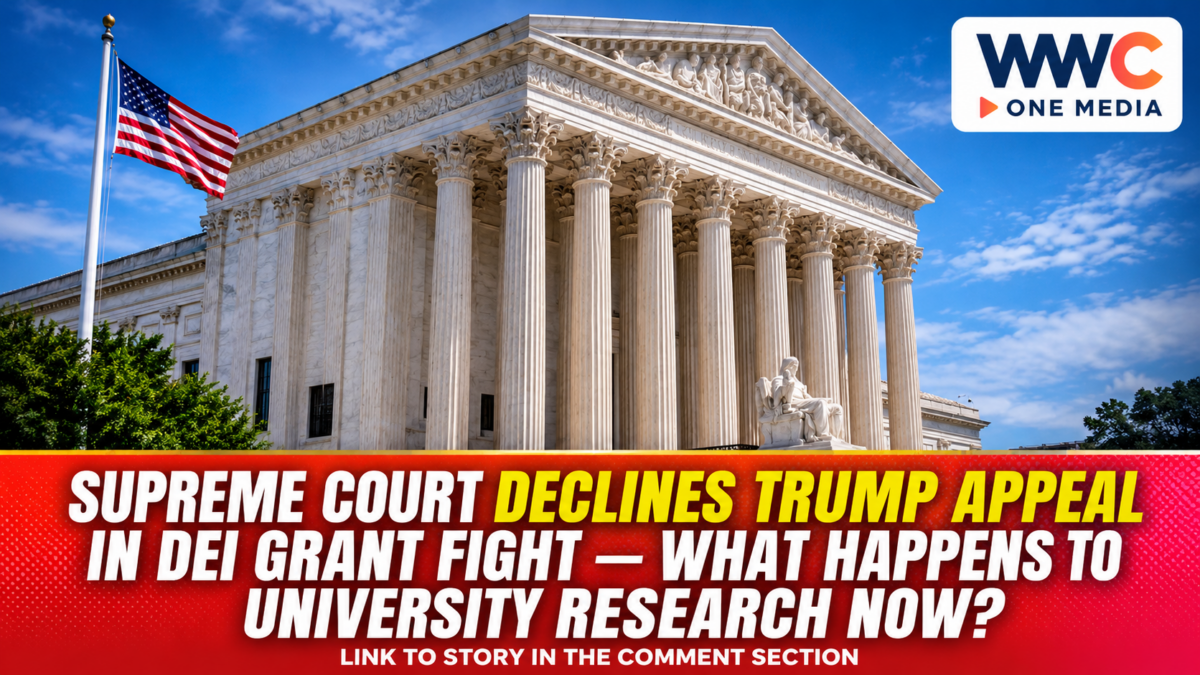
The US Supreme Court on November 16, 2026, declined the Trump administration’s request to review a federal appeals court decision involving research grants terminated under the administration’s policies on diversity, equity and inclusion (DEI). The case, Trump v. Thakur, concerns University of California researchers whose federal funding was cut by government agencies.
The Supreme Court’s docket records the petition as denied. That leaves the Ninth US Circuit Court of Appeals’ earlier ruling in place, including its decision to uphold preliminary relief for researchers whose grants were terminated because of their perceived DEI-related viewpoints. It does not mean the Supreme Court issued a ruling endorsing the appeals court’s reasoning. Supreme Court of the United States+1
The dispute matters beyond one group of researchers. It tests the boundary between a government’s authority to decide how public money is spent and the constitutional restriction against using funding decisions to punish viewpoints the government dislikes.
What the Supreme Court decided in Trump v. Thakur
The Supreme Court docket identifies the case as No. 26-210, Donald J. Trump, President of the United States, et al. v. Neeta Thakur, Individually and on Behalf of All Others Similarly Situated, et al.
The administration filed its petition for a writ of certiorari on August 18, 2026. The case was distributed for the Court’s November 13 conference, and the docket records the petition as denied on November 16. Supreme Court of the United States
A denial of certiorari means the Court declined to take up the appeal. It does not, by itself, establish that the justices agreed with the lower court, adopted its legal analysis or decided the constitutional questions in a new opinion.
That distinction is important because the Ninth Circuit’s ruling was an intermediate decision about preliminary relief. The underlying litigation was still subject to further proceedings.
Why the researchers challenged the grant terminations
The case began after federal agencies terminated research grants awarded to University of California researchers. The Ninth Circuit’s May 26, 2026 opinion identifies the Environmental Protection Agency, National Science Foundation and National Endowment for the Humanities as agencies involved in the original grant terminations.
The researchers challenged the cancellations through constitutional and statutory claims. The district court provisionally certified two classes: one involving grants terminated through form letters without grant-specific explanations, and another involving grants terminated because of the administration’s DEI-related executive orders. Ninth Circuit Court of Appeals+1
The distinction between those groups shaped the appeals court’s decision. The legal questions were not simply whether the government could change its funding priorities. They also involved how agencies selected individual grants for termination and whether those choices were based on the researchers’ perceived viewpoints.
For readers following the administration’s wider DEI enforcement strategy, WWC previously examined the government’s allegations involving Accenture’s federal contracting and employment practices. That dispute involved a different legal framework and should not be confused with the constitutional issues in Thakur.
The Ninth Circuit drew a line between two groups of grants
The May 26 appeals court ruling did not give the researchers a complete victory.
For the class whose grants were terminated because of DEI-related viewpoints, the Ninth Circuit affirmed the preliminary injunction. It concluded that the class was likely to succeed on its First Amendment claim because the agencies had selected particular grants based on the recipients’ perceived expression of DEI, DEIA or environmental justice viewpoints. Ninth Circuit Court of Appeals+1
The court reasoned that the government may set the purposes and limits of a funding programme, but it cannot use funding decisions within an existing programme to penalise viewpoints it disfavors. The panel said the DEI Termination Class was likely to succeed on its viewpoint-discrimination claim.
However, the court reversed the preliminary injunction for the separate Form Termination Class. It concluded that the class was unlikely to succeed on its Administrative Procedure Act claim in the district court because the Tucker Act likely placed the contract-related claims within the jurisdiction of the Court of Federal Claims. Ninth Circuit Court of Appeals+1
The final appellate disposition was therefore: affirmed in part, reversed in part and remanded. That is why it would be inaccurate to describe the case as a blanket ruling that every federal grant termination connected to DEI is unconstitutional.
What the First Amendment question actually means
The First Amendment protects freedom of speech, but the government also has authority to decide which projects it will support with public money. The dispute in Thakur concerns the boundary between those two principles.
The Ninth Circuit distinguished between ending a programme because the government no longer wishes to fund it and selecting individual grants within existing programmes because of the viewpoints associated with their recipients.
The panel said the record supported the researchers’ argument that the agencies had selected grants based on perceived DEI, DEIA and environmental justice viewpoints. It concluded that the challenged decisions were likely to violate the First Amendment. Ninth Circuit Court of Appeals+1
The administration disputed that legal interpretation. In its Supreme Court petition, the government framed the question as whether the First Amendment prevents the government from considering the viewpoints advanced by academic research projects when deciding whether to award or terminate competitive grants. Department of Justice
That disagreement remains important. A government may change its spending priorities, but the constitutional question becomes more difficult when the alleged reason for cancelling a particular grant is the viewpoint expressed through the funded research.
WWC has also covered the administration’s broader effort to reshape federal civil-rights enforcement, including the nomination of a Justice Department official to the Equal Employment Opportunity Commission.
The ruling does not settle every federal DEI funding dispute
The Supreme Court’s denial applies to the petition in Trump v. Thakur. It does not automatically resolve other lawsuits involving federal grants, universities, government agencies or workplace diversity programmes.
The case itself also contains limits that matter for understanding its practical reach. The Ninth Circuit upheld preliminary relief for the DEI Termination Class, not a final judgment resolving every claim in the litigation. It separately reversed relief for the Form Termination Class.
The government’s petition also described other developments in the underlying proceedings, including a settlement in principle involving the EPA claims and unresolved claims involving NSF and NEH at the time of the filing. Those details show why the case should not be treated as a final resolution of every grant affected by the administration’s policies. Department of Justice
A separate dispute involving Harvard’s admissions records also illustrates how the administration’s university-related legal challenges raise different questions. WWC previously explained why the dismissal of the Harvard admissions-data lawsuit did not decide whether the university’s current admissions policy was discriminatory.
The cases should not be merged. Thakur concerns federal research funding and alleged viewpoint discrimination; the Harvard dispute concerned the government’s effort to obtain admissions records.
What happens next
The Supreme Court’s November 16 docket entry closes the petition-stage attempt to obtain review in this case. The Ninth Circuit’s May ruling remains the controlling appellate decision in the proceedings addressed by that appeal.
The underlying litigation and the treatment of particular grants remain important to watch. The district court and the parties may still have to address issues left unresolved by the preliminary-injunction proceedings, while other cases involving federal funding and DEI-related policies continue on their own legal tracks.
For universities and researchers, the case highlights the importance of understanding both the terms of federal awards and the constitutional limits that may apply when agencies change funding decisions.
For the administration, it leaves the Ninth Circuit’s distinction between programme-level spending choices and alleged viewpoint-based grant cancellations standing in this case.
The broader question is not whether the government can ever change research priorities. It is whether it can single out particular recipients because of the viewpoints their research is perceived to express.
FAQ
Did the US Supreme Court rule that Trump’s DEI funding policy is unconstitutional?
No. The Supreme Court declined to review the case. The Ninth Circuit had ruled that the challenged grant terminations for the DEI Termination Class were likely to violate the First Amendment, but the Supreme Court did not issue a new merits opinion.
What is Trump v. Thakur about?
It concerns University of California researchers whose federal research grants were terminated by government agencies. The researchers challenged the decisions under constitutional and statutory provisions.
Which court ruled in favour of the researchers?
The Ninth US Circuit Court of Appeals upheld preliminary relief for the class whose grants were terminated because of perceived DEI-related viewpoints. It reversed relief for a separate class whose grants were terminated through form letters without grant-specific explanations.
Does the ruling protect every DEI-related research grant?
No. The decision concerns the classes and grant terminations addressed in this case. It does not automatically decide the legality of every federal funding cancellation.
What happens after the Supreme Court denied the petition?
The Supreme Court’s denial leaves the Ninth Circuit’s ruling in place. Further proceedings in the underlying case and disputes over specific grants may continue.