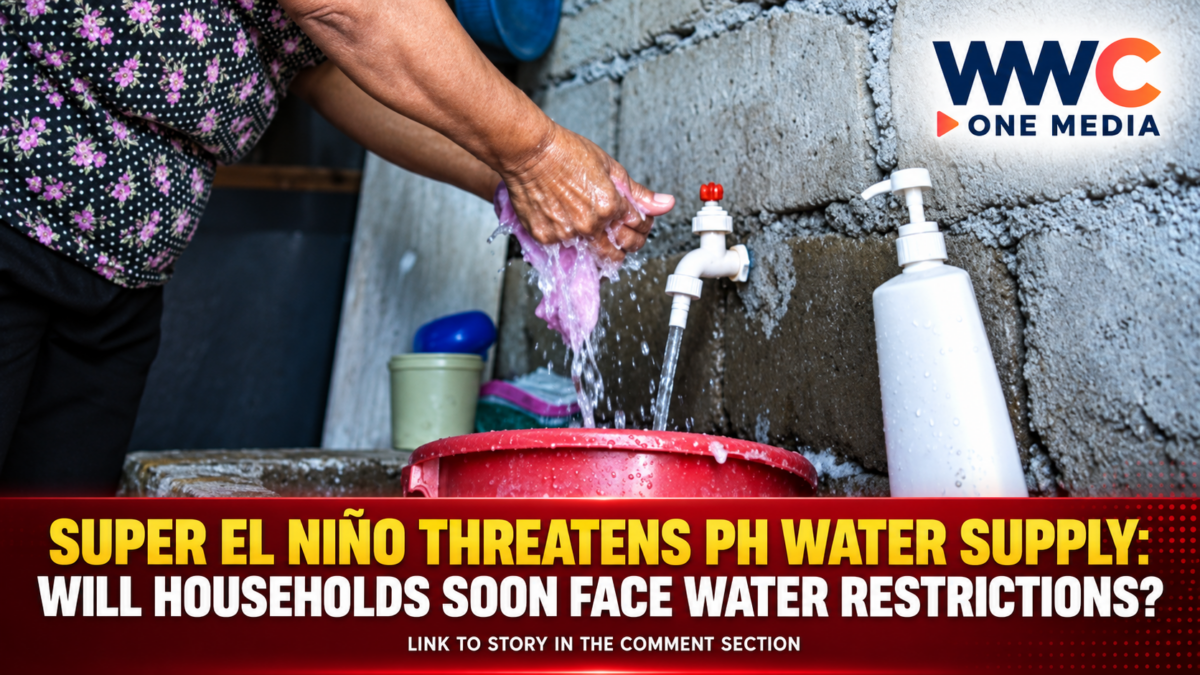
MANILA, Philippines — Water conservation measures and possible supply restrictions are becoming a growing concern as the Philippines prepares for a potentially very strong El Niño, prompting authorities to strengthen preparations for possible drought and reduced water availability.
The Local Water Utilities Administration (LWUA) is directing water districts to prepare for low-water conditions as the country braces for prolonged dry weather. The developing situation raises concerns about how households, businesses, farmers, and communities could be affected if water sources decline in the coming months.
However, possible restrictions should not be confused with a nationwide water-rationing order. The actual measures will depend on local water conditions, available resources, and the decisions of the agencies responsible for individual supply systems.
LWUA Strengthens Preparations for Possible Water Shortages
The government is stepping up efforts to protect water supplies ahead of the expected El Niño, which could bring below-normal rainfall and increase the risk of drought in vulnerable areas.
According to the Philippine News Agency’s October 14 report, LWUA Administrator Jose Moises Salonga said the agency had released ₱12 billion out of its ₱17-billion water infrastructure allocation to strengthen supply systems nationwide.
The agency also issued directives to 533 water districts on managing low-water situations while continuing infrastructure projects aimed at developing additional sources and reducing water losses.
The projects are intended to improve water security and help communities withstand prolonged dry conditions.
Authorities are also exploring measures such as desalination, mobile water-treatment facilities, expanded distribution networks, and water delivery trucks to help underserved communities.
Metro Manila Already Faces Water-Supply Adjustments
The threat is not limited to communities served by local water districts.
In a separate development, the National Water Resources Board (NWRB) announced a reduction in Metro Manila’s water allocation from Angat Dam for October as part of preparations for the expected El Niño.
Philstar.com reported on September 30 that the allocation for the Metropolitan Waterworks and Sewerage System (MWSS) was reduced to 44 cubic meters per second from its usual allocation of approximately 50 to 53 cubic meters per second.
The adjustment was intended to conserve available water and reduce the risk of more serious shortages later.
The NWRB also planned to reduce irrigation allocations, highlighting the competing demands of household consumption and agriculture during periods of limited supply.
GMA News reported on October 1 that authorities were encouraging water providers to explore alternative sources, including Laguna Lake and Upper Wawa, rather than relying too heavily on Angat Dam.
Officials stressed that preparing early would help manage demand and protect available reserves.
Will Households Experience Water Interruptions?
The possibility of restrictions does not automatically mean every household will experience a water interruption.
TV5 News reported on October 2 that the NWRB did not expect major water interruptions in Metro Manila at that time, describing the reduced allocation as a precaution against a potentially more serious supply problem in the future.
Conditions may differ in other parts of the country, particularly in communities that rely heavily on rainfall-sensitive reservoirs, rivers, or other vulnerable sources.
Water providers may adopt localized conservation measures or adjust operations depending on available supply and demand.
For residents, the important step is to monitor announcements from their local water district or concessionaire rather than assume that a restriction announced in one area applies nationwide.
PAGASA Warns of a Potentially Strong El Niño
The Philippine Atmospheric, Geophysical and Astronomical Services Administration (PAGASA) has warned that El Niño could intensify and persist into the first half of 2027.
El Niño is a climate phenomenon associated with unusually warm ocean temperatures in the central and eastern tropical Pacific. In the Philippines, it generally increases the likelihood of below-normal rainfall, dry spells, drought, and hotter conditions in affected areas.
The severity of its effects will depend on how the phenomenon develops and how rainfall patterns change across the country.
In an October 17 explainer, GMA News detailed government preparations that include rainwater collection, alternative water technologies, and measures to protect agriculture and vulnerable communities.
These efforts reflect concerns that prolonged dry conditions could affect not only drinking water but also irrigation, food production, and other essential services.
Government Rolls Out More Water-Security Measures
The administration has also strengthened coordination among agencies responsible for water, agriculture, the environment, and energy.
The Presidential Communications Office reported on October 13 that President Ferdinand Marcos Jr. reconvened key government agencies to discuss measures to mitigate El Niño’s potential effects on food, water supply, and energy.
The Department of Environment and Natural Resources has also urged households and businesses to avoid unnecessary water consumption, collect rainwater where practical, and reuse water for appropriate non-drinking purposes.
Meanwhile, LWUA’s infrastructure program aims to improve the capacity of local water districts to manage shortages and reach underserved communities.
These measures will be especially important if rainfall remains below normal for an extended period.
What Can Filipino Households Do Now?
Residents do not need to panic-buy bottled water, but starting practical conservation measures early can help households prepare.
Here are some steps families can take:
- Repair leaking faucets and pipes. Small leaks can waste substantial amounts of water over time.
- Turn off faucets when not needed. Avoid letting water run while brushing your teeth, applying soap, or washing dishes.
- Reuse suitable household water. Water from appropriate non-contaminated activities may be reused for cleaning or flushing toilets.
- Collect rainwater safely. Use collected rainwater for gardening and other suitable non-drinking purposes. Treat water appropriately before considering any use that requires potable quality.
- Avoid unnecessary water use. Reduce excessive car washing and other activities that consume large amounts of treated water.
- Follow official advisories. Check announcements from your local water district and relevant government agencies for any specific restrictions or service interruptions.
Water conservation is particularly important because the effects of prolonged dry weather can build over time, even when supplies initially appear adequate.
What Happens Next?
The critical question is whether water sources can sustain demand if the expected El Niño becomes more severe and continues into 2027.
LWUA’s preparations, the NWRB’s allocation adjustments, and the development of alternative water sources are intended to reduce that risk. However, the effectiveness of these measures will depend on rainfall, reservoir conditions, infrastructure readiness, and public cooperation.
For now, consumers should distinguish between precautionary preparations, actual local restrictions, and confirmed service interruptions.
The bottom line: The Philippines is strengthening its response to a potentially serious water-supply challenge. Whether more communities will face restrictions depends on how conditions develop and whether current preparations are enough to protect available water supplies.