
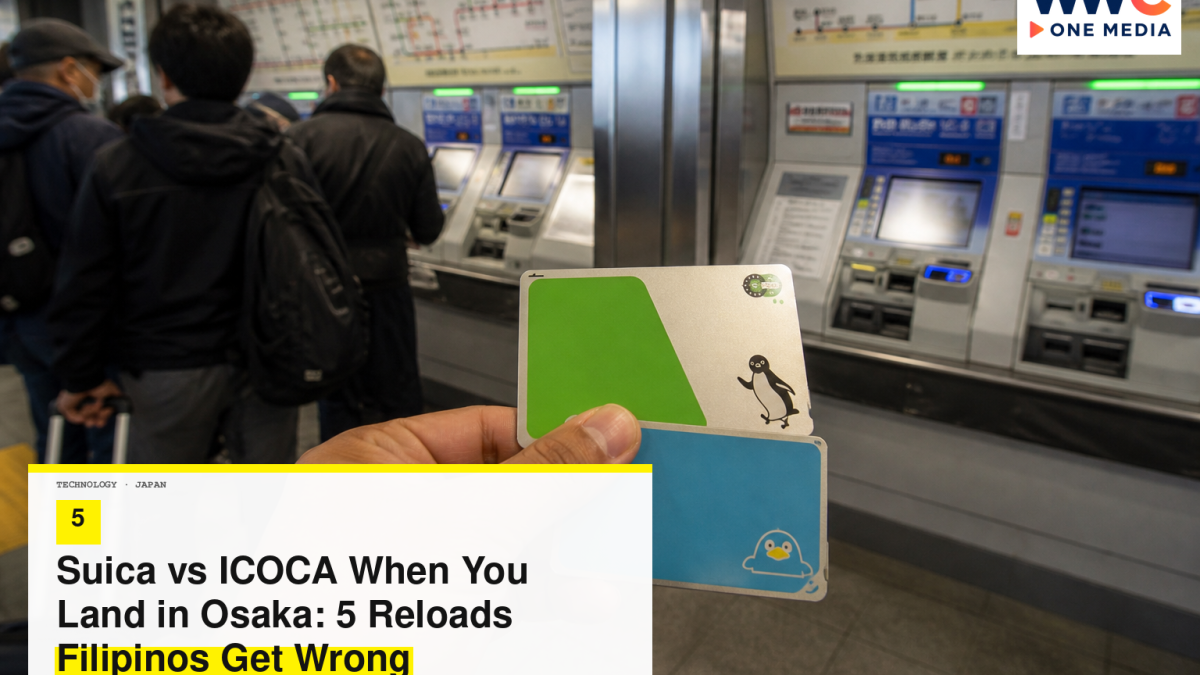
OSAKA, Japan — Kansai International is a long building over water, and the first machine you meet after immigration is already an opinion. Suica vs ICOCA when you land in Osaka is a Manila group-chat problem wearing a ticket hall. Tokyo friends said Suica. A blog said PASMO. The kiosk in front of you says ICOCA in letters you can actually buy. Filipinos get the reload wrong before they get the train wrong: they buy the card their group chat named, they feed a foreign credit card into a machine that wanted cash, they wave a phone and a plastic at the same gate, and they learn the balance at a paddle in Namba instead of at a concourse they could still think in.
This is not a yen ledger. This desk will not invent a starting balance, a deposit you must hit, or a lucky number to load. Machines post what they post. Cards have rules that change by product. What follows is the five reload mistakes that show up at KIX, on the Nankai, on JR, in a 7-Eleven at Umeda, and at an Osaka Metro gate when the pile of people behind you is not interested in your IC education.
Do the five before you join a queue. The Haruka will leave. The rapi:t will leave. The IC card will not explain itself in Tagalog.
1. Suica vs ICOCA when you land in Osaka: buying Tokyo’s card because a chat said so
Suica is an East Japan IC card people meet in Tokyo. ICOCA is a West Japan IC card people meet in Kansai. For many train gates across Japan, IC cards in this family talk to each other. That interoperability is why a tourist who already owns a Suica can often ride in Osaka without a sermon. It is not why you should hunt a Suica at KIX as if ICOCA were a lesser animal.
The first reload Filipinos get wrong is not a reload yet. It is the purchase. They walk past an ICOCA machine looking for the word they memorised. They ask a counter for Suica. They buy a Welcome product they read about for Narita. They install a mobile Suica that the phone will not finish because the region, the app store, or the wallet is not in a mood.
At KIX, buy the card that is actually on offer in the hall you are standing in, from a machine or counter you can reverse if the first hour goes badly. ICOCA is the local noun. If you already have a working Suica in a wallet from a previous Tokyo week, you can use that and skip a new piece of plastic. If you have nothing, do not roleplay Tokyo. Take ICOCA. Load it with cash you already changed, or with a method the machine clearly accepts. Ride.
A numbered purchase pass after immigration:
- Decide plastic versus phone before you reach the machine. If the phone wallet already holds a live IC card from a past trip, that is your default. Do not buy a second plastic “for backup” unless you know how you will stop dual-waving.
- If you have no IC card, look for ICOCA, not for a replica of Shinjuku.
- Read the screen. Tourist products, ordinary ICOCA, and other names are different SKUs. Expiry, refund, and app linking are not the same sentence. If you cannot read the screen, ask a counter, not a stranger who is also lost.
- Pay in a way the machine lists. Cash still solves more first hours than a card that gets declined for being foreign.
- Put the receipt in the passport sleeve until the first successful gate.
What not to do. Do not buy two cards “in case one is Tokyo and one is Osaka.” You will tap the wrong one and freeze in a gate. Do not assume a name you saw in a Tokyo station kiosk will be for sale at KIX in the same form. Do not let a queue push you into a product whose English you did not finish.
Objection: “But Suica works everywhere.” Often, for trains, the IC family does. That is not the same as “KIX will sell me Suica, and my phone will add it, and a Filipino debit card will top it up at 11 p.m.” Local plastic, local machine, cash in the wallet. Romance later.
If you are going onward to Kyoto the same afternoon, ICOCA is still the Kansai card. Kyoto is not a reason to hunt Suica. If you are hopping to Tokyo mid-trip, the card you already have will likely keep talking to gates. You can sort a Tokyo-specific product later, in Tokyo, if you even need one.
2. Reload machines that wanted cash, not the card that paid for the flight
The second wrong reload is the payment method. Filipinos land with a card that survived an airline website and expect a JR ticket machine to be the same animal. Some machines take some cards. Some do not. Some take Japanese cards and shrug at foreign ones. Some want cash and have no interest in your argument.
This desk will not invent a yen figure for a first load. Load enough that you can reach the hotel and a convenience store without becoming a person who mini-reloads at every transfer. Not so much that a refund becomes a project if you chose a product that is awkward to cash out. Exact numbers are on the screen. Use the screen.
How to reload without a scene:
- Prefer cash at KIX for the first load. You already needed some yen for a row of ordinary travel reasons. The machine is one of them.
- Later, convenience stores in Namba, Umeda, Tennoji, and the neighbourhood of your hotel will often take cash onto an IC card at a register or a small machine. Watch what the cashier actually does. Do not shove the card at a barcode reader that is for something else.
- Phone-wallet IC cards reload inside the wallet or the operator app, with payment methods that app accepts. Foreign cards fail here often enough that you should not make a digital-only card your only way home on night one.
- If a machine rejects the card, stop repeating the insert. You have not trained it. You have held a queue. Switch to cash or to a counter.
- Keep one reload habit, not four. If 7-Eleven cash is what worked, that is your method for the week.
What not to do. Do not drain a machine with repeated PIN tries. Do not leave a card in a slot because the English timed out. Do not reload on a platform when a train is already in the display if you still have enough to exit the next gate. Platform reloads are how people miss the rapi:t while arguing with a touchscreen.
City logistics. KIX is an airport island. You will take Nankai to Namba, JR Haruka toward Tennoji and beyond, a bus, or a car. Each of those has a fare logic. IC is for the trains and many buses and for convenience-store taps. It is not automatically every limousine bus. Read the bus. If the bus wants cash or a different ticket, that is not ICOCA failing. That is a different product.
3. Phone wallet versus plastic when you land, and the double tap that freezes a gate
Mobile ICOCA, mobile Suica, Apple Wallet, Google Wallet — the names are a forest. Some phones can hold an IC card. Some accounts can create one. Some tourist phones cannot finish the setup because the region of the Apple ID, the availability of the operator app, or a Japanese mobile number expectation gets in the way.
The third wrong reload is really a wrong default. People set up half a phone wallet on airport Wi-Fi and also buy plastic, then present both at a gate. Dual-waving is how you double-tap, error, and become architecture in a paddle.
Pick one default for the trip:
- Plastic ICOCA in a card slot you can reach without emptying the bag. Phone stays away from the reader.
- Phone IC only, Express or equivalent understood, plastic empty or left at the hotel so it cannot speak.
- Plastic as the daily, phone as a dark backup you do not also wave.
Express transit settings, if your phone has them, mean a locked phone might still pay. That is convenient on a morning in Umeda. It is also how a phone in a pocket pays a gate you brushed. Know whether it is on. If you do not know, plastic in the hand is clearer for week one.
What not to do. Do not stack ICOCA, a credit card with contactless, and a phone against the same reader “to be sure.” Sure is one object. Do not keep a Suica in the wallet and an ICOCA in the phone and guess. Do not put the IC card in the back of a phone case if the phone also has a wallet card. The reader will hear a choir.
If the phone dies, plastic still works. That sentence is why a lot of first-week Osaka trips should be plastic even if you are a wallet person at home in Manila. A dead phone at a KIX gate at night is a queue. A plastic card is a tap.
Reload of a phone card is a software problem. Reload of plastic is a machine and a 7-Eleven problem. Pick the problem you can solve when you are tired.
4. Mixing Suica and ICOCA until the gate beeps, then reloading the quiet one
The fourth wrong reload is topping up the card you are not presenting. You bought ICOCA at KIX. You still have an old Suica in the passport sleeve from 2019. You reload the Suica at a machine because the word is familiar, then tap ICOCA at the gate because that is what is in the easy slot. The quiet card gets fat. The working card dies at a Metro gate under Umeda.
One card on the body. The others stay in the hotel safe or the luggage. If you need to retire an old Suica, do it as a separate errand on a calm afternoon, not as a split-brain at a ticket machine while a Haruka countdown runs.
A simple body rule:
- Left pocket or a dedicated slot: the live card.
- Luggage: anything else with an IC chip, including old PASMO, old Suica, a coworker’s leftover, a card you “might use in Tokyo next year.”
- Phone: either the live card or nothing that can tap transit.
If a gate beeps wrong, do not keep tapping. Step out of the way if you can, go to a helper machine or a staffed gate, and say you may have tapped two. Staff have seen this. A pile-up behind you has not signed up to watch you experiment.
What not to do. Do not reload both “so they stay even.” Even is how you guarantee a mix-up. Do not use one card for trains and another for convenience stores as a system. You will forget. One live IC. Stores, Metro, JR, Nankai, the vending machine that takes it. Simple.
If a shop does not take IC, that is a cash or code problem, not a reason to introduce a second IC brand.
5. Last-day reloads, leftover value, and the refund you postponed until the KIX queue
The fifth wrong reload is the greedy last top-up. People load “plenty” on the morning they fly out of KIX, miss a bus, take a train, buy a last onigiri, and then stand at an airport counter trying to refund a product that did not want to be refunded in ten minutes.
This desk will not invent remaining-balance rules. Some tourist IC products expire. Some ordinary cards refund at a counter with paperwork and a cut. Some leftover value is a souvenir you accept. Read what you bought on day one. Photograph the leaflet.
Last-day practice:
- Do not reload on the morning of the flight unless you are actually empty.
- Ride on what is left. If a gate refuses, a short ticket is a cleaner cost than a fat reload you cannot unwind.
- If you want a refund, arrive earlier than the boarding anxiety. Counters have lines. Airports have their own clock.
- Unlink phone cards only if you know the value’s fate. Deleting an app is not a refund.
- Keep the physical card if the product is yours to keep and you will return. A future Osaka week is a reason. A maybe is not a reason to empty a wallet onto a card at 6 a.m.
What not to do. Do not throw an IC card in a KIX bin because you are done. If it still has value or a deposit depending on type, that is either a counter conversation or a card you take home. Do not give it to a stranger at immigration as a favour. Do not try to sell leftover value in a group chat. Ride it, refund it through the proper counter, or keep it.
If your flight is from Itami instead of KIX, the same last-day logic holds with a different train map. If you fly from Kobe’s airport, again: do not fat-reload at the wrong end of the region.
KIX arrival path, written as a walk
Plane, quarantine theatre if any, immigration, bags, customs, the hall. IC machines and counters live in that public air after you are a person with luggage. Wi-Fi may exist. It may not be enough to finish a mobile IC signup. Cash machines exist. They have their own card moods. None of this is a reason to stand in the first queue you see because it has English.
If two people are travelling, one buys, one watches bags. The buyer reads the full screen. The watcher does not also buy a second card.
Toilets, water, SIM or eSIM — those can come before trains. A dead phone and a new IC card is still a workable night if the card is plastic. A live phone with a failed mobile IC and no plastic is a worse night.
Nankai rapi:t toward Namba is a different ticket culture from JR Haruka. Some limited-express seats want a reserved ticket plus the ride. IC might cover a base and not a reserved seat. Read. If you need a reserved seat, you may still be buying a ticket even if you own ICOCA. That is not a failed reload. That is a train type.
What ICOCA actually is in Kansai, without a brochure voice
It is an IC card from JR West’s family, used as a stored-value tap for a lot of trains, buses, and shops in the region, and as part of the national IC conversation that lets many cards tap in many cities. It is not a JR Pass. It is not a tourist rail pass. It is not a reservation. It will not explain Green Car. It will not replace a limited-express seat ticket by itself.
Suica is the Tokyo cousin in the same broader IC world. PASMO is another cousin. You do not need the whole family. You need one live card.
Filipinos who already commute with Beep, or who have used EZ-Link, already understand stored value. The Osaka mistake is collecting cousins.
Convenience stores, vending, and the tap that is not a train
7-Eleven, FamilyMart, Lawson — many will take IC. The register is not a ticket gate. You may need to say you are paying with the card, or tap where the cashier points. A failed tap is often a second IC in the wallet, a phone fighting the plastic, or a card that is actually empty.
Vending machines that take IC are a gift when your hands are full. They are also how leftover value disappears in drinks you did not plan. That is fine. It is still a reload if you then panic-top-up because a drink killed the last of a balance you needed for a Metro ride. Drink after you know you can exit.
Hotels may or may not take IC. Do not count on it for a bill. Cards and cash still exist.
A note on phones, Apple IDs, and the setup you should not start on airport tile
If you want mobile IC, start the research at home in Manila. Wallet region, whether your handset can add the card, whether a Japanese operator app will even let you in, whether your payment card will talk to the wallet. If any of those is a maybe, plastic at KIX is the adult path.
Do not reset an Apple ID country at KIX to chase a card. That is how you break subscriptions and media libraries for a tap you could have bought as plastic in five minutes.
Do not borrow a Japanese relative’s phone to finish a setup and then fly home. The card will not live in your pocket.
Bottom line
Suica vs ICOCA when you land in Osaka is five reloads Filipinos get wrong, not a fandom. Buy the card KIX is actually selling if you have none — often ICOCA — instead of hunting Tokyo’s noun. First load with a method the machine accepts, usually cash. One default, phone or plastic, never both at the paddle. Reload the live card only. Do not fat-top-up on the morning you fly. This desk will not invent a yen balance. The screen has numbers. Your pocket should have one IC card, some cash, and a phone that is allowed to die. The gate in Namba is a bad classroom.

Leave a Reply