
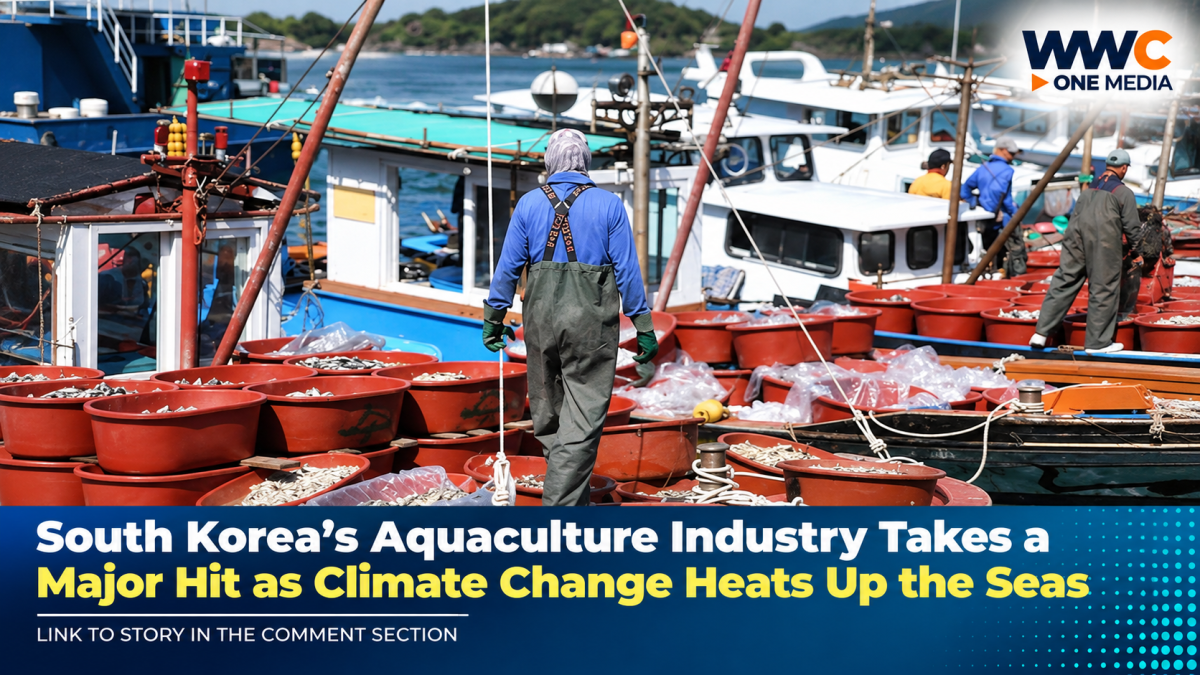
TONGYEONG, South Korea — Climate change is no longer a distant threat for South Korea’s aquaculture industry. This summer, unusually warm seas have delivered a devastating blow to fish farmers, with millions of farmed fish dying as prolonged high-water temperatures push marine ecosystems and aquaculture operations toward their limits.
At Dara Port in Tongyeong, South Gyeongsang Province, fish farmers have been hauling boatloads of dead fish ashore, offering a stark picture of the economic and environmental damage caused by increasingly intense marine heat.
The Korea Times reported that 13.53 million farmed fish had died amid rising sea temperatures, with cold-water species such as Korean rockfish and grey mullet among those affected. Warm-water species have also suffered losses.
High-temperature alerts lasted nearly two months
The crisis intensified during this year’s record heat wave.
High-water-temperature alerts were first issued along the southern coast of South Gyeongsang Province on July 16 before spreading to other areas. According to the Korea Times, the alerts remained in effect for 57 consecutive days, with some areas only recently seeing conditions downgraded as air temperatures began to fall.
That prolonged exposure matters because fish raised in coastal cages cannot simply escape waters that become dangerously warm.
Marine heatwaves can reduce oxygen availability, increase physiological stress and make farmed animals more vulnerable to disease. For farmers, that can translate into sudden stock losses and severe financial pressure.
Korea’s warming seas are changing the aquaculture equation
The problem extends beyond one exceptionally hot summer.
A recent scientific assessment of the economic damage caused by climate change to Korean aquaculture found that rising sea temperatures are already damaging important farmed species and could threaten the industry’s future growth and stability.
Separate research published this year also indicates that the East Sea has been warming at roughly two to four times the global ocean rate over 2000–2025. Scientists have linked this broader warming trend to major changes in marine ecosystems, including a dramatic contraction in the habitat and fishery of common squid around Korea.
The consequences are therefore not limited to fish farms. Changes in water temperature can alter where marine species live, reproduce and feed, potentially reshaping Korea’s wider seafood industry.
Marine heatwaves are becoming a bigger threat
The Korea JoongAng Daily reported in August that marine heatwave days around Korea had nearly quadrupled, with such events lasting close to three months in some years and contributing to the deaths of millions of farmed fish.
The country’s seas are also warming at a pace that has attracted growing scientific and media attention. The Korea Herald recently reported that Korean waters have been warming at approximately twice the global rate, highlighting how much heat is being absorbed by the ocean even when temperatures on land begin to moderate.
That creates a dangerous mismatch for aquaculture: the weather above the water may start improving while the water itself remains dangerously warm.
The economic cost could grow
The impact on farmers is immediate — but the long-term economic consequences could be even larger.
A 2026 study examining climate-change damage to Korean aquaculture warned that continued warming could produce substantial economic losses and threaten the stability of the sector.
Researchers have long identified Korean aquaculture as particularly vulnerable because many commercially important species have relatively narrow temperature ranges. As waters warm, farmers may face increasing pressure to change the species they cultivate, modify production methods or move farming activities to areas with more suitable conditions.
South Korea is already responding with broader plans to modernize its fisheries and seafood industries. A government roadmap reported earlier this year aims to increase national seafood production to 4 million tonnes by 2030, while improving sustainability, farmer incomes and exports.
But the latest fish deaths demonstrate the scale of the challenge: expanding production while the marine environment itself is becoming increasingly difficult to predict.
Climate change is hitting the wider Korean marine ecosystem
The aquaculture crisis is occurring alongside other signs of environmental stress.
Around Jeju Island, for example, researchers and divers have recently documented deterioration of soft-coral communities associated with rising sea temperatures and severe weather. Reuters reported that some coral colonies were showing significant decline, while local divers have observed changes in marine life and catches.
These developments point to a wider transformation of Korea’s coastal environment.
For fish farmers, however, the issue is particularly urgent because every extreme-temperature event can directly threaten their stock, income and ability to continue operating.
A warning for Korea’s seafood future
South Korea has built a major aquaculture industry around its coastal waters, but climate change is challenging the environmental conditions on which that industry depends.
This year’s mass fish deaths show that rising ocean temperatures are no longer simply a future projection. They are already creating real losses for Korean farmers and forcing the industry to confront a difficult question: how can aquaculture survive if the waters supporting it keep getting hotter?
The answer may require a combination of better monitoring, climate-adapted species, new farming technologies and changes in where and how seafood is produced.
But as marine heatwaves become longer and more frequent, the window for adaptation may be narrowing.
For Korea’s aquaculture farmers, climate change is no longer something on the horizon. It is already in the water.




Leave a Reply