
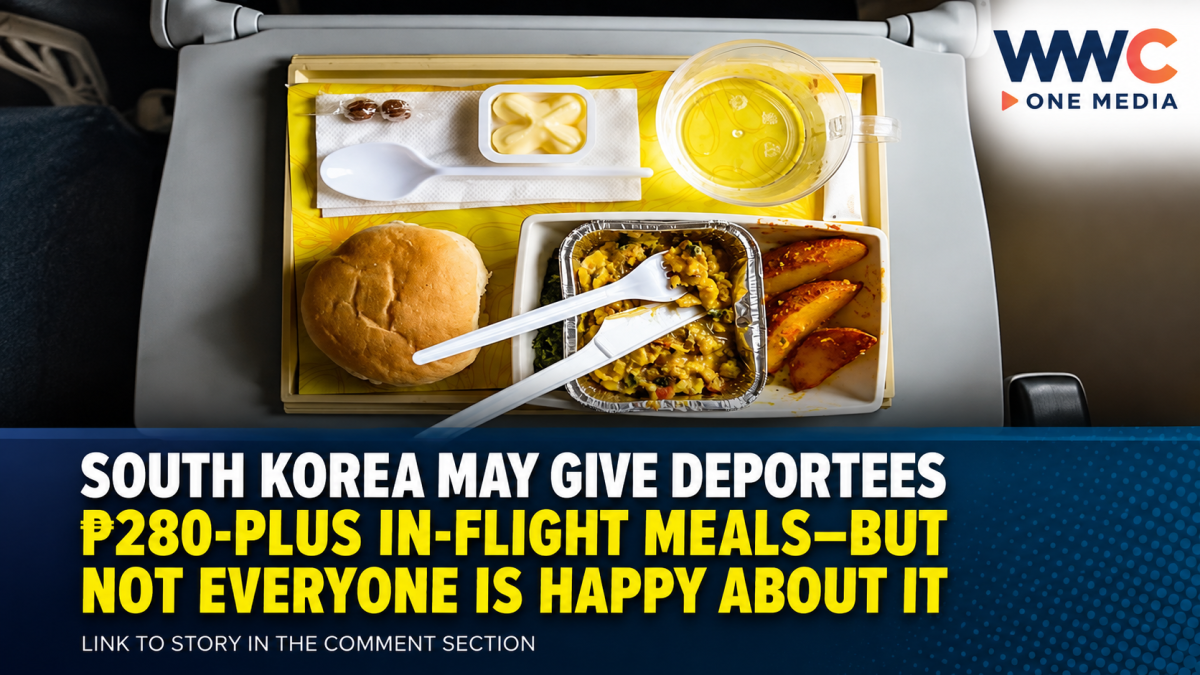
SEOUL — South Korean immigration authorities are considering expanding access to in-flight meals for foreign nationals awaiting deportation, a proposal that has quickly triggered debate over humanitarian treatment, security and the cost of providing meals to people facing forced removal from the country.
The plan is being reviewed by the Incheon Airport Immigration Office under South Korea’s Ministry of Justice. It would apply to foreigners held in the airport’s departure waiting area before being sent out of the country following immigration violations, according to South Korean reports.
At present, those awaiting deportation generally receive simple food such as bread and beverages while waiting for their departure.
Authorities are considering replacing or supplementing that arrangement with regular in-flight meals, saying that even people subject to deportation should be provided with adequate basic food and humane treatment.
Why the proposal is gaining attention
The issue has become controversial because the proposed meals are reportedly worth about 6,910 South Korean won per serving, or roughly the cost of a standard airline meal.
Authorities argue that the change would help protect the basic rights of people awaiting removal and could also contribute to South Korea’s international image.
The proposal, however, has drawn objections from some personnel working at the airport.
One concern involves security.
According to Yonhap, some employees have questioned whether utensils supplied with the meals could potentially be misused inside a controlled airport facility. Workers have also raised concerns about food handling and deterioration in an enclosed waiting environment.
There are also concerns about whether providing meals at this cost could create a perception that immigration enforcement is becoming less strict.
Some employees reportedly argue that the government should distinguish between humanitarian treatment and benefits provided to people who have violated immigration rules.
But this is not exactly a brand-new policy
The current debate can be traced back to an earlier change in South Korea’s airport procedures.
In October 2022, Korean authorities eased restrictions that had previously limited where aircraft-supplied meals could be consumed. The change allowed in-flight meals to be provided to foreigners waiting for repatriation in airport departure waiting rooms.
The measure was introduced partly because providing suitable food inside the secured airport area could be complicated, particularly for people with religious or dietary requirements.
That means the current proposal is better understood as a possible expansion or broader application of an existing arrangement, rather than South Korea suddenly creating the concept of providing airline meals to people awaiting removal.
Deportation detainees are not all the same
Another important point often lost in the online debate is that people awaiting deportation can have different immigration and legal backgrounds.
The airport departure waiting area is used by foreigners who are being removed from South Korea following matters such as illegal stay or unauthorized employment.
South Korean authorities have also acknowledged that some people subject to deportation orders may have criminal histories. That has become one of the arguments raised by employees who are concerned about security inside the facility.
At the same time, the Korean government has emphasized that immigration enforcement must be balanced with legal protections and human rights.
In June, South Korea’s Ministry of Justice said it would work to strengthen the legality of immigration detention and protection while pursuing the prompt repatriation of people who have received deportation orders. The ministry said its objective was to balance public safety, social order and protection of human rights.
In-flight meals are already part of the airport humanitarian system
Reporting from Korea also shows why food provision at Incheon Airport has become an important issue.
The Korea JoongAng Daily recently reported on an asylum-seeking couple who spent months in the airport’s transit area while fighting to have their refugee claim considered. During their time there, they received in-flight meals provided in the airport waiting area.
Their case is different from that of foreigners who have already received deportation orders, but it demonstrates that in-flight meals are already being used at Incheon Airport as part of arrangements for people unable to enter South Korea while their immigration status is unresolved.
What happens next?
For now, the proposal remains under consideration.
There is no indication that South Korea has adopted a blanket rule requiring in-flight meals for every foreign national awaiting deportation.
The debate instead highlights a difficult question facing immigration authorities around the world: how should governments maintain firm immigration enforcement while ensuring that people in state custody are treated humanely?
For South Korean authorities, the answer will have to account for more than the price of a meal. Officials must also consider security, logistics, dietary needs, staff concerns and the government’s broader commitment to protecting basic rights.
The final decision could therefore determine whether the proposed upgrade becomes a routine part of South Korea’s deportation process—or remains a controversial idea that never moves beyond the review stage.

Leave a Reply